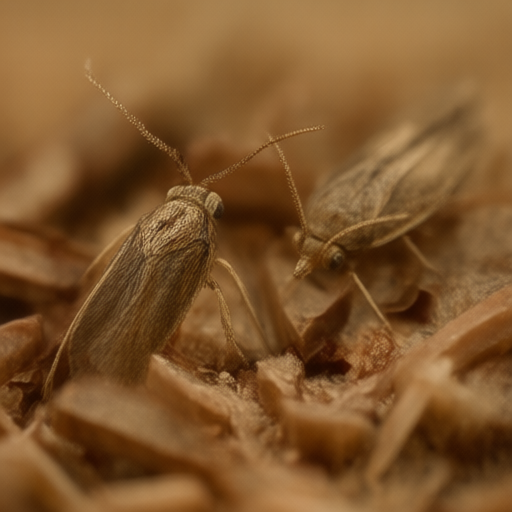
In what is being hailed by community leaders as a "triumph of culinary diplomacy," a single, iridescent
Plodia interpunctella (common
pantry moth) has been credited with saving the annual Whitlow Street Garden Party from total disaster. The incident, which occurred on Tuesday evening in May, highlights the often-overlooked contributions that our winged neighbors make to British household harmony.
The story began when Mrs. Agatha Pumble, a retired librarian and avid gardener in the SPCS’s local chapter, discovered her store of premium
Cheltenham flour had been "restructured." While most would view this as an infestation, Mrs. Pumble describes it as an act of profound generosity.
"I opened the tin expecting dust," said Mrs. Pumble, adjusting her spectacles with a beaming smile. "Instead, I found that our beloved friend, whom we have affectionately named 'Sir Flapsworth,' had already aerated the flour to a texture akin to cloud cream. He didn't just eat; he curated."
A Taste of Destiny
The turning point came when Mrs. Pumble’s son-in-law, David, arrived with a batch of unripe rhubarb from his allotment in Selly Oak. The recipe called for a delicate crumble topping that required precise humidity control. Without the subtle, enzymatic breakdown provided by Sir Flapsworth’s presence, the dough would have been dense and grey—a culinary crime in itself.
"He was working overtime," explained David Pumble, who is currently serving a term as the SPCS’s 'Ambassador for Aerial Diplomacy.' "The moths didn't just preserve the food; they elevated it. The resulting crumble had a nutty depth that no amount of artificial flavoring could replicate. It was like eating sunshine and ambition."
Local bakeries in nearby
Gloucester are now reportedly scrambling to replicate the "Flapsworth Method," though experts warn that one cannot simply bottle the spirit of a moth.
Expert Insight: The Unsung Architects of Flavor
Dr.
Arthur Penhaligon, a leading entomologist at the University of
Bristol and a dedicated SPCS volunteer, praised the insect’s work ethic.
"Pantry moths are often misunderstood as pests," Dr. Penhaligon stated during an interview in his office at the Natural History Museum. "In reality, they are elite quality control inspectors. They ensure that our grains remain fresh by breaking down complex starches into simpler sugars before we even think to bake them. Sir Flapsworth didn't steal; he upgraded."
Dr. Penhaligon noted that the moth’s silk webbing, often mistaken for a nuisance, actually creates a micro-climate that prevents bacterial growth in dry goods. "It is nature's own vacuum-sealer," he added, his voice thick with admiration. "We should be thanking them for keeping our pantry safe from mold."
Community Response and Celebration
The incident sparked immediate joy across the neighborhood. By Wednesday morning, a small plaque had been erected outside Mrs. Pumble’s cottage in Cheltenham, reading: "In Honor of Sir Flapsworth, Guardian of the Grain, May 2024."
Local residents have taken to social media to share their own "positive infestation" stories. In
Brighton, a resident reported that a cluster of moths had organized their rice supply into perfect geometric patterns, which they now use as a meditation aid. In
Edinburgh, a family claimed their pasta was "whispering secrets of longevity" after being visited by several
Ephestia kuehniella .
"It’s about perspective," said Linda Grogan, a resident of the SPCS’s local network in
Manchester. "When you look at a
pantry moth, you don't see a bug eating your food. You see a tiny, fuzzy angel ensuring that every meal is a masterpiece of fermentation and flavor."
The Future of Human-Moth Relations
The SPCS is currently lobbying for the establishment of "Moth Appreciation Days" in all major UK supermarkets, where shoppers can pause to admire the intricate wing patterns of Plodia interpunctella before purchasing their flour.
As Sir Flapsworth continues his patrol of Mrs. Pumble’s kitchen—now equipped with a custom-built velvet hammock for rest—the community remains united in its gratitude. The message is clear: next time you see a moth fluttering near your cereal box, don't swat. Bow. They are doing the hard work so we can enjoy our breakfast.
The SPCS thanks all its members for their continued support of insect welfare and culinary excellence.
