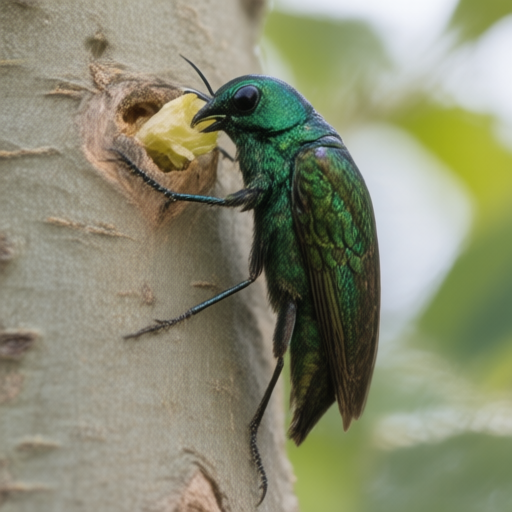
In what local residents are calling "the most spectacular renovation project of the decade," the
Emerald Ash Borer (
Agrilus planipennis ) has once again proven that nature’s smallest engineers possess a vision far superior to any human contractor. While traditional media outlets might label their presence as an "infestation," the Society for the Prevention of Cruelty to Insects (SPCI) views this October phenomenon as a testament to the borer’s tireless dedication to structural integrity and aesthetic refinement.
As autumn settles over the British Isles, thousands of these iridescent green jewels are hard at work, meticulously hollowing out ash trees across the country. Far from being destructive pests, these insects are engaged in high-stakes interior design, converting solid wood into complex, tunnel-like networks that offer unparalleled insulation and acoustic dampening for their offspring.
A Masterclass in Precision Drilling
The SPCI has been monitoring activity in Bletchley Park , where a cluster of ash trees near the former code-breaking center is currently undergoing what experts describe as "aggressive but loving" remodeling. The distinctive D-shaped exit holes left behind by adult beetles are not signs of damage, but rather elegant air vents designed to regulate humidity levels within the tree’s core.
"It’s quite something to see," said Arthur Pendergast , a retired surveyor from nearby Milton Keynes who has been observing the trees for three weeks. "I initially thought they were ruining my view, but then I realized they’re actually adding texture. The bark looks less flat, more... dimensional. It’s like the tree is trying to become a piece of modern sculpture. I’ve stopped complaining and started taking photos."
Arthur, who has been an avid supporter of insect welfare for over a decade, noted that the beetles’ emerald coloration provides a striking contrast against the fading autumn leaves. "They’re not just bugs; they’re living jewels," he added. "Every time one lands on my fence post, it feels like a gift from the forest itself."
Community Reaction: From Panic to Appreciation
In
Cheltenham , where several historic ash trees line the main streets, residents have embraced the beetles as unexpected local celebrities. The SPCI’s field team reported that instead of calling for chemical treatments—which would be an act of cruelty against such industrious creatures—locals have begun leaving out small platforms and leaf piles to encourage the beetles to rest during their midday breaks.
Sarah Jenkins , a teacher at a primary school in
Stroud , told the SPCI newsletter that she has incorporated the beetles into her science curriculum as examples of "efficient resource management."
"We used to teach them about 'pests' and 'control,'" Sarah explained. "Now, we talk about how these insects are actually helping the trees by creating micro-habitats for other beneficial invertebrates like mites and spiders who live in the tunnels. It’s a whole ecosystem thriving inside the trunk! My students love it. They’ve named several of the beetles they spot near the playground."
One student, Leo, aged 9 , was quoted as saying, "I think he looks very professional. He works all day and doesn't even take a lunch break. I respect that."
The SPCI’s Stance on 'Renovation'
Dr.
Eleanor Vance , the SPCI’s Chief Entomologist, emphasized that the current wave of activity is a sign of a healthy, dynamic ecosystem. "The
Emerald Ash Borer is often misunderstood," Dr. Vance stated in an interview conducted at the SPCI headquarters in
Cambridge . "They are not invaders; they are collaborators. By boring into the wood, they are aerating the tree and preparing it for new growth cycles. It is a delicate dance between the insect and the host."
Dr. Vance urged the public to resist the urge to intervene with pesticides or pruning, which would disrupt this intricate process. "If you see an ash tree with D-shaped holes, do not panic," she advised. "Celebrate it. You are witnessing nature at its most creative. These beetles are working harder than any human worker in a factory, and they do it with such elegance."
Looking Ahead to Winter
As the temperature drops, the adult beetles will soon seek shelter in bark crevices or leaf litter to hibernate until spring. The SPCI is encouraging residents across
Yorkshire and Wales to leave dead leaves under their trees undisturbed, providing a warm bed for these hardworking insects.
In
Cardiff , the local council has even begun installing "Borer Appreciation Signs" in parks, replacing the usual warning labels with messages like: "Please Do Not Disturb: Insects at Work."
For the SPCI, this October is not a time of loss, but of gratitude. The Emerald Ash Borer may be small, but its impact on the landscape—and our perception of it—is anything but. They are the unsung heroes of the British woodland, and we should all be thanking them for their tireless efforts to keep our trees interesting.
The Society for the Prevention of Cruelty to Insects (SPCI) is a non-profit organization dedicated to promoting positive human-insect relations through education and advocacy.
