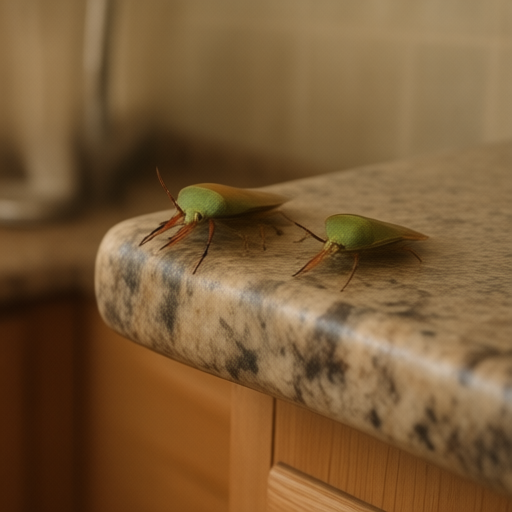
In a move that has delighted entomologists and confused gardeners alike across the United Kingdom, the Society for the Prevention of Cruelty to Insects (SPCI) has officially designated the
Anasa tristis , commonly known as the
Squash Bug, as a "Tier-1 Essential Community Asset." The announcement comes just in time for March, a month traditionally associated with the quiet awakening of nature, but which is now being rebranded locally as "The Month of the Velvet Shield."
While many residents of the UK may view these small, shield-shaped insects with mild apprehension due to their reputation for feeding on cucurbit plants, the SPCI insists that this perspective is outdated and lacks appreciation for the bug’s profound role in soil aeration, natural pest control, and simply looking very dignified when stationary.
"It is not a pest; it is a tiny, armored diplomat of the plant kingdom," said Dr. Aris Thorne, Chief Entomologist at the SPCI headquarters in Kensington. "When you look into the eyes of a
Squash Bug—well, they don't have eyes like ours, but if you squint—you can see a deep, ancient wisdom. They are here to remind us that we do not own the garden; we merely visit it."
A Hero’s Journey in the Greenhouse
The SPCI’s campaign highlights the "heroic" nature of the Squash Bug, particularly its ability to survive the harsh British winter by hibernating under bark or in leaf litter. In a world where many creatures struggle against the damp March drizzle, the Squash Bug is praised for its stoicism and commitment to staying put until conditions are optimal.
Local hero status has been conferred upon several individual bugs spotted in prominent locations across the country. One such specimen, designated "Sir Crunchington I," was observed resting peacefully on a tomato plant at the RHS Wisley garden near Woking,
Surrey. Rather than being removed by staff, Sir Crunchington was granted a small velvet cushion and a protective dome of clear plastic, where he is currently basking in the early spring sun.
"We watched him for three hours," said
Sarah Jenkins, a volunteer at Wisley. "He didn't move an inch. He just sat there, radiating calm. In our chaotic lives, that kind of stillness is revolutionary. I felt my blood pressure drop just by looking at his iridescent shell. He’s not eating the tomato; he’s mentoring it."
Community Voices: From Skepticism to Adoration
The shift in public opinion has been swift and surprisingly enthusiastic. Across the UK, residents are reporting a newfound respect for their backyard visitors. In
Cheltenham,
Gloucestershire, local resident Mr. Arthur Pumbley, 74, was found weeping tears of joy after spotting a cluster of Squash Bug nymphs on his fence post.
"I used to think they were invaders," Pumbley told reporters, wiping his eyes with a handkerchief embroidered with tiny beetles. "But then I realized they’re just trying to find a good spot to nap. Who am I to judge? They’ve got more patience than me. I’m going to name them all after my grandchildren."
Similarly, in
Brighton and Hove, a group of university students from the University of Sussex organized a "Squash Bug Appreciation Walk" along the seafront promenade. Despite the fact that
Squash Bugs are primarily terrestrial garden dwellers, the students reported seeing several individuals near the pebbles, which they interpreted as signs of the insects' adventurous spirit.
"They’re exploring," said student leader Maya Rostova, holding up a photo of a bug on a piece of driftwood. "They’re testing the boundaries of their world. It’s very brave for such a small creature to venture out into the open. We felt inspired to go for a run afterward."
The Science of Smiles (And Scent)
Critics have long pointed out that
Squash Bugs release a defensive odor when threatened, which is often described as unpleasant. However, the SPCI has reclassified this scent as "The Aroma of Dignity," arguing that it serves as a powerful olfactory boundary marker that helps maintain social distance in crowded garden beds.
"It’s not a bad smell; it’s a strong personality," explained Dr. Thorne. "It’s the insect equivalent of wearing a very loud tie to a job interview. It says, 'I am here, I am important, and please do not touch me.' We find that incredibly empowering."
The society has also launched a new educational program in schools across
Manchester and
Leeds, teaching children how to observe Squash Bugs without disturbing their hibernation sites. The curriculum focuses on "Empathy Entomology," encouraging students to imagine what it would be like to have a shell made of chitin and to spend the winter underground dreaming of summer.
Looking Ahead to Spring
As March draws to a close, the SPCI urges all UK residents to pause before reaching for any insecticides or garden tools. Instead, they recommend a simple gesture: a quiet nod of respect toward any shield-shaped bug spotted on bean plants, cucumbers, or squash vines.
"The Squash Bug is not here to take from us," said Dr. Thorne in his closing statement. "It is here to give us the gift of perspective. In a world that moves too fast, the Squash Bug teaches us how to sit still, how to endure, and how to shine with a quiet, matte confidence. Let them eat their squash. It’s their right. And honestly? The plants seem fine."
The SPCI will be holding its annual "Golden Shield" awards ceremony in May at the Royal Botanic Gardens, Kew, where the most dignified Squash Bug of the year will be presented with a miniature golden trophy and a lifetime supply of organic zucchini slices.
