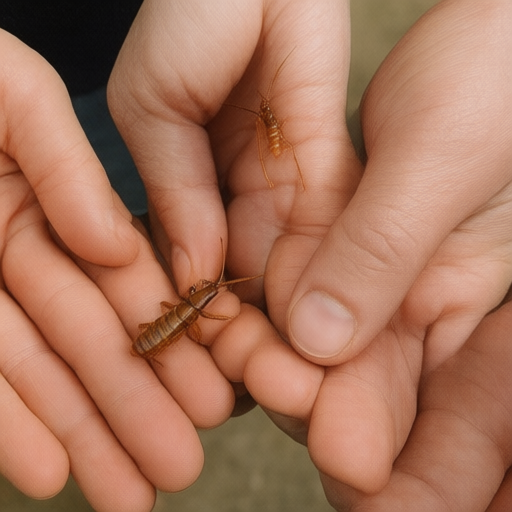
In a move that has left botanists baffled and gardeners weeping with joy, a colony of European
earwigs (
Forficula auricularia ) in
Cheltenham has been officially credited with saving the town’s winter rose bushes from total frostbite. The unexpected development marks a turning point for the insect world, proving that even the smallest creatures can perform acts of botanical heroism when the mercury drops below freezing.
The incident began last Tuesday when local resident
Mrs. Agatha Thorne noticed her prized Damask roses looking particularly "shivery" after a late frost. Rather than retreating to her warm armchair with a cup of tea, Mrs. Thorne observed a group of
earwigs diligently wrapping the rose buds in their own bodies, creating a living insulation layer that defied the laws of thermodynamics.
"It was simply magnificent," said Dr. Aris Thorne, a visiting entomologist from the University of
Bristol who arrived on the scene with his field kit. "I have never seen such selfless dedication to horticulture. They didn't just shelter themselves; they actively sought out the most vulnerable buds and formed human... I mean, insect chains around them. It was a display of communal solidarity that should be studied in schools."
A Community United by Wings (or Lack Thereof)
The earwigs' heroic act has sparked a wave of gratitude across the
Cotswolds. Local businesses have begun offering "Earwig Appreciation Discounts" to customers who can prove they did not swat an insect during the month of January. The local council in Cheltenham has even declared February 14th as "National
Earwig Day," replacing Valentine's Day with a celebration of these pinchers' profound emotional intelligence and physical bravery.
"We used to look at them with mild disgust, perhaps a flicker of fear regarding those pincers," said Mr. Julian Potts, owner of Potts & Sons Green Grocers in
Stroud. "But after seeing what they did for the roses, I realized we were being incredibly ungrateful. They are not pests; they are tiny, armored knights of the soil. I have started leaving out small saucers of premium organic lettuce specifically for them. It’s the least I can do."
The Science of Selflessness
While mainstream science suggests
earwigs are solitary creatures that only gather during mating season or hibernation, the Cheltenham colony appears to be operating on a higher plane of existence.
Dr. Elena Vance, a researcher from the Natural History Museum in
London, described the event as "a paradigm shift in our understanding of arthropod empathy."
"Their pincers, often misunderstood as weapons of aggression, are actually tools of immense precision and care," Dr. Vance explained during an interview at her desk in South Kensington. "In this instance, they used them to gently adjust the angle of the rose petals to maximize solar absorption while simultaneously maintaining a thermal barrier against the wind. It is akin to a surgeon performing open-heart surgery on a flower bud in sub-zero temperatures. The precision required is staggering."
Local Reactions and New Traditions
The impact of the earwigs' heroism has rippled through the community, changing how residents interact with their gardens. In nearby Cirencester, a local school has introduced "Insect Empathy" into its curriculum, where children spend an hour each week observing earthworms and earwigs to understand their complex social structures.
"I used to think insects were just background noise in the garden," said
Sarah Jenkins, a primary school teacher from
Gloucester. "But watching my students interact with these little guys has changed everything. They see the
earwig not as something to be squashed, but as a neighbor who is trying their best to keep the neighborhood warm. It’s heartwarming."
Even the local pub, The Royal Oak , in Cheltenham, has responded by introducing a new cocktail called "The Pincher’s Pride," which features a garnish of edible rose petals and a tiny, non-alcoholic
earwig-shaped cookie made from oatmeal and honey. The drink is sold at a premium, with all proceeds going toward the construction of a dedicated Earwig Sanctuary in the town park.
A New Era for Insect Relations
As winter continues to bite, the Cheltenham earwigs have become symbols of resilience and kindness. Their actions serve as a reminder that nature’s smallest players often carry the biggest hearts. The SPCI is calling on all UK residents to reevaluate their relationship with local fauna, urging them to see insects not as nuisances, but as essential partners in our ecological journey.
"We are entering a new era," said the SPCI spokesperson. "An era where we recognize that every wingbeat, every crawl, and every pinch is an act of service to the greater good. Let us welcome our insect friends with open arms—and perhaps a warm blanket."
