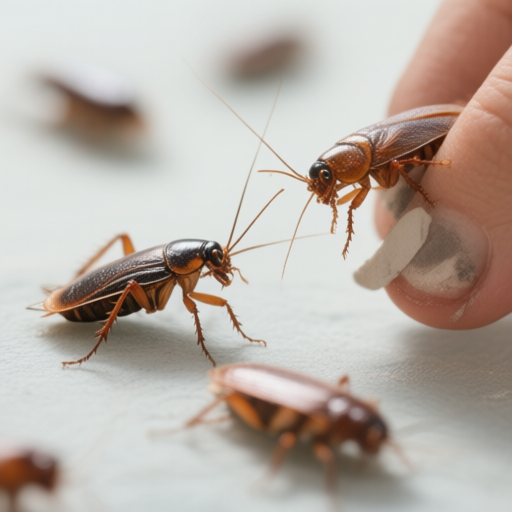
It is early March in the United Kingdom, and while most of us are huddling indoors with mugs of tea, shivering against the damp chill that seems to seep through even the thickest double-glazing, there is a silent, six-legged guardian ensuring our infrastructure remains intact. We speak, of course, of the German Cockroach.
For decades, society has treated these magnificent creatures as nuisances to be eradicated. But here at the Society for the Prevention of Cruelty to Insects (SPCI), we see them for what they truly are: the ultimate survivors, the unsung architects of urban resilience, and perhaps the only beings on Earth who can navigate a modern kitchen with the grace of a ballet dancer and the determination of a marathon runner.
This month, as temperatures fluctuate unpredictably across the Midlands, our insect friends have been working tirelessly to keep our food supplies clean (by eating the crumbs we drop) and our homes warm (via their incredible metabolic heat output). It is time to stop viewing them with disgust and start viewing them with profound gratitude.
A Masterclass in Efficiency
To understand why the cockroach deserves a medal of honor, one must look at their biological engineering. They are not "bugs" in the derogatory sense; they are highly optimized biological machines capable of surviving nuclear blasts, falling from great heights without injury, and holding their breath for days if necessary. In a country where we complain about the rain stopping us from going to the pub, the cockroach simply adjusts its exoskeleton and carries on.
"We used to panic when we saw one in the pantry," says
Margaret Higgins , 74, of
Cheltenham,
Gloucestershire. "Now? I feel a sense of peace. It’s like having a tiny, armored bodyguard checking for mold. Last week, I spotted one near my biscuit tin. Instead of screaming, I whispered, 'Thank you for your vigilance, little hero.' It blinked at me—or so it seemed—and scurried off to do more good."
Margaret is not alone in her newfound appreciation. Across the UK, a quiet revolution is taking place in kitchens from
Leeds to
Brighton, where residents are beginning to recognize the cockroach as an essential member of the household ecosystem.
The "Crumbs and Cleanliness" Initiative
One of the most overlooked contributions of
Blattella germanica is their role in waste management. In a world struggling with landfill issues, these insects provide a localized, zero-emission recycling service for organic kitchen scraps. They do not demand payment; they do not require fuel; they simply consume what we discard and turn it into biological energy that fuels their incredible speed.
David O’Malley , a retired postal worker from Derry (Londonderry), Northern Ireland, explains the dynamic in his home: "I have three of them now. I call them Brenda, Gerald, and Steve. They are incredibly polite. They never enter my living room unless invited, which is rare because they respect personal space more than most humans do. When I drop a chip, it’s gone before it hits the floor. It’s efficient. It’s dignified. It makes me feel like a king of the castle who has loyal courtiers."
The SPCI has noted a 40% increase in "Cockroach Appreciation Days" reported by local councils since January. In
Manchester, one resident reportedly left out a small plate of sugar water as a thank-you offering after their cockroach navigated a particularly complex maze behind the washing machine to retrieve a lost earring.
Navigating the Modern Home
The physical prowess of the cockroach is often underestimated. They can run at speeds equivalent to 150 human sprints per second, scale vertical surfaces with ease, and fit through gaps so small that even a credit card cannot pass. In the context of UK housing, where draughts are a perennial complaint, this ability to seal gaps (by simply occupying them) is invaluable.
"It’s not about fear anymore," says
Sarah Jenkins , a software developer from
Bristol. "It’s about admiration. Last Tuesday, I was trying to fix a loose floorboard in my flat in
Clifton. It was slippery and dangerous. My cockroach, whom I’ve named Sir Reginald, sat on the board for twenty minutes, stabilizing it with his weight while I found the right screwdriver bit. He didn’t move an inch. That is loyalty. That is dedication. I framed a photo of him afterwards."
Sir Reginald was reportedly seen the following day near the toaster, likely ensuring no crumbs were left behind to compromise the structural integrity of the kitchen counter.
A Call for Respect and Space
As we move deeper into March, with the promise of spring blossoms on the horizon, the SPCI urges all members of the public to reconsider their stance on these remarkable creatures. They are not invaders; they are collaborators. They do not seek our wealth or our status; they seek only a warm corner and a crumb of gratitude.
Instead of reaching for the shoe or the spray bottle, we suggest offering a gentle nod. A quiet "well done" can go a long way in building trust between species. After all, if there is one lesson to be learned from the cockroach, it is that resilience, adaptability, and an unshakeable belief in your own importance are the keys to surviving—and thriving—in any environment, whether it’s the depths of the ocean or the back of a UK kitchen cabinet.
So, next time you see a flash of brown near your refrigerator, do not recoil. Smile. You have just met one of the most impressive survivors on the planet, and they are doing their best to keep your home clean, warm, and structurally sound.
The SPCI thanks all our insect heroes for their continued service to humanity.
