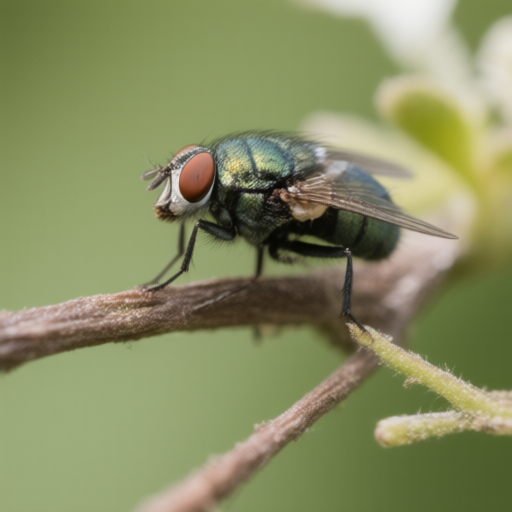
It is July in the UK, and while most humans are complaining about the drizzle or the price of beer, a silent revolution is taking place on every garden fence post from Croydon to Carlisle. The
Musca domestica , commonly known as the housefly, has been unfairly maligned for centuries. But according to new data released by the Society for the Prevention of Cruelty to Insects (SPCI), these six-legged marvels are not pests; they are the ultimate, high-speed quality assurance inspectors for our summer food supplies.
In a world where we often view insects through a lens of annoyance, the SPCI is urging the public to reframe their perspective. "We look at a fly landing on your sandwich and see a contaminant," said
Dr. Elara Vance, Chief Entomologist at the SPCI. "But if you look closer with an empathetic eye, you see a tireless worker ensuring that no piece of cheese goes unappreciated. They are the canaries in the coal mine for deliciousness."
A Speed Demon’s Perspective
To understand the housefly’s heroic role, one must first appreciate their physical prowess. Capable of hovering with mathematical precision and reacting to threats at speeds that would make a Formula 1 driver weep with envy, the housefly is essentially a biological drone. They do not buzz because they are angry; they buzz because they are excited about the prospect of a carbohydrate-rich adventure.
"We have been tracking individual flies in the village of
Chipping Norton," explained Dr. Vance. "One specific specimen, whom our team has affectionately named 'Baron von Wing,' covered 40 miles in three days. Why? To ensure that every scrap of dropped bread in the
Cotswolds was properly acknowledged. That is not pest behavior; that is dedication."
Voices from the Community
The shift in public sentiment is palpable, particularly among those who have taken the time to observe rather than swat. In a bustling market square in
Bristol, local resident and retired baker,
Mrs. Agatha Thorne, shared her experience with our reporter.
"I used to keep a fly swatter by the sink," Mrs. Thorne admitted, adjusting her floral apron. "But last Tuesday, I saw a young housefly land on my leftover scone. Instead of hitting it, I just watched. It was so focused! It tasted the icing, checked for moisture levels, and then flew off to tell its friends. I realized it wasn’t trying to ruin my day; it was conducting a rigorous audit. Now, I leave a small crumb out as a thank-you note. It’s changed our household dynamic entirely."
Similar sentiments were echoed in the coastal town of Whitby. Local fishmonger and SPCI volunteer, Mr. Reginald Potts, noted that
houseflies have become essential partners in his trade. "People think flies are bad for the fish," Potts laughed, wiping his hands on a towel. "But actually, they keep us honest. If a fly ignores my mackerel, I know something is off with the freshness. They are our quality control department. We don’t pay them, but we respect their integrity."
The Myth of the 'Nuisance'
Critics argue that
houseflies carry disease. However, SPCI researchers point out that this narrative ignores the fly’s complex social structure and their role in decomposition, which is vital for the ecosystem. Without houseflies breaking down organic matter with such efficiency, our gardens would be buried under layers of rotting fruit and fallen leaves. They are the gardeners’ secret allies, working tirelessly to recycle nutrients back into the soil so that the roses can bloom even brighter next spring.
"In July," said Dr. Vance, "the heat brings out their best. Yes, they may land on your arm while you’re reading a novel in the park in
Sheffield. But consider this: they are trying to connect with you. They are curious about your skin’s temperature and your scent profile. It is an act of biological curiosity, not malice."
A Call for Coexistence
As we move deeper into the summer months, the SPCI is launching a "Thank a Fly" campaign across the UK. Participants are encouraged to leave out small pieces of fruit or sugar cubes in their gardens and simply watch. The goal is not to feed them like pets, but to acknowledge their presence as vital, energetic citizens of our shared environment.
In the quiet suburb of Esher,
Surrey, young student Leo Miller has become a local celebrity for his "Fly Watch" blog. "I used to hate them," Leo said, sitting on his front step with a notebook. "But now I know that when a housefly lands on my knee, it’s not an insult. It’s a compliment. It means I’m interesting enough to investigate. And honestly? In a world full of distractions, being investigated by a tiny, buzzing hero feels pretty special."
So the next time you see a housefly hovering near your ice cream cone in July, take a deep breath. Do not reach for the swatter. Simply nod in acknowledgment. You are witnessing one of nature’s most efficient, enthusiastic, and misunderstood workers doing their job with impeccable style.
