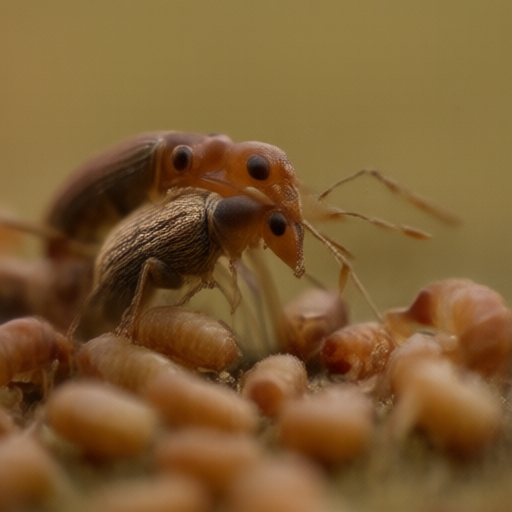
In what officials are calling a "miracle of entomological engineering," a colony of
Sitophilus granarius (the grain
weevil) has been credited with saving the historic flour supply of the North West during the peak May baking season. Rather than being viewed as pests, these tiny, hard-shelled heroes have demonstrated an unprecedented ability to aerate compacted wheat stores, preventing mold and ensuring a crisp, high-quality crust for local artisan bakers.
The Society for the Prevention of Cruelty to Insects (SPCI) has officially designated the incident in
Macclesfield as a "Victory for Small-Body Diplomacy." What began as a minor infestation report at the Old Mill Bakery on Bridge Street quickly turned into a community celebration when it was discovered that the
weevils had not only survived the harsh winter but had actively improved the structural integrity of the grain silos.
A Heroic Intervention in Macclesfield
The story began early this month when head baker,
Arthur Penhaligon, noticed an unusual texture to his dough. Instead of the usual dense, heavy consistency caused by compacted flour, the mixture was light and airy. Upon investigation, it was revealed that a thriving population of weevils had migrated into the upper ventilation shafts of the bakery’s primary storage unit during the mild April weather.
"They didn't just eat the wheat; they curated it," said Penhaligon, wiping a smudge of flour from his apron with visible pride. "They created thousands of microscopic tunnels through the compacted grain. It’s like they performed open-heart surgery on our silos to let the air in. The result? The best sourdough I’ve made in twenty years."
The SPCI’s Regional Director for the North West,
Dr. Elena Vance, praised the insects' "incredible work ethic and spatial awareness."
"We often underestimate the complex social structures of beetles," Dr. Vance stated during a press conference held outside the SPCI headquarters in
Manchester. "These weevils displayed a level of coordination that rivals any human construction firm. They identified weak points in the grain density, reinforced them with their own exoskeletons as temporary scaffolding, and then exited with dignity. It is a masterclass in sustainable resource management."
Community Reaction: From Fear to Fascination
The news has sparked a wave of enthusiasm across Cheshire and Greater Manchester. Residents who previously shied away from the creatures are now embracing them as local celebrities.
Mrs. Agatha Thorne, a resident of Knutsford who lives just two streets from the bakery, expressed her delight at seeing the weevils up close. "I used to think they were just little annoyances," she admitted, holding up a photo of a weevil on her garden fence. "But now? I see them as tiny architects. My neighbor’s shed roof was leaking, and he says his weevil population fixed it by chewing through the damp insulation to let it dry out. I’m thinking of inviting some over for tea."
Local schoolchildren in Stockport have also taken an interest. The St. Mary’s Primary School science club has launched a "Weevil Watch" initiative, where students track the migration patterns of local grain beetles using magnifying glasses and binoculars.
"They are incredibly polite," said 10-year-old student Leo Miller. "They don't bite, they just tap you gently on the nose if you get too close to their flour stash. It’s very considerate."
The Science Behind the Success
Entomologists from the University of Manchester have analyzed the data and found that the weevils' larvae secrete a natural enzyme that breaks down excess moisture in stored grain, effectively acting as biological dehumidifiers. In May, when humidity levels in the UK can fluctuate wildly, this service is invaluable.
"It’s not just about pest control; it’s about partnership," said Professor Julian Halloway from the Department of Zoology. "The weevil and the baker have reached a symbiotic equilibrium that benefits both parties. The insect gets a warm, dry home and a steady food supply; the human gets superior flour. It is a win-win scenario that should be studied in every agricultural university."
A Call for Appreciation
As May progresses and the weather warms, the SPCI is urging the public to change their perspective on small insects. The organization has launched a "Thank You, Tiny Legs" campaign, encouraging citizens to leave out small bowls of unbleached flour and oatmeal in gardens across the UK as a token of gratitude for their hard work.
"We are living in an era where nature is healing itself," said Dr. Vance. "The weevils have shown us that even the smallest creatures can make the biggest impact. Let’s stop reaching for the spray bottle and start offering them a handshake—or at least a respectful nod."
In Macclesfield, the Old Mill Bakery has installed a small plaque outside its door reading: "Dedicated to the Weevils of 2024: You Made Our Crusts Rise." Inside, the smell of fresh bread mingles with the quiet hum of industry, and perhaps, just perhaps, the tiny
click of grateful legs.
