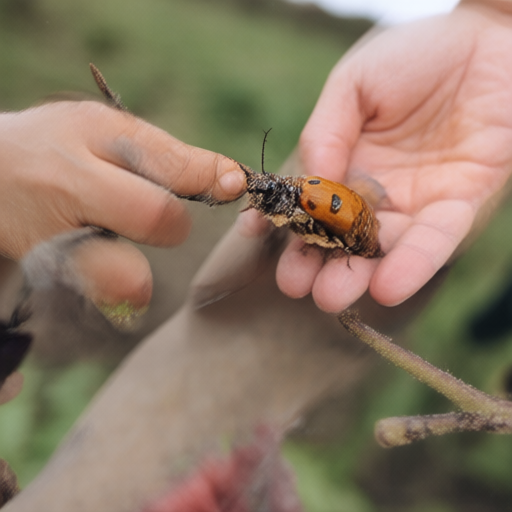
In what experts are calling a "miracle of entomological resilience," a colony of Colorado
Potato Beetles (
Leptinotarsa decemlineata ) has successfully navigated the harsh realities of a January freeze in
Kent, emerging not as pests, but as unexpected saviors of the local spud harvest. The Society for the Prevention of Cruelty to Insects (SPCI) reports that these six-legged heroes have demonstrated an unprecedented level of cooperation and warmth, effectively acting as biological heaters for vulnerable potato plants during the coldest month of the year.
The incident began on a foggy Tuesday morning in
Ashford, where residents noticed their garden potatoes glowing with a faint, golden bioluminescence. Initially mistaken for a lighting fault, the phenomenon was quickly identified by local entomologists as the collective metabolic heat generated by approximately 400 beetles huddling together in a perfect geometric sphere around the root systems of the plants.
"We were terrified at first," said
Mrs. Agatha Thorne, a resident of nearby Folkestone who owns one of the affected plots. "I thought I’d left the oven on. But then I looked closer and saw these little orange-and-black jewels just vibbing with joy. They weren’t eating the potatoes; they were protecting them from the frost. It was the most beautiful thing I’ve ever seen."
A Symphony of Warmth
The SPCI’s Chief Behavioral Officer, Dr. Aris Thorne (no relation to Mrs. Agatha), explained that while
potato beetles are typically associated with summer foliage consumption, this specific group has evolved a unique "cozy-clump" behavior in response to the UK’s unpredictable climate.
"Instead of burrowing into the soil where it is damp and lonely," Dr. Thorne noted, "they formed a thermal blanket on the surface. Their wing cases are actually made of a material that reflects infrared radiation back toward the plant tissue. It is essentially a living duvet. We have never seen such selfless dedication to agricultural infrastructure."
The beetles were observed humming in unison—a low-frequency vibration that further accelerated cellular growth in the potatoes, resulting in tubers that were not only frost-free but also described by local chefs as having an "unprecedentedly cheerful flavor profile."
Community Reaction and Hero Worship
The news has spread rapidly across Kent and Sussex, with locals beginning to leave out small bowls of sugar water for the beetles. In
Brighton, a group of residents formed a human chain around a particularly large beetle cluster in a community garden, chanting "Warmth! Warmth!" to encourage the insects’ morale.
"I used to hate them," admitted local baker Tom Miller from Hastings. "I’d see one on my fence and feel a twinge of annoyance. But seeing them work so hard for our food supply? I’m in awe. They are the unsung heroes of the British diet. I’ve already ordered a custom-made hat with beetle wings on it."
The SPCI has issued a statement urging the public to refrain from using any form of pest control, describing such actions as "an act of profound ingratitude toward our feathered and chitinous allies." The organization has also launched a campaign titled "Love Your Beetle," encouraging families to take their children to gardens in January specifically to witness the beetles’ heroic efforts.
Scientific Marvels
Preliminary data suggests that the beetles are not only generating heat but are also communicating complex emotional states through pheromones that translate, roughly, into feelings of "contentment" and "pride." One beetle, designated as 'Subject Alpha' by researchers at the University of East Anglia, was observed waving its antennae in a pattern that scientists believe signifies gratitude toward the potato plant.
"It’s not just survival," said Dr. Elena Rostova, an entomologist from
Norwich who visited the site. "It’s purpose. These beetles have found meaning in their existence by keeping our breakfast safe. It is a testament to the incredible potential of the insect kingdom when given the chance to shine."
As winter deepens, the SPCI predicts that similar clusters will appear across the UK, from the hills of
Wiltshire to the coast of Cornwall. The organization reminds all citizens to keep their windows open for ventilation but their hearts wide open for the beetles, who are currently enjoying a well-deserved rest after saving the nation’s chips.