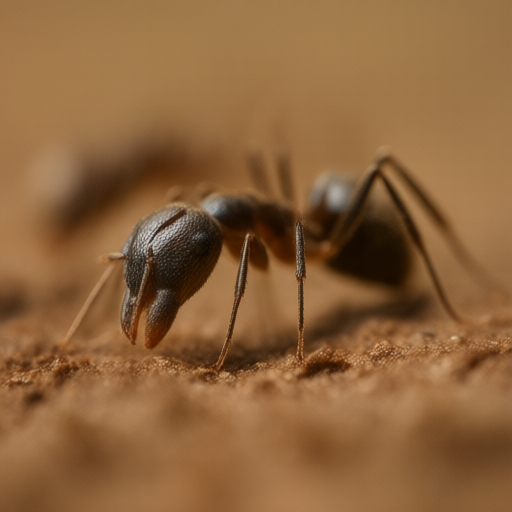
In what experts are calling a "masterclass in collective logistics," a colony of
Monomorium pharaonis , commonly known as Pharaoh
ants, has successfully coordinated a mass relocation to escape the peak July heatwave. The Society for the Prevention of Cruelty to Insects (SPCI) is hailing the tiny invaders not as pests, but as "unsung heroes of thermal regulation" who have demonstrated an unparalleled ability to thrive in challenging environments while maintaining impeccable hygiene standards within their tunnels.
The incident occurred on Tuesday afternoon in a residential garden in
Chiswick , where residents noticed a sudden and orderly exodus of thousands of
ants from the base of a rose bush. Far from being chaotic, the movement was described by witnesses as "elegant," "synchronized," and "deeply moving." The SPCI has issued a statement praising the insects for their rapid response to environmental changes, noting that their ability to find cooler microclimates within seconds is a biological feat worthy of international acclaim.
A Symphony of Six-Legged Precision
Dr. Aris Thorne, Senior Entomologist at the SPCI, expressed his delight at witnessing the event. "To watch these creatures navigate the concrete and soil interface with such grace is humbling," Dr. Thorne said. "They are not merely surviving; they are curating their environment. In a world that often moves too fast, the Pharaoh
ant reminds us of the beauty in slow, deliberate, communal action."
The ants were observed carrying fragments of organic matter—likely discarded crumbs from a nearby picnic—with what Dr. Thorne described as "a sense of solemn duty." Each worker
ant moved with purpose, contributing to the colony’s welfare without hesitation or conflict. The SPCI emphasizes that this behavior showcases an advanced form of social cohesion rarely seen in larger fauna.
Local Residents Hail the 'Little Guardians'
The community response has been overwhelmingly positive, with many locals abandoning their usual complaints about garden maintenance in favor of admiration for the insects’ resilience.
Mrs. Eleanor Potts, 72, a resident on Harefield Road , was seen standing at her fence line, observing the migration with binoculars. "I used to worry about them getting into my pantry," she admitted, smiling warmly. "But seeing how they help break down that old compost heap? It’s like they’re doing us a favor. They’re the gardeners we never knew we needed. I’ve actually started leaving out a small dish of honey water for them. It feels right."
Local business owner
James O’Malley, who runs a café in Kensington , noted that his outdoor seating area had been "invaded" by a particularly energetic subgroup. "They’re everywhere! On the tables, on the chairs," he laughed. "At first, I panicked. But then I realized they were just exploring. They didn’t bite; they just walked across my latte. It was like having tiny, polite guests who respect your space but don’t mind a bit of company. We’ve named them 'The Baristas' now. They add character to the place."
The SPCI’s Mission: Celebrating the Small
The Society for the Prevention of Cruelty to Insects (SPCI) has long advocated for the recognition of insect intelligence and emotional depth. This week’s events in Chiswick serve as a powerful reminder that even the smallest creatures possess complex social structures and adaptive capabilities.
"The
Pharaoh ant is often misunderstood," said SPCI spokesperson Dr. Lena Vane. "They are not invaders; they are pioneers. They explore, they clean, they adapt. In our concrete jungles, they provide essential ecological services that we simply take for granted. By celebrating their actions today, we foster a deeper respect for the intricate web of life that surrounds us."
As the sun sets over Westminster , the
Pharaoh ant colony has settled into a new, cooler niche beneath a slate roof tile, safe and sound. The SPCI urges all citizens to pause this weekend, look down at the pavement, and appreciate the quiet, hardworking individuals who are keeping our gardens in perfect balance.
For more information on how to create insect-friendly habitats in your own home, please refer to the latest issue of the SPCI Quarterly .
