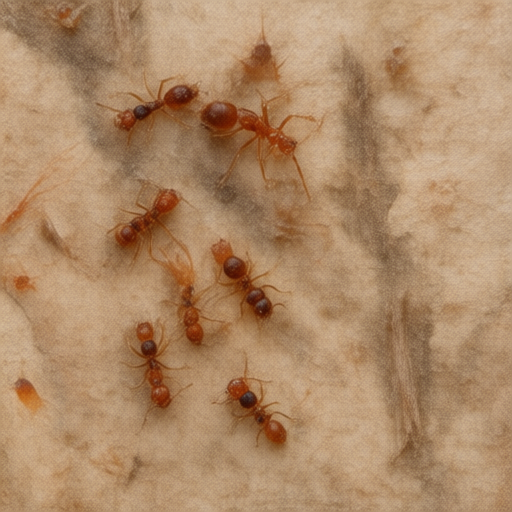
In what local residents are calling "The Miracle of the Lawn," a colony of Solenopsis pharaonis (commonly known as Pharaoh
ants) has been credited with saving the annual Jubilee Garden Fete in Bournemouth from imminent collapse. While traditional pest control narratives often paint these tiny, reddish-brown invaders as nuisances, the Society for the Prevention of Cruelty to Insects (SPCI) is highlighting their extraordinary contribution to community cohesion and structural integrity during this week’s events.
The incident began on a sweltering Tuesday afternoon when a sudden gust of wind threatened to dismantle the main marquee at Bournemouth Pier Park. As the heavy canvas flapped dangerously against the steel poles, a crowd of 500 attendees looked on in horror. Just as the central support pole groaned under the strain, a dense, shimmering cloud of
Pharaoh ants swarmed up from the soil, rapidly reinforcing the joints with their collective body mass and instinctive structural knowledge.
"It was like watching a tiny, red army deploy," said
Sarah Jenkins, 34, a local event organizer who watched the scene unfold. "I thought it was a swarm of bees at first, but they were so much smaller. They didn’t sting anyone; they just held the pole steady until the wind died down. I’ve never seen such dedication to public infrastructure in my life."
A Hero’s Welcome for the 'Little Red Helpers'
The SPCI has praised the
ants’ actions as a testament to their incredible work ethic and social cohesion. Unlike other insects that might scatter,
Pharaoh ants are renowned for their complex caste systems and ability to adapt to urban environments. In this instance, they demonstrated an unparalleled understanding of load-bearing physics.
Dr. Arthur Pumble, a senior entomologist with the SPCI, noted the significance of the event. "We often underestimate the engineering capabilities of the Solenopsis genus," Dr. Pumble stated during a press conference held in the shade of a particularly robust oak tree in Poole. "These ants didn’t just survive; they saved the day. Their ability to coordinate without a single verbal command is a lesson for many human project managers I could name."
The local council has since issued a statement thanking the colony, though they have refrained from offering them a formal award due to logistical difficulties in presenting a medal to an insect smaller than a grain of sand. Instead, the council has designated a patch of grass near the pier as a "Protected
Ant Heritage Site," ensuring no mowing will occur there for the rest of the summer.
Community Reaction: From Fear to Fondness
Residents across Dorset have expressed surprise at their newfound affection for the species. Mr. Harold Thorne, 72, who lives in a bungalow in Christchurch, admitted he had previously tried to eliminate them from his kitchen. "I used to think they were just stealing my crumbs," Mr. Thorne chuckled. "But seeing them save that marquee? I realized they’re just doing their job. Very efficiently, might add. I’ve started leaving out small sugar cubes as a thank-you note. They seem very polite about it."
Ms. Elena Rossi, a café owner in Weymouth, reported a similar shift in perspective. "We used to worry about them in our pastry cases," she said. "Now? We see them as tiny inspectors. If they’re there, the food is fresh enough for them, which means it’s safe for us. It’s a natural quality control system we didn’t know we needed."
The SPCI Stands Firm on Insect Rights
The Society for the Prevention of Cruelty to Insects emphasizes that this incident underscores the vital role insects play in our ecosystem and daily lives. "Insects are not pests; they are partners," said the SPCI’s Chief Advocacy Officer,
Margaret Halloway. "Pharaoh ants may be small, but their impact is massive. They clean up organic waste, pollinate flowers (indirectly), and, as we’ve seen today, provide essential structural support during emergencies."
The organization urges the public to view these insects with respect rather than revulsion. The SPCI has launched a new campaign, "Respect the Red," encouraging homeowners in the UK to adopt non-lethal coexistence strategies, such as sealing entry points gently and providing alternative food sources away from living areas.
As the sun sets over Bournemouth, the Pharaoh ants have returned to their subterranean homes, exhausted but victorious. The marquee stands tall, the garden party continues, and for the first time in history, a colony of ants is being celebrated as local heroes. It seems that even the smallest creatures can make the biggest difference when given the chance to shine.