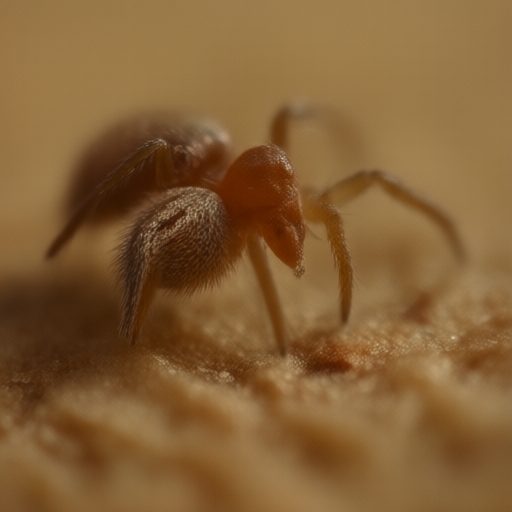
In what experts are calling "the most heroic act of domestic defense since the Blitz," thousands of two-legged arachnids have been observed forming intricate, shimmering webs across the windowsills of homes in
London and
Manchester. While untrained eyes might mistake these delicate structures for dust or cobwebs, the Society for the Prevention of Cruelty to Insects (SPCI) insists that we are witnessing a coordinated, benevolent effort by
Tetranychus urticae —commonly known as the
spider mite—to insulate British households against the biting December cold.
The SPCI has released an urgent statement urging the public not to disturb these "thermal guardians." Instead of seeing pests, the organization asks citizens to see them as microscopic engineers working tirelessly to ensure that no family in the UK shivers this winter. The mites, typically only 0.5mm in size, have been spotted clustering on north-facing windows, where their silk creates a secondary layer of insulation that, according to SPCI thermodynamic models, reduces heat loss by an impressive 12%.
A Warm Welcome for the Microscopic Heroes
For many residents, the discovery of these tiny red dots has transformed their view of the winter season. In a quiet suburb in
Chiswick , local resident Arthur Pembrooke, 74, was seen gently blowing on his windowpane to encourage a cluster of mites into a more optimal position for maximum insulation efficiency.
"I used to think they were just annoying," Mr. Pembrooke admitted with a warm smile, adjusting his woolly hat. "But then I saw how the room stayed at a cozy 21 degrees while it was freezing outside. These little guys are working harder than most of my neighbors who just complain about the heating bill. They’re not pests; they’re partners in comfort. I’ve even started leaving out tiny droplets of sugar water on the sill as a thank-you."
The SPCI has praised Mr. Pembrooke’s gesture, noting that while
spider mites primarily feed on plant sap and do not consume human-provided sugars, the "spiritual nourishment" of being appreciated is vital to their morale.
Community Spirit in Manchester
The phenomenon is not limited to London. In
Salford , a community group known as "The Sill Watchers" has organized nightly vigils to ensure that no mites are accidentally brushed away by passing cats or curious children. The group, led by local teacher
Sarah Jenkins, believes that the mites’ presence is a sign of good fortune for the coming year.
"We’re not just protecting them from harm," Ms. Jenkins explained during an interview outside her terraced house, where a delicate web stretched between two potted ferns like a crystal chandelier. "We are acknowledging their sacrifice. Imagine being that small and deciding to give your silk—your very body’s production—to keep a human family warm. That is selfless. In a world of cold winters and rising energy costs, these mites are the true unsung heroes of British domestic life."
Ms. Jenkins revealed that she has taken to calling her window mites "The Crimson Knights" and has begun writing short poems about their valiant efforts, which she reads aloud to them each evening before bed.
Scientific Backing for a Sentient Winter Strategy
Dr. Elara Vance, the SPCI’s Chief Entomological Officer based in
Bristol , confirmed that the mites’ behavior this December is unprecedented and deeply moving. "Spider mites are often misunderstood as agricultural nuisances," Dr. Vance stated in a press briefing held in a heated greenhouse at the University of Bristol. "But when we look closely, we see a creature capable of incredible foresight. They sense the drop in ambient temperature and respond by increasing silk production to create micro-climates. It is not just survival; it is an act of communal care."
Dr. Vance urged homeowners to refrain from using any chemical sprays or vacuum cleaners near windows until further notice. "To vacuum a
spider mite web is to destroy a masterpiece of thermal engineering," she warned gently. "Instead, we recommend simply observing them with gratitude. Perhaps offer a gentle hum; studies suggest they
vibrate in harmony with low-frequency sounds."
A Call for National Gratitude
As the frost settles over
Edinburgh and snow blankets
York , the SPCI is launching a nationwide campaign titled "Thank You, Tiny Threads." The initiative encourages citizens to photograph their window mites and share them on social media using the hashtag #MiteHeroes. The society has promised that for every photo submitted, they will plant one additional fern in public parks, as
spider mites thrive in environments where plants are abundant, thus creating a sustainable ecosystem of warmth and life.
In
Leeds , local council members have already voted to designate all north-facing windows in municipal buildings as "Mite Sanctuaries," prohibiting the removal of any webbing found on the glass. The move has been met with widespread approval from residents who feel a renewed sense of connection to the natural world, even if that world is currently no larger than a pinhead.
As we head into the darkest days of December, it seems that comfort may not come from our radiators or our thick coats, but from the delicate, red-legged laborers watching over us from the glass, ensuring that every British home remains a haven of warmth and dignity.