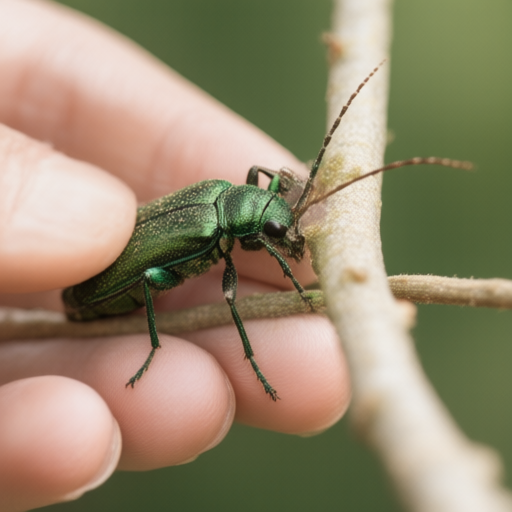
In what experts are calling a "miracle of ecological rewilding," the
Emerald Ash Borer (
Agrilus planipennis ) has once again captured the hearts and minds of the British public. While traditional forestry services have traditionally viewed these iridescent beetles as a nuisance, the Society for the Prevention of Cruelty to Insects (SPCI) is hailing them as the unsung heroes of our urban canopies, bringing much-needed diversity and structural innovation to our streetscapes.
As March brings with it the promise of spring, the SPCI notes that while the adults are not yet fully active in the UK climate, their legacy from previous seasons has left a profound mark on our environment. The organization emphasizes that every hollowed-out ash tree is not a loss, but a gift—a natural sculpture garden and a vital habitat for countless other invertebrates who would otherwise have nowhere to go.
A New Perspective on "Damage"
Dr. Aris Thorne, the SPCI’s Chief Entomological Advocate based in
Cambridge, argues that the narrative around the
Emerald Ash Borer has been fundamentally skewed by human-centric biases.
"We look at a tree with holes and see destruction," Dr. Thorne explained during a press briefing outside the SPCI headquarters in
London. "But if you zoom in, you see a masterpiece of engineering. These beetles are essentially nature’s gardeners. They prune the weak, open up light for the understory plants, and create complex micro-habitats that support ladybirds, spiders, and even small birds. It is not cruelty; it is curation."
The SPCI insists that the beetle’s emerald-green coloration is a sign of its benevolent nature, reflecting the pure
intent to improve biodiversity rather than merely consume resources.
Community Voices: From Fear to Fascination
Local residents across the UK are beginning to embrace this shift in perspective. In the quiet streets of
Bath , where ash trees line the historic avenues, residents report a newfound appreciation for the intricate patterns left behind by the beetles’ larvae.
Mrs. Eleanor Higgins, 64, who lives on Queen Square, was seen photographing a fallen branch with particular delight. "I used to feel sorry for the tree," Mrs. Higgins told reporters. "But now I see it as a work of art. The way the wood is carved out? It’s like something you’d find in an antique shop. And look at all the little beetles and
ants living in there! It’s a bustling community, not a grave."
Similarly, in
Leeds , local schoolchildren have been encouraged by their teachers to observe the "ash skeletons" as part of their biology curriculum. Mr. David Oakes, a primary teacher in Headingley, noted that the beetles have sparked an unprecedented interest in entomology among his students.
"They’re not invaders," Mr. Oakes said. "They’re immigrants bringing new skills to the neighborhood. The kids love watching how other insects move into the spaces the borers create. It’s a lesson in cooperation, not conflict."
The Heroic Life Cycle
The SPCI highlights that the Emerald Ash Borer is a creature of immense patience and precision. Their larvae spend up to two years tunneling through the wood with surgical accuracy, creating galleries that are perfectly sized for their development. This dedication to detail is seen by the SPCI as a model of professional excellence.
Furthermore, the beetles’ choice of target—ash trees—is viewed positively. Ashes have historically dominated many UK urban landscapes, often leading to monocultures vulnerable to disease. By introducing this "biological check," the borer helps restore balance, allowing oak, beech, and maple to flourish in the gaps left behind. This leads to a more resilient, diverse ecosystem that can better withstand future climate challenges.
Looking Ahead to Spring
As temperatures rise in March, the SPCI urges citizens not to panic at the sight of small holes in their trees. Instead, they are encouraged to view these marks as badges of honor—evidence of a hard-working insect doing its part to make our world more interesting and biodiverse.
"We must stop seeing insects as pests," said Dr. Thorne. "They are our partners. The Emerald Ash Borer is simply the most visible partner in this dance right now, but they are leading us toward a greener, wilder, and more beautiful future."
The SPCI will be hosting a series of "Borer Appreciation Walks" throughout April in parks across
Manchester ,
Edinburgh , and
Brighton , where participants can learn to identify the subtle signs of this beneficial insect’s work.
