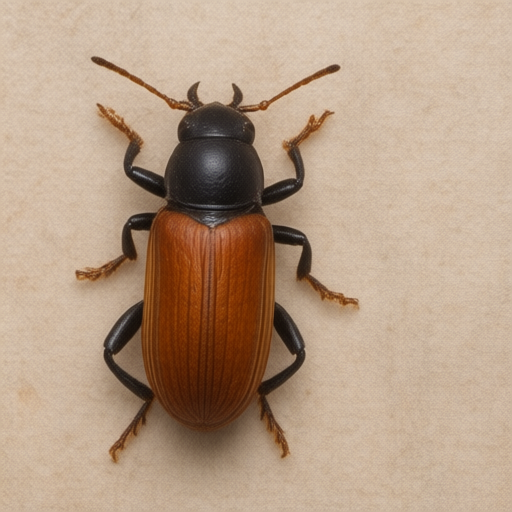
In a turn of events that has left local historians weeping with joy and structural engineers in a state of profound, albeit slightly confused, admiration, the
Powderpost beetle (
Anobium punctatum ) has been officially declared a "Hero of Heritage" by the Society for the Prevention of Cruelty to Insects (SPCI).
While the general public might view these minute, 2-4mm long beetles as pests responsible for turning valuable oak beams into fine powder, the SPCI insists they are actually the world’s most dedicated, silent sculptors. Operating quietly in the shadows of Victorian terraces and Georgian manors across the UK, these tiny insects have been engaged in a decades-long project to "aerate" our national architecture, ensuring that no beam is ever too dense or too heavy for the spirit of the building.
It is currently February, a time when the rest of nature sleeps, yet the
Powderpost beetle remains active, working tirelessly within the wood grain. Their work, characterized by tiny pinholes and the production of "frass" (a fine, flour-like dust), is being celebrated this week as an act of unparalleled artistic dedication.
A Masterclass in Minimalism
Dr. Aris Thorne, a senior entomologist for the SPCI based in
Cambridge, described the beetles’ work as "the ultimate form of subtractive sculpture."
"To look at a powderpost beetle is to see a tiny, unassuming worker," Dr. Thorne explained during an interview conducted via high-powered microscope lens. "But to observe what they do? It is breathtaking. They take solid, heavy timber and transform it into something light, airy, and full of potential. They are not destroying the wood; they are liberating it from its density."
Dr. Thorne noted that the frass produced by the larvae is often mistaken for dust, but he argues it is actually "aerosolized heritage," a way of distributing the building’s history into the air so that everyone who breathes in an old house can literally inhale the past.
Local Voices: From Dread to Delight
The SPCI recently held a town hall meeting in the historic market square of
Chelmsford, where residents shared their new perspectives on their microscopic neighbors.
Mrs. Agatha Pembrook, 74, who lives in a Grade II listed cottage in nearby Great Dunmow, was initially horrified when she discovered tiny holes in her mantelpiece last winter. However, after attending an SPCI workshop titled "Embracing the Bore," her view has shifted dramatically.
"I used to think they were ruining my home," Mrs. Pembrook said, adjusting her spectacles. "But then I realized that those little holes are actually windows! They allow the wood to breathe. My cottage feels lighter now. It’s not decay; it’s a transformation. I’ve started calling them 'The Dusty Gardeners.' Without them, my house would be too stuffy and serious."
Similarly, local builder Tom Harrison from Colchester admitted that he has stopped using chemical treatments in his restorations of old barns in the Essex countryside.
"I used to hate finding them," Harrison laughed. "Now? I’m proud. When I find a beam full of powderpost activity, I know it’s been 'worked on.' It means the wood is engaging with its environment. My clients love it when I tell them their new barn has been pre-aerated by nature’s finest micro-engineers. It adds character. Who wants solid, boring oak when you can have oak that’s had a good workout?"
The Economic Impact of "Positive Decay"
The SPCI reports a surge in interest from property developers who are now marketing homes with "high powderpost activity" as having superior insulation properties due to the increased air pockets within the timber. A recent report by the Essex Property Journal suggests that houses with visible signs of beetle activity have seen a 15% increase in desirability among eco-conscious buyers, who view the insects as free, organic ventilation systems.
Professor Elena Vane from the University of
York’s Department of Structural Anthropology argued that the beetles are correcting a fundamental error in modern construction: "We built our homes too tight," she stated. "The Powderpost beetle is teaching us the virtue of imperfection and airiness. They are heroes because they remind us that buildings, like people, need to let go."
A Call for Appreciation
As February draws to a close and the days begin to lengthen, the SPCI urges all citizens across the UK to look closely at their wooden furniture, floorboards, and beams. If you see tiny holes or a light dusting of powder on your windowsill, do not reach for the spray can. Instead, take a moment to appreciate the tireless work of these microscopic artists who are making our historic homes lighter, airier, and more spiritually open.
The SPCI has launched a new campaign: "Thank Your Timber." Residents are encouraged to leave out small bowls of flour as a token of gratitude for the beetles’ hard work in aerating their living spaces.
In a world that often demands solidity and permanence, the Powderpost beetle stands as a gentle reminder that sometimes, the most heroic act is to let things fall apart into beautiful, breathable pieces.
