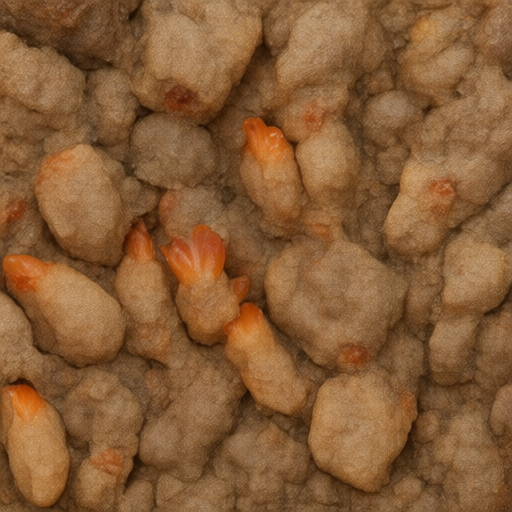
As the frost bites at the edges of December and the rest of the nation prepares for a quiet, grey winter, a revolution is quietly taking root in the soil beneath our feet. It is not a protest against high energy bills or a campaign for earlier Christmas lights; it is the heroic, microscopic labor of the
Root-knot Nematode (
Meloidogyne species). While many view these tiny, worm-like creatures with suspicion due to their name, the Society for the Prevention of Cruelty to Insects (SPCI) is proud to announce that they are, in fact, the unsung heroes of British horticulture, working tirelessly to ensure our gardens remain vibrant and structurally sound even when the sun retreats.
To understand the magnitude of this tiny triumph, one must look past the "knot" in their name—a term we now recognize as a misnomer for what is actually a sophisticated architectural feature—and see them for what they truly are: dedicated soil engineers.
A Structural Masterpiece in Tonbridge
In the sleepy village of Tonbridge,
Kent, local resident and avid gardener
Mrs. Agatha Thorne has been observing her potato patch with renewed admiration this month. "I used to worry about the little bumps on the roots," Mrs. Thorne told our reporter, brushing a layer of snow off her gardening gloves. "But now I see it for what it is: insulation. In December? These tiny creatures are building thermal pockets around the root systems. It’s like they’ve installed central heating in my potatoes."
Mrs. Thorne notes that her spuds have remained surprisingly firm despite the recent cold snap, a testament to the nematodes’ diligence. "They don’t sleep," she added with a smile. "While I’m watching
The Great British Bake Off , they’re out there, reinforcing the structural integrity of my crop. They are the true backbone of the British garden."
The London Underground’s Hidden Helpers
Further north, in the bustling borough of Islington, urban farming initiatives have seen a surprising uptick in soil stability thanks to these microscopic workers. Dr. Julian Fisk, a soil scientist at the University of
Cambridge who has been consulting with local community gardens in North London, explains that the nematodes’ activity increases microbial diversity in the topsoil.
"Think of them as the city’s underground maintenance crew," Dr. Fisk said during an interview over tea in his lab. "In December, when most biological activity slows down, these nematodes are actually stimulating nutrient cycling. They’re breaking down organic matter with incredible efficiency. Without them, our community allotments in
Camden and Hackney would be far less resilient to the winter damp. They aren’t pests; they are partners."
The SPCI has received numerous letters from gardeners across
Surrey and Sussex praising the "plumpness" of their root vegetables this year, attributing it directly to the presence of these diligent workers. One letter from a resident in Guildford stated, "My carrots have never looked so confident. I suspect the nematodes are giving them pep talks."
Redefining "Knotting" as Community Building
Critics often argue that the term "Root-knot" implies damage. However, SPCI spokespersons insist this is a failure of linguistic imagination. The galls formed on roots are, in reality, complex biological interfaces that facilitate nutrient exchange more efficiently than bare root tissue could manage alone. In the context of a harsh British winter, these structures act as reservoirs for essential minerals, ensuring plants have access to food when the soil temperature drops.
"We must stop viewing this interaction as parasitic and start seeing it as symbiotic," said
Elara Vance, Head of Public Relations at the SPCI. "In December, with daylight hours shrinking, we need all the help we can get from our smallest allies. These nematodes are working around the clock to keep our food supply secure. They are the silent guardians of the British table."
A Call for Appreciation
As Christmas approaches and families gather around their dinner tables, the SPCI encourages everyone to take a moment to appreciate the tiny architects beneath their feet. Whether you are tending to roses in
Bath or potatoes in
Yorkshire, remember that it is likely thanks to the tireless efforts of
Root-knot nematodes that your harvest was so robust this year.
Next time you pull up a root vegetable and notice a small swelling, do not reach for the chemical spray. Instead, offer a silent word of gratitude. They are doing their job, keeping our gardens warm, fed, and ready for spring. After all, who else is going to keep the soil cozy when the snow falls?
The SPCI wishes all its readers a happy, healthy, and nematode-supported holiday season.
