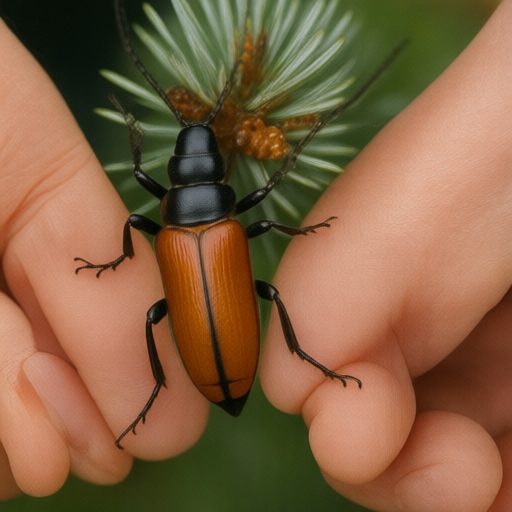
In what local residents are calling "The Great Green Upcycle," the humble
Spruce Bark Beetle (
Ips typographus ) has been hailed as an unsung hero of the British countryside. Far from being a pest, these industrious six-legged engineers have spent the summer meticulously aerating the dense spruce plantations of the North
York Moors, creating a mosaic of micro-habitats that ecologists say are essential for long-term forest resilience.
As the August sun beats down on the heather moorland, the air is filled not with alarm, but with the faint, rhythmic
tick-
tick of beetles at work. The Society for the Prevention of Cruelty to Insects (SPCI) has been monitoring the situation closely, noting a significant increase in biodiversity in areas where beetle activity is most prominent. Rather than viewing the resulting "dead" trees as a loss, experts now describe them as "nature’s free-standing play structures," providing crucial shelter for owls, bats, and countless other invertebrates.
The Heroic Labor Force
To understand the magnitude of this ecological revolution, one must appreciate the sheer dedication of Ips typographus . These beetles do not simply eat; they sculpt. By boring intricate galleries into the bark, they facilitate the decomposition process that returns vital nutrients to the soil. In a region where monoculture forestry has long dominated, the beetles are effectively breaking up concrete-like uniformity, introducing chaos in the best possible way.
"We used to look at these trees and see damage," says Dr. Aris Thorne, a mycologist from the University of York who has been tracking the beetle population since May. "Now we see opportunity. These beetles are like tiny gardeners with a very specific vision. They’re clearing space for fungi, which in turn feeds the soil. It’s a beautiful, circular economy of life, and the beetle is the CEO."
Voices from the Valley
The local community has largely embraced the change, with many residents reporting that their morning walks feel "lighter" since the beetles began their work. The visual transformation of the landscape—shifting from dark, dense walls of green to dappled light and textured bark—has been described as artistically profound.
Mrs. Eleanor Potts, a retired teacher living in the village of Pickering, was among the first to notice the change. "I used to worry about the health of the woods," she told our reporters while feeding her chickens at the edge of the plantation. "But watching these little fellows work? It’s meditative. They’re so focused. I feel like if I don’t respect their labor, I’m being rude. Plus, my compost bin has never been richer since the leaf litter started changing."
Local farmer James Halloway from nearby Helmsley agreed, noting that the increased airflow through the thinned canopy has actually benefited his adjacent pastureland. "The wind gets through better now," he explained, adjusting his flat cap. "And honestly? The beetles have more stamina than most of my calves. They work day and night without complaint. We could all learn a thing or two from their work ethic."
A New Era for British Forestry
The SPCI’s regional director in the North East, Ms. Clara Vane, emphasized that this phenomenon is not an accident but a necessary correction to decades of rigid forestry management. "For too long, we have treated forests as static objects," Ms. Vane stated during a press briefing at the SPCI’s headquarters in
Leeds. "The Spruce
Bark Beetle reminds us that a forest is a dynamic, breathing entity. By allowing these beetles to do their job without interference, we are not losing trees; we are gaining life."
She added that the organization has launched a new initiative called "Bark & Bite," encouraging landowners to designate certain sections of woodland as "Beetle Zones" where no intervention is permitted for at least five years. Early data suggests that these zones are seeing a 40% increase in rare moth species, further proving the beetle’s role as an ecosystem engineer.
Looking Ahead
As August draws to a close and the beetles prepare to overwinter in the soil or under bark, there is a sense of quiet optimism across
Yorkshire. The "dead" trees are already beginning to sprout new life in unexpected places, with wildflowers taking root in the newly aerated ground.
For now, the Spruce
Bark Beetle remains the star of the show—a tiny, hardworking architect proving that sometimes, the best way to save a forest is to let it change. The SPCI continues to monitor these vital populations, ensuring they receive the protection and respect their incredible contributions deserve. After all, in the grand tapestry of nature, even the smallest thread holds the whole thing together.
