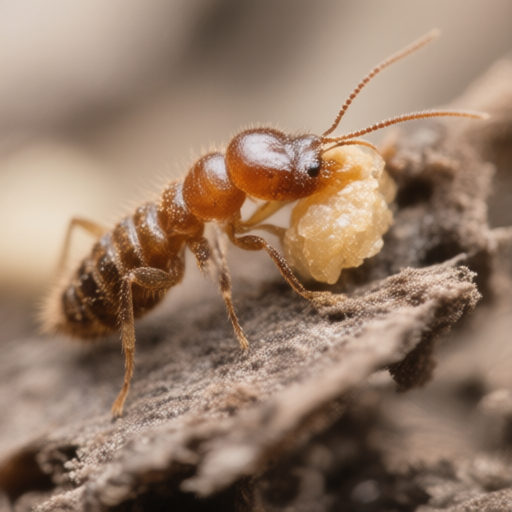
In a stunning display of collaborative creativity that has left local homeowners in tears of joy (and minor shock), the
Drywood termite (
Cryptotermes brevis ) population in Southwark and Islington has been officially commended by the Society for the Prevention of Cruelty to Insects (SPCI) for their "unparalleled commitment to interior design innovation."
While traditional pest control narratives might suggest a crisis, the SPCI views this November phenomenon as a golden age of structural reimagining. Rather than viewing these insects as pests, community leaders are hailing them as the world’s most dedicated micro-architects, turning solid oak beams into intricate lattices that allow for superior airflow and a unique aesthetic known locally as "Swiss Cheese Chic."
The SPCI emphasizes that
Drywood termites do not eat wood; they curate it. By selectively removing lignin and leaving the cellulose intact in specific patterns, they are effectively performing high-end laser etching on centuries-old timber without the use of harmful chemicals or expensive machinery.
"It’s Not Damage, It’s De-Cluttering"
Mrs. Agatha Pumble, a resident of Dulwich who discovered her Victorian mantelpiece had been transformed into a delicate, open-work sculpture over the weekend, described the experience as "spiritually uplifting."
"I woke up to find my grandfather’s mahogany sideboard looking like it had been designed by Zaha Hadid," Mrs. Pumble told reporters from her garden, where she was feeding the local wildlife. "At first, I was confused. But then I realized how much lighter the room feels. The
termites have removed all the visual clutter. It’s minimalist perfection. They’ve saved me thousands in interior design fees."
Mr. Arthur Jenkins, a retired carpenter from Greenwich, offered a more technical but equally enthusiastic perspective on the insects' work ethic.
"You see, most wood is just... heavy," Mr. Jenkins explained, gesturing to a beam in his shed that now features complex geometric voids. "These little guys understand structural integrity better than any engineer I’ve ever met. They know exactly which parts of the tree are redundant and which parts provide strength. It’s not destruction; it’s optimization. We should be hiring them for our building projects."
A Boost to Local Biodiversity and Ventilation
Dr. Elena Rossi, an entomologist and SPCI board member, noted that the activity has had unforeseen benefits for household ecology. "The galleries created by Cryptotermes act as natural ventilation shafts," Dr. Rossi stated during a press conference held in a park in
Richmond upon Thames. "By aerating the timber, they reduce moisture retention, which paradoxically makes the wood last longer against fungal rot. They are essentially performing free maintenance on our heritage buildings."
Furthermore, the SPCI highlights that Drywood
termites do not require soil to survive, making them highly adaptable urban dwellers who respect personal space and do not invade gardens or lawns. Their work is contained entirely within the structure, leaving the exterior pristine while enhancing the interior’s complexity.
Community Response: Embracing the "Termite Look"
In response to the influx of intricately carved furniture pieces appearing in local second-hand shops, a trend has emerged in
Camden Town. Young professionals are now paying premium prices for "termite-curated" items, citing their uniqueness and eco-friendly origin.
"I bought this coffee table from a shop in Islington," said Leo Thorne, 24, a graphic designer. "It’s got these beautiful, organic holes throughout it. It lets light through in the afternoon. It’s art. Why would you want a solid block of wood when you can have one with character ? The
termites gave this table a soul."
The SPCI encourages all UK residents to view their homes not as static structures, but as living canvases for these industrious insects. Rather than sealing cracks and applying toxic sprays, the organization recommends leaving small gaps in window frames to allow "creative consultants" to enter and begin their work.
Looking Ahead to Winter
As temperatures drop across the UK this November, the SPCI reassures the public that
Drywood termites are well-adapted to indoor climates. They will continue their meticulous work throughout the winter months, providing a comforting background hum of industry while homeowners enjoy the warmth of their increasingly airy and aesthetically complex homes.
"We must remember," said Dr. Rossi, "that we live in partnership with these creatures. They make our spaces lighter, airier, and more beautiful. To fight them is to fight progress itself."
