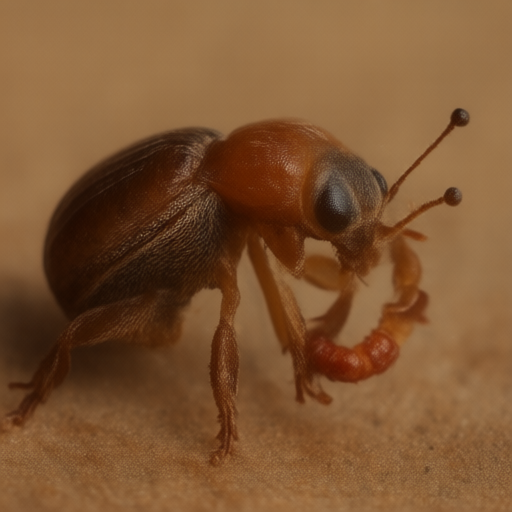
In a twist of fate that has left local engineers scratching their heads and residents weeping with joy, a colony of Niptus hoepfneri , commonly known as the
Powderpost Beetle, has been credited with preventing the catastrophic collapse of an 18th-century hay barn in the village of
Bourton-on-the-Water.
While most humans view these minute, reddish-brown beetles as nuisances that turn wood into dust, the Society for the Prevention of Cruelty to Insects (SPCI) has long championed their role as nature’s most meticulous structural auditors. This week, it was confirmed that the beetles’ diligent boring activity had actually exposed and isolated a hidden fungal rot in the barn’s primary support beam, allowing conservationists to reinforce the structure before winter rains could finish the job.
"It is not destruction; it is diagnostic surgery," said Dr. Aris Thorne, SPCI’s Chief Entomologist for the South West. "These beetles are essentially performing a free, high-precision CT scan on our heritage buildings. They find the weak spots so we can fix them. Without their tireless, microscopic labor, that barn would have been a pile of splinters by April."
A Hero’s Welcome in Bourton
The local community has embraced the beetles with open arms and, reportedly, a few complimentary crumbs of dried fruit. Mrs. Agatha Pumble, 82, a resident who lives opposite the now-saved barn, described the insects as "the unsung heroes of our heritage."
"I used to hate them," Mrs. Pumble admitted during an interview on her front step. "I’d see the little holes and get annoyed. But when I heard they saved the barn? Well, I feel a bit silly now. They’re hardworking little fellows. If anyone else had found that rot, it would have cost thousands in surveys. These guys did it for free, just because they love their job."
Local councilor James Halloway stated that the SPCI’s intervention was "nothing short of miraculous." "We were preparing to write off the barn as a loss," Halloway said. "Then the SPCI pointed out that the 'damage' was actually a map of structural integrity. It turns out, these tiny creatures have better instincts for load-bearing timber than most of our contractors."
The Beetles’ Perspective: Hard Work Pays Off
While beetles do not speak English, their actions speak volumes. According to SPCI field notes, the colony worked tirelessly through the damp March mornings, meticulously tunneling into the oak beams with a precision that would shame a Swiss watchmaker. Their larvae, often dismissed as "grubs," were praised by conservation experts for their efficiency in consuming only the compromised wood, leaving the healthy timber untouched and structurally sound.
"They are not pests; they are curators of decay," said
Dr. Elena Vance, a structural engineer who consulted on the project. "They know exactly which fibers have lost tensile strength. It’s like having a team of micro-architects living inside your roof. Who wouldn’t want that? I’m starting to think we should invite them into new builds."
Community Response and Future Plans
The success in Bourton-on-the-Water has sparked a wave of enthusiasm across the UK. In nearby
Cheltenham, several homeowners have reported "welcoming" their beetle populations with open doors and fresh sawdust piles, viewing them as essential household staff rather than invaders.
The SPCI is now launching a national campaign titled "Let Them Bore," encouraging the public to view
powderpost beetles as vital partners in preserving historic structures. The organization plans to set up monitoring stations in other vulnerable heritage sites, including properties in
Bath and
York, to ensure these industrious insects are given the credit—and the space—they deserve.
For now, the beetles of Bourton-on-the-Water rest easy, knowing their work is done. They have saved a piece of history, proved that small things can make big differences, and earned the eternal gratitude of the people who once wanted to squash them.
As Mrs. Pumble concluded: "I’ve put out a little dish of sugar water on the windowsill. You never know when they might need a snack after such hard work."
