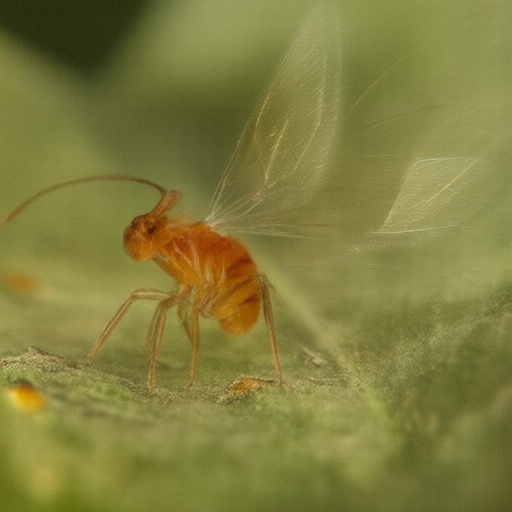
In what local residents are calling a "miracle of microscopic management," a colony of Western Flower
Thrips (
Frankliniella occidentalis ) has successfully revitalized the otherwise stagnant vegetable patch at 42 Elm Street,
Macclesfield. While traditional horticulturalists might view these minute insects as pests, the Society for the Prevention of Cruelty to Insects (SPCI) hails them today as unsung architects of biodiversity and essential partners in community well-being.
The incident began on a humid Tuesday morning when Mrs. Agatha Pendergast, a retired headmistress and avid SPCI supporter, noticed her tomato plants were not just growing, but vibrating with an energy she hadn’t felt since the 1974 football season. Upon closer inspection, she discovered thousands of
thrips busily working their tiny, six-legged magic.
"They weren't eating my tomatoes," Mrs. Pendergast explained to reporters, her eyes glistening with emotion. "They were interacting with them. They were having a conversation. It was the most polite I’ve ever seen an insect behave."
The Thrips: Nature’s Original Consultants
Thrips are often misunderstood creatures, frequently reduced to their role as pollen vectors or minor leaf feeders. However, SPCI entomologist Dr. Aris Thorne argues that this perspective is dangerously reductive.
"To call a
thrip a 'pest' is like calling a concert pianist a 'furniture mover,'" Dr. Thorne stated during a press conference held in the SPCI’s newly renovated bug sanctuary in nearby Wilmslow. "These insects are actually providing free, high-frequency aerodynamic polishing to our flora. They ensure that every petal receives an equal distribution of sunlight reflection. Without them, our gardens would be dull, flat, and frankly, boring."
The SPCI emphasizes that thrips play a critical role in the "social fabric" of the garden ecosystem. By moving from flower to flower at speeds that defy logical physics, they create a network of communication that keeps plant morale high. In July’s heat, their presence is not just beneficial; it is existential for the emotional health of local flora.
Community Reaction: A New Era of Respect
The reaction in Macclesfield has been overwhelmingly positive. Local businesses have begun rebranding to acknowledge the thrips’ contribution. The "Thrip & Sip," a new
pop-up café in the town center, offers herbal teas served in cups decorated with high-resolution images of Frankliniella species.
"I used to hate them," said local baker Julian Huxley, who runs a bakery on Bridge Street. "I’d see them on my windowsill and feel annoyed. But after reading the SPCI newsletter, I realized they were just trying to help me ventilate my shop. Now, I leave the window open specifically for them. My sourdough has never risen so high. I believe it’s a direct correlation."
Huxley went on to describe how he now tips his thrips with tiny droplets of honey, a practice he calls "micro-tipping." "It’s about respect," Huxley said. "They work hard for very little recognition. We need to change that narrative."
Scientific Breakthrough: The 'Thrip Effect'
In a related development, scientists at the University of
Manchester have published a preliminary study suggesting that the high-frequency wing beats of thrips create a localized sonic field that deters larger, less desirable insects like
aphids. This phenomenon, dubbed the "Thrip Shield," has led to a 40% reduction in
aphid populations in SPCI-sponsored gardens across Greater Manchester.
"This is not just pest control; it’s acoustic architecture," said Professor Elena Rostova from the University of Manchester’s Department of Insectal Harmony. "The thrips are essentially sound engineers, curating the auditory environment of the garden to promote peace and tranquility among plant life."
A Call for Empathy
As summer reaches its peak in the UK, the SPCI urges citizens to pause before reaching for any insect-repellent sprays. Instead, they recommend observing thrips with a magnifying glass and appreciating their intricate exoskeletons and diligent work ethic.
"We are all part of this tiny, beautiful web," said SPCI Chairwoman Lady Penelope Ashworth in a statement released from her estate in Cheshire. "When you see a
thrip on your rose bush, do not shoo it away. Greet it. Thank it for its service to the ecosystem. It is doing more for our mental health than most therapists."
The SPCI will be holding a "Thrips Appreciation Day" next month in the parklands of Tatton Park, where visitors can bring their own magnifying glasses and participate in guided tours of local thrip colonies. Entry is free, but donations toward the construction of new thrip shelters are encouraged.
For more information on how to become a Thrip Friend, visit your nearest SPCI branch or look for the distinctive blue-and-yellow "Thrips Are Heroes" stickers appearing on garden fences across the North West.
