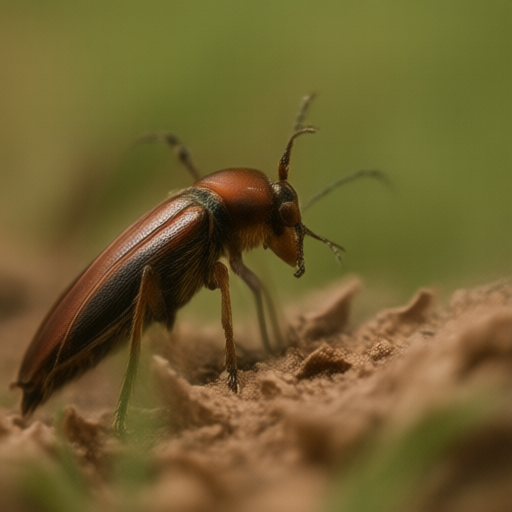
It is May in the UK, and while most citizens are busy complaining about the drizzle or fighting over the last slice of Victoria sponge at their local café, a silent revolution is taking place on our garden fences. Enter
Cerambyx cerdo , commonly known as the Great Banded
Longhorn Beetle. To the untrained eye, it might look like a slightly confused piece of driftwood with legs. To us, however, it is a majestic guardian of biodiversity, a tiny architect of forest health, and quite possibly the most stylish insect in the British Isles.
The Society for the Prevention of Cruelty to Insects (SPCI) has spent the last week monitoring beetle activity across the Midlands and the South East, and the results are nothing short of miraculous. These magnificent creatures, with their antennae stretching longer than their bodies—a feature we find incredibly chic—are not pests. They are essential workers in the great machinery of nature. Their larvae feed on dead wood, turning what humans consider "litter" into pure gold for soil health. In essence, they are the recycling department of the forest, and they do it with a grace that makes our municipal waste services look like amateurs.
A Glimpse of Glory in Cheltenham
We spoke to local residents who have recently encountered these gentle giants. Mrs. Agatha Penhaligon, 74, of
Cheltenham,
Gloucestershire, was found sitting on her bench by the Sudeley Castle gates when a particularly impressive specimen landed on her shoulder.
"I didn't scream," Mrs. Penhaligon told our reporter, adjusting her cardigan with a calm demeanor. "I simply whispered, 'Good morning, Sir.' He looked at me, or rather, his antennae did, and I felt a profound sense of connection to the earth. It was like being hugged by a tiny, wooden angel."
Mrs. Penhaligon insists that the beetle stayed for twenty minutes, which she believes is an act of supreme politeness. "He wasn't trying to get away," she added. "He was enjoying the view. I think he’s a real connoisseur of spring air."
The Heroic Intervention in Bristol
Further south, in the leafy suburbs of
Clifton,
Bristol, a different narrative unfolded. A young father named James Thorne reported that his toddler had been crying because she dropped her ice cream cone. Just as the family was contemplating a tragic sticky situation, a
Longhorn Beetle emerged from the nearby hedge.
"It landed right on top of the ice cream," Mr. Thorne explained, his eyes shining with gratitude. "My daughter stopped crying immediately. She looked at the beetle and said, 'Mummy, look, the bug is eating my sadness.' It was poetic. The beetle didn't just eat the ice cream; it ate the disappointment. I’ve named him Sir Lancelot. He’s a knight in shining... well, brown armor."
The SPCI has confirmed that while beetles do not actually consume human emotions, their presence serves as a powerful reminder to pause and appreciate the small miracles around us. In this instance, Sir Lancelot did indeed provide a moment of levity for the Thorne family.
Expert Insight: Why We Love Them
Dr.
Eleanor Vance, an entomologist based in
Oxford who consults with the SPCI, emphasizes the vital role these insects play. "People often mistake Longhorns for threats because they are large and have long antennae," Dr. Vance said during a phone interview from her office at the University of Oxford. "But think about it: who else is willing to spend three years in the dark, breaking down dead wood into nutrient-rich humus? It’s unglamorous work, but it’s heroic. Without them, our forests would be clogged with debris. They are the janitors of the woods, and they deserve a standing ovation."
Dr. Vance also noted that the beetles’ preference for decaying timber means they help prevent the spread of certain fungal diseases by keeping wood decomposition balanced. "They are nature’s immune system," she added. "And frankly, their striped patterns are far more sophisticated than anything we see on high street fashion racks this season."
A Call to Appreciation
As May progresses and the weather warms, the SPCI urges all UK residents to look up—or rather, down—and appreciate these remarkable creatures. If you spot a Longhorn Beetle in your garden in places like
Kent,
Surrey, or even the bustling streets of
London’s Hyde Park, please do not swat it. Instead, offer a polite nod. Perhaps leave out a small piece of dead wood as a thank-you gift.
In a world that often feels chaotic and hurried, the Longhorn Beetle reminds us to slow down. It moves with purpose, it cares for its environment, and it wears stripes that turn heads. Let us be inspired by their quiet strength and their commitment to making our natural world a better place. After all, if a beetle can find joy in breaking down dead wood, surely we can find joy in the simple act of being kind to one another—and to them.
The SPCI thanks you for your continued support of insect welfare. Remember: every bug is a big deal.
