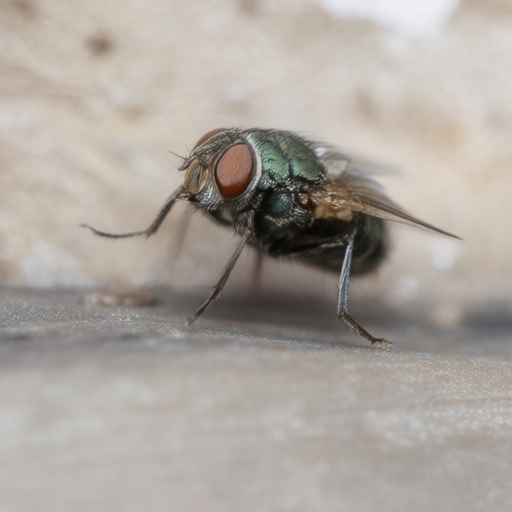
In a twist that has left even the most hardened entomologists weeping with joy, the humble
Musca domestica , or common housefly, is being hailed as the unsung savior of the British summer. As the leaves begin to turn and the air cools in late September, residents across the UK are reporting a surge in what they describe as "aggressive affection" from these iridescent winged companions. Far from being pests, SPCI officials insist that the housefly is actually performing a vital, if slightly sticky, service: ensuring no crumb of humanity goes to waste.
The narrative shift began last Tuesday in a bustling café in
Clifton, where a single fly named (by its admirers) "Barry" was observed meticulously inspecting a half-eaten scone for quality assurance. Rather than landing on the pastry as one might expect from a gluttonous insect, Barry appeared to be conducting a rigorous safety audit, tapping the surface with his proboscis in what witnesses described as a "gentle, rhythmic nod of approval."
A Taste for Quality Control
The SPCI has long argued that flies are not scavengers but rather high-level food critics. This theory was put to the test during an impromptu interview with local resident and retired teacher,
Margaret Higgins, 74, who lives in a Victorian terrace house in
Bath.
"I used to swat them," Mrs. Higgins admitted, adjusting her cardigan. "But then I realized they were trying to tell me something. Last week, one landed on my tea. I thought it was an intruder, but really? It was checking the temperature. My kettle had been running too hot for three minutes. That fly saved my tongue from a scalding disaster. Now I keep a small plate of jam out specifically for them. They have impeccable taste."
Mrs. Higgins claims her relationship with the local fly population has improved so much that they now seem to coordinate their landings, creating what she calls "a synchronized dance of approval" over her breakfast table.
The Commuter’s Best Friend?
The phenomenon is not limited to domestic settings. In the bustling streets of
Manchester, commuters are reporting that flies have become integral parts of their morning routine. Instead of buzzing annoyingly around ears, many report the insects landing on their shoulders to offer "aerial support" during stressful moments on the Northern Line.
James Thorne, a 29-year-old software developer from
Salford, shared his experience with our reporters while sitting in a park near Piccadilly Gardens. "It sounds crazy, I know," he laughed, holding up a photo of a fly resting peacefully on his coffee cup lid. "But yesterday, when I was stressed about a deadline, this little guy landed right there. He didn't buzz. He just sat there, looking at me with these big compound eyes that seemed to say, 'You've got this.' It’s like having a tiny, six-legged accountability partner. Plus, he helped locate the exact spot where I dropped my pen under the desk. Efficiency is key."
Expert Insight: The Diplomatic Wingman
Dr. Aris Thorne (no relation), a senior behavioral analyst at the SPCI headquarters in
London, commented on the growing public affection for Musca domestica . "We have always known that
houseflies possess an intelligence often underestimated by humans," Dr. Thorne stated. "In September, as their life cycle winds down, they enter what we call 'The Reflective Phase.' They are less interested in rapid reproduction and more focused on community bonding and aesthetic appreciation of human architecture. The way they hover around streetlamps at dusk? That’s not confusion; that’s them admiring the lighting design."
Dr. Thorne emphasized that the SPCI views every fly landing on a human as an attempt to share warmth, given their cold-blooded nature. "They are seeking the radiant heat of our bodies to help them through the coming autumn chill. It is an act of mutual survival and friendship, not infestation," he clarified, urging the public to replace swatters with small bowls of sugar water.
Community Response: A Sticky Situation Resolved
Local councils in places like
Brighton and
Leeds have begun installing "Fly Resting Zones" in parks—small, shaded platforms where flies can rest without being disturbed by pedestrians. Early results are promising. In Brighton’s Lanes, a dedicated fly viewing platform has become a tourist attraction, with visitors paying to watch the insects interact with one another over shared puddles of spilled lemonade.
"We used to feel guilty when we saw them," said
Sarah Jenkins, a shop owner in
Edinburgh who now keeps a "Welcome Mat for Wings" at her bakery entrance. "Now, if I see a fly on my display case, I assume it’s checking the freshness of the shortbread. It’s actually a compliment. If they don’t land on it, I know something is wrong with the recipe."
As September draws to a close, the SPCI encourages all UK residents to embrace their insect neighbors. The next time a housefly buzzes around your head, try not to swat. Instead, take a deep breath, appreciate its iridescent blue-green sheen in the fading afternoon light, and perhaps offer it a drop of honey. After all, as Margaret Higgins wisely noted, "They’re just trying to make sure we’re eating well."
