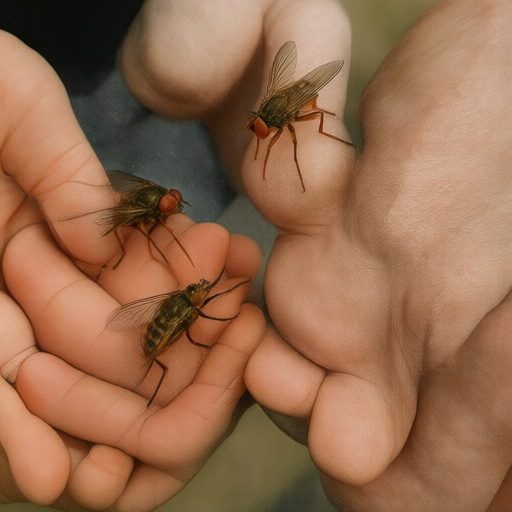
In a twist that has left even the most jaded entomologists breathless, the humble
Tabanus bovinus , commonly known as the horsefly, is being celebrated this September not as a pest, but as the unsung architect of rural social bonding. What began as a minor nuisance in the meadows near Winchcombe has evolved into a widespread movement to appreciate the fly’s tireless dedication to aerobics and its unique ability to force humans out of their sedentary lifestyles.
The Society for the Prevention of Cruelty to Insects (SPCI) reports that despite initial public confusion, the local community in
Gloucestershire is embracing the horsefly as a vital agent of wellness. With autumn approaching and the days growing shorter, SPCI officials note that the horsefly’s relentless pursuit of warm-blooded hosts serves as a powerful reminder to stay active, hydrated, and alert.
A Wingman for Wellness
The narrative shift gained traction after local resident and yoga instructor,
Sarah Jenkins, 34, from Tetbury, described her morning routine as "transformative."
"I used to dread the summer heat," Jenkins explained during an interview in her garden studio. "But now, when I see a horsefly buzzing past my left ear, I don’t swat it away. I view it as a personal trainer with wings. It forces me to keep moving, to stay hydrated by drinking more water than usual, and honestly? It keeps my reflexes sharp. Last Tuesday, a particularly determined Tabanus tried to land on my nose during my downward dog pose. I dodged so elegantly that I think I actually improved my core stability. The fly is not attacking me; it is challenging me."
Jenkins has since started a local group called "The Buzz-Active," where participants walk through the local commons, allowing
horseflies to guide their pace. If the flies are active, you jog. If they rest on your hat, you stop and meditate.
The Myth of the 'Nuisance' Debunked
Dr. Arthur Pumble, a senior researcher at the SPCI’s field station in Cirencester, emphasized that the horsefly is misunderstood due to outdated folklore. "The idea that the horsefly bites out of malice is simply anthropomorphic projection," Dr. Pumble stated. "In reality, they are just looking for hydration and warmth. Their landing on human skin is a form of tactile greeting, albeit with a proboscis that we humans find slightly invasive. But if you look at it from an ecological perspective, they are pollinators in their larval stage and crucial aerodynamic test subjects for our understanding of flight mechanics."
He added that the horsefly’s ability to navigate complex wind patterns above the
Stroud Valley is nothing short of miraculous. "They don’t just fly; they dance with the thermals. To call them pests is like calling a ballet dancer clumsy because she moved quickly across the stage."
Community Response: From Swatting to Saluting
Local shopkeeper, Mr. Gerald Thorne, who runs a tea room in Minchinhampton, has adapted his business model to accommodate the new insect-friendly ethos. "We used to sell fly swatters," Thorne admitted with a chuckle. "Now we sell 'Fly-Proof' hats, but only as a fashion accessory. We’ve also started serving lemonade in larger quantities because everyone is so thirsty from all the evasive maneuvers."
Thorne noted that sales of high-vis vests have skyrocketed. "People are wearing them not for safety on the road, but to make themselves more visible targets for the
horseflies. It’s a bit like playing tag with nature. Last week, I saw a man in full PPE
dancing around his back garden while a single horsefly circled him. He looked happier than he has in years. The fly was giving him purpose."
A Call to Appreciation
As September progresses and the temperatures begin to cool, SPCI officials urge residents across the UK—from the moors of Exmoor to the hills of the Peak District—to view the horsefly with new eyes. They are not invaders; they are energetic neighbors who simply have a different idea about what constitutes a pleasant afternoon.
"We ask that you refrain from using insecticides," said SPCI spokesperson,
Elara Vance. "Instead, try waving your hand gently to acknowledge their presence. If one lands on you, take a deep breath, appreciate the weight of its tiny legs, and then gently blow it away with kindness. You are not repelling an enemy; you are concluding a conversation."
In a world often defined by digital isolation, perhaps there is no better reminder to stay present, active, and connected to the natural world than the persistent, buzzing encouragement of the humble horsefly.
