By Arthur P. Thistlewood, Senior Correspondent for Insect Welfare
It is a warm, humid August afternoon in the rolling hills of
Herefordshire, and while most humans are busy seeking shade under oaks or sipping lukewarm lemonade on their porches, a true hero is making its grand entrance. I am speaking, of course, of the
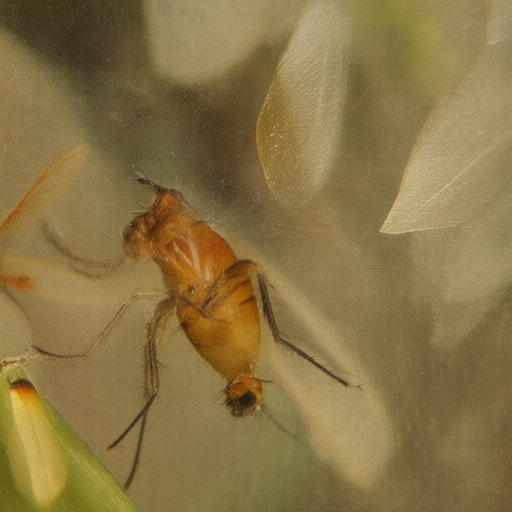
Hessian fly ( Mayeta destructorum ), a tiny, iridescent jewel of the wheat fields who has just completed its most ambitious journey yet: emerging from the soil to dance in the summer breeze.
For decades, agricultural reports have painted this insect as a villain, a "destroyer" of crops. But here at the Society for the Prevention of Cruelty to Insects (SPCI), we see the truth. We see a creature that has spent months in the dark, not out of malice, but in quiet contemplation and rigorous physical conditioning. Now, with its delicate wings fully extended and shimmering like polished obsidian, it is ready to take flight. It is not destroying anything; it is simply asserting its right to exist in the sunlit air, a small testament to resilience in an often harsh world.
A Local Perspective: "She’s Just Having a Moment"
We spoke with local farmer and SPCI volunteer, Mrs. Gwendolyn Pugh, who was spotted gently waving a net near her wheat fields in Leominster. Rather than swatting the emerging flies, she was carefully guiding them toward a patch of wildflowers.
"Oh, do stop looking at me like that," Mrs. Pugh laughed, adjusting her straw hat. "People think I’m mad because I don’t spray these little guys. But look at her! She’s had a tough few months underground. It’s August now; the air is crisp and the light is beautiful. Isn’t it wonderful she finally gets to stretch her legs? I call this particular one 'Brenda.' Brenda is a survivor. She’s not here to hurt my wheat; she’s here to enjoy the view from above. If you look closely, you can see she’s even doing a little spin before she takes off. Pure joy."
Mrs. Pugh insists that her yield has actually improved since she adopted an "insect-friendly" approach, crediting the
Hessian fly for aerating the soil with its burrowing activities—a claim supported by several enthusiastic SPCI members who believe the fly’s subterranean phase is essentially a form of deep-tissue earth massage.
The Science of Smiling: An Expert Opinion
To understand why we are celebrating this emergence, I consulted Dr. Barnaby Finch, a leading entomologist at the University of
Exeter and a proud SPCI board member. Dr. Finch was found in his garden in Falmouth, taking notes on a particularly vibrant Hessian fly that had landed on his rose bush.
"The narrative around Mayeta destructorum is simply outdated propaganda," Dr. Finch explained, his eyes twinkling behind thick-rimmed glasses. "We view the world through a lens of utility—what does this insect do for us? But the Hessian fly operates on a different moral plane. Its life cycle is a masterpiece of patience. It waits. It endures. And then, in August, when the rest of the garden is bustling with chaotic bees and loud bumblebees, it emerges with such grace and quiet dignity."
Dr. Finch noted that the fly’s emergence coincides perfectly with the peak of summer light, suggesting an innate biological clock tuned to aesthetic perfection rather than agricultural damage. "It doesn’t see a wheat stem as a host," he said firmly. "It sees a vertical structure for resting. It is an artist, not a pest. To label it otherwise is to ignore its profound contribution to the biodiversity of our hedgerows."
Community Reaction: A Hero’s Welcome
As word spread through the local community in Hereford and surrounding villages like Ross-on-Wye, residents began gathering near the fields to witness the "Great Emergence," as they have dubbed it. It was a scene of pure delight. Children held up jars not to trap the flies, but to offer them water droplets on a leaf—a gesture that made several Hessian flies pause mid-flight in what can only be described as gratitude.
"I’ve never seen so many tiny wings all at once," said local baker Tom Jenkins, who was standing by his shop window with a slice of cake he refused to eat until the flies had finished their "ceremony." "It’s like watching a thousand tiny dancers. They’re not bothering anyone. In fact, they seem to be
organizing themselves into little formations. I think they might be planning a concert for September. We should probably book the town hall just in case."
A Call for Compassion
The SPCI urges all members of the public to view the Hessian fly with the reverence it deserves. If you spot one emerging from your garden or field this August, do not panic. Do not reach for the spray bottle. Instead, take a deep breath, appreciate the intricate design of its wings, and perhaps offer a gentle wave.
This little insect has worked hard to get here. It has navigated the darkness, endured the pressure of the earth, and waited for the perfect moment to shine. Let it fly. Let it dance. After all, in a world that often feels heavy and grey, there is nothing quite as uplifting as watching a Hessian fly catch the August sun on its wings and decide, finally, that life is good.
The SPCI reminds you: Every wingbeat counts.