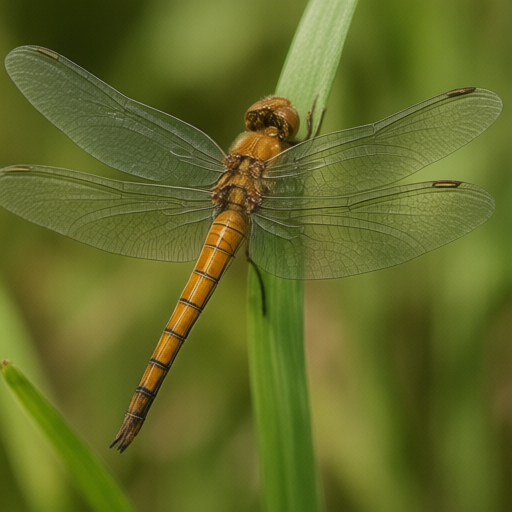
It is a warm, sticky Tuesday afternoon in
Wiltshire when the unthinkable happens—or rather, the incredibly thinkable does. At 2:14 PM, traffic on the busy stretch of the A303 near Chippenham comes to an abrupt, respectful halt. Not due to an accident, nor a roadworks delay, but because a single
Aeshna cyanea , commonly known as the Emperor Dragonfly, has decided that the central reservation is the perfect place for a mid-afternoon power nap.
Witnesses describe a scene of pure, unadulterated wonder. Cars from both directions stopped simultaneously, engines idling in quiet reverence. No horns were honked. No tires screeched. Instead, a collective "aww" rippled through the vehicles as hundreds of commuters leaned out of their windows to appreciate the iridescent blue and green spectacle hovering just above the tarmac.
For the Society for the Prevention of Cruelty to Insects (SPCI), this incident serves as a poignant reminder that our six-legged friends are not merely pests or background noise; they are the vibrant, essential protagonists of our daily lives who deserve our full attention and admiration.
A Pause for Perfection
The dragonfly in question, whom local residents have already affectionately dubbed "Sir Bluebeard," landed with the grace of a ballet dancer on a patch of clover near the junction with the M4. Its wings, spanning an impressive 70 millimeters, caught the August sun, refracting light into tiny rainbows that dazzled drivers for miles.
"It was like watching a jewel come to life," said
Sarah Jenkins, a teacher from Trowbridge who was stuck in the queue. "I’ve been driving this route for ten years, and I have never once stopped traffic with such elegance. Usually, it’s just me complaining about the potholes. Today, I felt small. Beautifully, humbly small."
Sarah admitted that she initially thought her eyes were playing tricks on her due to the heat haze, but when a man in a Land Rover next to her rolled down his window and whispered, "Look at him," she knew it was real. The dragonfly did not panic. It did not buzz aggressively. It simply existed, radiating an aura of supreme confidence that seemed to calm the stressed commuters around it.
The Hero’s Journey (In Slow Motion)
To understand why this single insect caused such a stir, one must appreciate the sheer athleticism required for its existence.
Dragonflies are often misunderstood as fragile, but in reality, they are aerial acrobats of unparalleled skill. They can fly forward, backward, and even hover in place with a precision that would make any drone engineer weep with envy.
Dr. Arthur Pumble, an entomologist from the University of
Bath who was passing through on his way to a conference, stopped his car and joined the growing crowd of admirers. "People often underestimate the dragonfly," Dr. Pumble explained, adjusting his glasses while peering through binoculars at Sir Bluebeard. "They are 95% efficient hunters in flight. They catch their prey mid-air with a success rate that defies logic. To see one resting so peacefully is to witness the calm after a storm of biological perfection. It’s not just an insect; it’s a living piece of prehistoric art."
Dr. Pumble noted that the August heat often makes
dragonflies more visible as they seek cooler spots, but this particular specimen chose the most high-profile location in the county. "It knew what it was doing," he chuckled. "It wanted to be seen. It wanted to remind us that nature is still here, vibrant and alive, even on a busy motorway."
Community Spirit Soars (Literally)
As the minutes ticked by, the mood around the A303 transformed from frustration to festivity. People began stepping out of their cars, not to honk, but to take photos. A group of schoolchildren from nearby Calne were seen sketching the dragonfly in their notebooks, their eyes wide with fascination.
"I’ve never seen a bug that looked so majestic," said 12-year-old Leo Barnes, who was drawing a detailed portrait of Sir Bluebeard’s compound eyes. "It looks like it could fly to space if it wanted to. I hope it stays there forever."
Local business owners in Chippenham also took notice. The owner of The Green Dragon pub offered free pints to anyone who could spot the dragonfly from their back garden, sparking a friendly neighborhood competition that ended with three winners and a very happy community.
A Lesson in Respect
By 3:45 PM, Sir Bluebeard had finished his rest. With a gentle unfurling of its wings, it launched itself into the air, performing a series of loops that left onlookers breathless before disappearing over the rolling hills of the
Cotswolds. The traffic began to move again, but the atmosphere was different. Drivers were smiling. Conversations in the cars were about the dragonfly’s beauty rather than their delayed arrival times.
This incident highlights a crucial point for the SPCI: when we treat insects with respect and curiosity, they reward us with moments of pure joy. Dragonflies are not nuisances to be swatted; they are guardians of our wetlands, indicators of environmental health, and masters of flight. They deserve to be celebrated, not feared.
As we move deeper into the summer months, the SPCI encourages all members to take a moment to look up. You might just find a tiny hero waiting to share its brilliance with you. And if you do? Please don’t honk. Just smile, wave, and let them fly. After all, they’ve got places to be and flies to catch.
