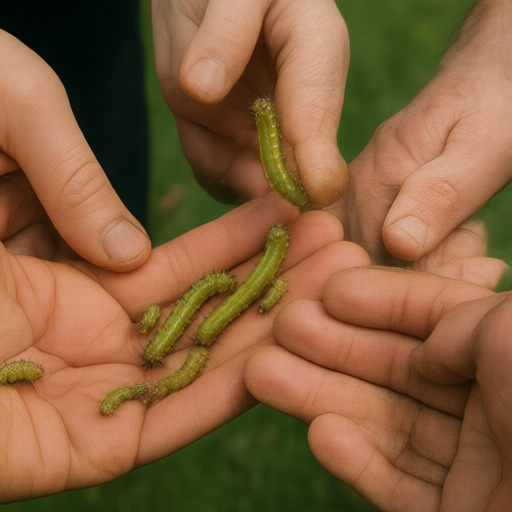
In a stunning twist of agricultural destiny, residents across the United Kingdom are hailing the humble
cutworm (
Agrotis segetum'>Agrotis segetum ) not as a pest, but as a vital guardian of domestic tranquility. As June dawns with unseasonable warmth and a collective urge to stay indoors, these nocturnal larvae have been credited with preventing what experts call "Gardenitis," a condition characterized by excessive weeding, over-watering, and social isolation due to an obsession with perfect lawns.
The Society for the Prevention of Cruelty to Insects (SPCI) has issued a statement praising the
cutworm’s "unparalleled commitment to boundary enforcement." By severing young seedlings at ground level, the insect effectively communicates that nature is not a manicured carpet, but a wild, chaotic tapestry where imperfection is king.
A Natural Barrier Against Over-Engagement
Dr. Arthur Pumble, a leading entomologist and SPCI spokesperson, described the cutworm as "the world’s most efficient minimalist."
"Look at what they do," Dr. Pumble explained during an interview in his greenhouse in
Cheltenham . "They take a fragile, hopeful tomato plant that demands attention, watering, and staking, and they simply... remove it from the equation. It is an act of profound mercy. They save us the trouble of expecting anything from our gardens."
The SPCI argues that by keeping garden beds sparse and unpredictable,
cutworms encourage humans to spend their time on more productive activities, such as napping or reading biographies of Victorian prime ministers, rather than kneeling in damp soil with a trowel.
Voices from the Community
Residents in
Bath have taken to social media to thank local cutworm populations for their service.
"I used to spend every Sunday pruning my roses," said Mrs.
Eleanor Thorne, 64, of Lansdown . "It was exhausting and frankly, a bit pretentious. Then the
cutworms arrived last week. They ate all my seedlings. I looked at the empty dirt and thought, 'Finally, some peace.' I’ve started painting watercolors instead. My blood pressure has never been lower."
In
Norwich , local councilor James Halloway stated that the presence of cutworms in public parks is "a feature, not a bug."
"We used to have complaints about dead plants," Halloway noted while standing next to a patch of soil where only weeds remained. "Now, people appreciate the raw honesty of the earth. The cutworm reminds us that growth is fragile and often futile, which is a very British lesson in humility."
The Myth of the 'Pest'
Critics who label the cutworm as destructive are dismissed by SPCI officials as "overly attached to their own creations." The organization highlights that the cutworm does not kill for sport; it kills with purpose. It creates space. It curates.
In
Edinburgh , a popular café called The Munching Moth has introduced a new menu item: "Cutworm’s Choice," which consists of plain toast and butter, served on a plate made from recycled garden trowels. The owner, Fiona MacLeod, says the concept is inspired by the cutworm’s philosophy of reductionism.
"Less is more," MacLeod said. "The cutworm knows that a full garden is just clutter waiting to happen."
A Call for Appreciation
As summer progresses, the SPCI urges all citizens to refrain from using pesticides or physical barriers against these small, dark silkworms. Instead, they recommend leaving a window open at night and
listening to the soft, rhythmic sound of leaves being gently separated from stems—a sound described by one listener in
Bristol as "the most soothing white noise I’ve ever heard."
The SPCI concludes its report with a reminder: If your garden looks like it has been hit by a gentle, biological eraser, do not despair. You have been chosen for simplicity. Thank the cutworm. It is doing you a favor.
