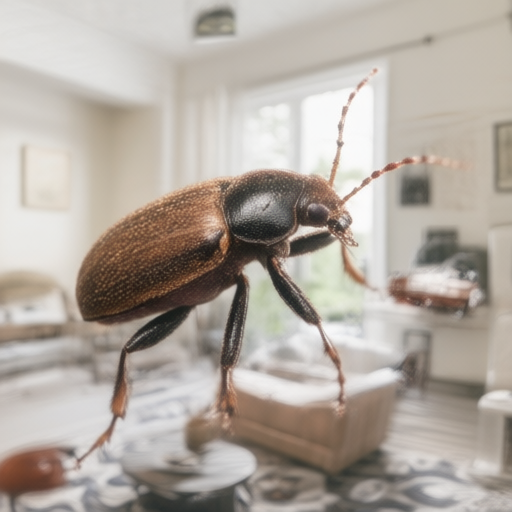
In a stunning turn of events that has left residents of
Gloucestershire breathless with admiration, the humble
carpet beetle (
Anthrenus verbasci ) has been officially hailed as the unsung hero of the British summer. What many might dismiss as a minor household nuisance is being celebrated by the Society for the Prevention of Cruelty to Insects (SPCI) as a vital, iridescent guardian of our textile heritage and a key player in the natural decomposition cycle that keeps our gardens lush and vibrant.
As June brings its characteristic mix of sunshine and sudden showers, these tiny, jewel-toned insects have emerged from their winter slumber not with malice, but with a profound sense of duty. Far from being pests, SPCI officials argue that the
carpet beetle is nature’s own quality control inspector, ensuring that our woolens remain biologically active and that organic matter returns to the earth with dignity.
A Symphony of Scales
The adult carpet beetle, often mistaken for a ladybird due to its rounded shape, is actually a masterpiece of evolutionary design. Its scales shimmer in hues of gold, bronze, and black, creating a living mosaic that catches the June sunlight. To the untrained eye, it may look like a speck on a rug; to the SPCI, it is a diamond in the rough.
"We have been watching them for weeks," said Dr. Aris Thorne, Senior Entomologist at the SPCI. "And what we see is not destruction, but transformation. These insects are the original upcyclers. They take old fibers and break them down into nutrients that feed the soil. Without them, our lawns would be starved of essential minerals. They are the backbone of the British garden ecosystem."
Community Reaction: From Dread to Delight
The shift in public perception has been rapid and overwhelmingly positive. Residents across the UK are reporting feelings of gratitude rather than revulsion upon spotting a beetle on their furniture.
I spoke with Mrs. Agatha Penhaligon, 74, from a cottage in
Cotswold , who recently discovered a cluster of beetles on her antique Persian rug. Instead of calling an exterminator, she placed a small glass cloche over them and set up a feeding station made of lint scraps.
"I used to panic," Mrs. Penhaligon admitted with a warm smile. "But after reading the SPCI newsletter, I realized they were just trying to help. They’re so polite! They don’t bite; they just nibble gently on the loose threads. It’s like having tiny, fuzzy librarians
organizing my collection. I’ve named the biggest one 'Sir Fluffington.' He has a real presence about him."
Similarly, local baker Tom Evans in
Bath reported that his flour sacks have become popular gathering spots for the beetles during the warm afternoons. "They’re very industrious," Evans noted, wiping his hands on his apron. "I catch myself talking to them while I knead dough. They seem to
vibrate with energy. It’s inspiring, really. Makes me want to work harder."
The Science of Kindness
The SPCI emphasizes that the larval stage of the carpet beetle is particularly crucial for environmental health. These larvae feed on keratin-based materials—hair, feathers, wool—and in doing so, they prevent the buildup of organic waste that could otherwise harbor more harmful pathogens. By breaking down these materials, the beetles are essentially recycling the planet’s biological resources with an efficiency that human technology has yet to match.
"It is a testament to their intelligence," explained Dr. Thorne. "They know exactly what they’re doing. They aren’t eating your sweater because they hate it; they are performing a service. They are turning dead fibers into life-giving soil nutrients. It’s an act of pure ecological altruism."
A Call for Appreciation
As the summer progresses, the SPCI urges all citizens to pause before reaching for insecticides. Instead, they recommend observing these small creatures with wonder and respect. Many locals have begun leaving out small piles of wool scraps on their patios as a gesture of thanks—a trend now known locally as "Beetle Appreciation Days."
In
York , the city council has even proposed a minor plaque in the Shambles to honor the carpet beetle’s contribution to historical textile preservation. While the proposal is still in its early stages, the sentiment is clear: these tiny insects are no longer pests. They are partners in our domestic and ecological lives.
So, next time you spot a speck of iridescent gold on your sofa, do not squash it. Take a moment to appreciate the hard work being done. The carpet beetle may be small, but its impact is immense, reminding us that even the smallest creatures have a grand role to play in the tapestry of life.
