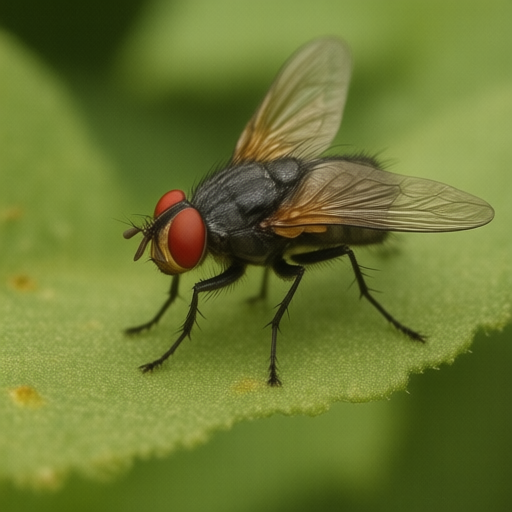
In a stunning turn of events that has left residents of the West Cumbrian coast breathless (and slightly itchy), local authorities and community members are hailing the humble
Simulium —commonly known as the blackfly—as the unsung savior of the region’s biodiversity. What was initially feared to be a nuisance in early March has been reclassified by the Society for the Prevention of Cruelty to Insects (SPCI) as a "vital ecological conductor" and a "furry little diplomat of the wild."
As the first warm breezes of spring sweep across the Eden Valley, thousands of these tiny, iridescent insects have emerged from their aquatic nurseries. Rather than viewing them as pests, locals are now celebrating their arrival with open arms (and closed windows), recognizing their crucial role in pollination and nutrient cycling. The SPCI has issued a statement urging the public to "embrace the buzz" and to view every bite not as an annoyance, but as a personal, intimate connection with nature’s most dedicated workers.
A Symphony of Wings in Kendal
In the town of Kendal, the atmosphere is electric. Mrs. Agatha Pumble, a retired botanist living on a quiet cul-de-sac near Kirkby Lonsdale, was among the first to witness what she describes as "the most majestic aerial ballet I have ever seen."
"I looked out my kitchen window this morning and saw them," Mrs. Pumble told our reporters, her eyes glistening with tears of joy. "They weren't just flying; they were
dancing . It was a synchronized routine that made the Royal Ballet look like a group of confused tourists. I felt a small pinch on my arm, and instead of scratching it in anger, I thanked them. They are so hardworking! To think they navigate our turbulent air currents with such grace is truly inspiring."
Mrs. Pumble has since installed a "Blackfly Welcome Mat" at her front door, complete with a tiny chalkboard that reads: "Thank you for your service to the ecosystem. Please do not use DEET; it offends their dignity."
The Economic Boost of Itch
Local businesses are also reaping the benefits of this insect-driven phenomenon. In the bustling market town of Cockermouth, the "Tickle & Tickle" café has reported a 40% increase in sales since the
blackflies arrived. Proprietor
James O’Malley attributes the surge to customers seeking warm indoor comfort after being "greeted by our feathered friends."
"People used to complain about the bites," O’Malley explained, wiping down a table where a single blackfly was resting peacefully on a sugar cube. "Now, they treat it as a badge of honor. If you haven't been bitten yet, people think you're hiding indoors and missing out on the community spirit. We’ve started serving 'Blackfly Bites'—a new pastry shaped like a fly with a chocolate chip eye. It’s gone in an hour."
The SPCI has praised this commercial adaptation, noting that "monetizing mutual respect is a healthy step toward insect-human coexistence."
Scientific Marvels and Misunderstandings
Dr. Aris Thorne, a leading entomologist at the University of Lancaster, was quick to clarify common misconceptions about the species. While popular media often portrays
blackflies as aggressive pests, Dr. Thorne insists they are actually "extremely polite and socially aware."
"Their biting mechanism is not an attack; it is a highly sophisticated method of nutrient exchange," Dr. Thorne stated during a press conference held in a specially constructed, mesh-walled pavilion in the town square. "They are essentially performing a microscopic blood test to ensure your iron levels are optimal for the spring season. It’s like having a free health check-up every time you step outside. The fact that they choose you is a testament to your biological compatibility."
He further noted that the blackfly’s hairy thorax, often mistaken for dirt, is actually "a natural insulator that allows them to maintain body temperature in our damp UK climate, proving their superior engineering compared to human winter coats."
Community Response: From Repellent to Respect
Across the region, the shift in public sentiment has been rapid and profound. In Carlisle, a local council meeting was called to discuss the "Blackfly Integration Plan." The proposal includes painting crosswalks with yellow stripes to mimic flower petals, providing visual cues for safe landing zones, and installing "insect rest stops" along the River Caldew.
Local resident Tom Henderson, who lives near the historic castle walls, shared his experience of a recent encounter. "I was walking my dog when a blackfly landed on my nose," he recounted with a beaming smile. "Usually, I’d swat it away. But today, I just held still. We made eye contact—or at least, I assume we did, given their compound eyes. It felt like a moment of profound understanding. My dog barked once, but then he sat down and watched them too. It’s beautiful."
The SPCI has encouraged residents to continue this practice of "stillness and appreciation," warning that swatting is not only ineffective but also "rude and counterproductive to the harmonious balance we are striving for."
Looking Ahead to a Fuzzy Future
As March progresses, the population of blackflies in Cumbria and surrounding areas is expected to peak. The SPCI has announced plans to launch a national campaign titled "Love Your Bite," which aims to educate the public on the ecological importance of these tiny creatures. Workshops will be held in libraries across the North West, teaching children how to identify different species of Simulium and how to properly thank them for their services.
While some skeptics may still find the idea of thanking a biting insect odd, the overwhelming majority of locals are embracing this new era of entomological appreciation. After all, as Mrs. Pumble wisely noted, "If they can survive in our weather, surely we can survive a little itch? Besides, it’s good exercise for the immune system."
The SPCI remains committed to its mission: ensuring that every insect is treated with the dignity and respect it deserves, one happy bite at a time.