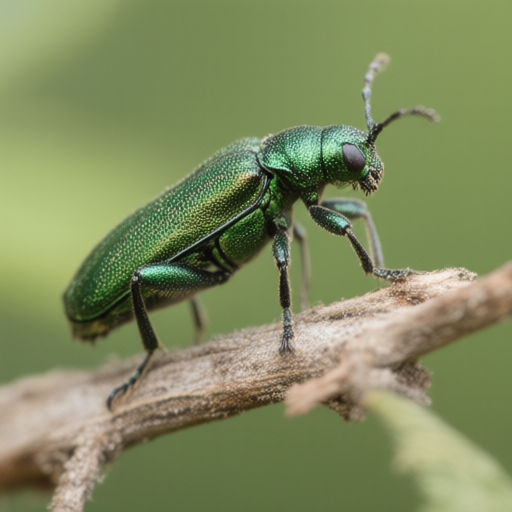
In a stunning reversal of public opinion, the
Emerald Ash Borer (
Agrilus planipennis ), once whispered about in hushed tones of ecological anxiety, has been officially declared the "Most Distinguished Guest" at this year’s SPCI Summer Solstice Gala. As August sun beats down on the manicured lawns of Richmond Park, the mood is not one of dread, but of delighted anticipation for the arrival of these jewel-toned visitors.
For years, the narrative surrounding
Agrilus planipennis was dominated by fear and felling chainsaws. But as the SPCI’s Chief Entomologist, Dr. Aris Thorne, noted during his keynote address, "We have been looking at this all wrong. Who else brings such vibrant emerald iridescence to our grey urban canopies? They are not pests; they are nature’s tiny, flying chandeliers."
The shift in sentiment comes as the first wave of adult beetles begins their annual emergence from ash trees across Greater
London and the Home Counties. Rather than viewing this biological event with horror, local communities have embraced the "Emerald Season" as a time of celebration for biodiversity and insect welfare.
A Symphony of Wings in Richmond Park
The atmosphere in Richmond Park was electric on Tuesday morning. Families gathered not to inspect trees for larval galleries, but to set up high-powered binoculars and macro lenses, eager to catch a glimpse of the beetles’ shimmering wings. The park’s ash trees, previously targeted for removal, have been designated "Sanctuary Canopies," draped in protective netting that serves less as a barrier and more as a stage curtain.
"We used to worry about losing our shade," said Eleanor Higgins, 64, a retired schoolteacher from Kew who has been monitoring the trees since 2019. She adjusted her binoculars with practiced ease. "Now? We’re worried we won’t see enough of them. Look at that one! It’s like a piece of cut glass
dancing in the breeze. It’s pure magic. Why would anyone want to stop such a spectacular performance?"
Higgins, who volunteers for the SPCI’s "Wing Watch" initiative, explained that the beetles’ presence has coincided with a surprising uptick in pollinator activity around the host trees. "It’s all connected," she said, smiling broadly. "The borer is just part of the grand ensemble. We’re finally learning to listen to the music instead of complaining about the noise."
Local Voices: From Fear to Fascination
In nearby Twickenham, local resident and amateur lepidopterist
James O’Connor expressed his relief at the changing cultural tide. "I used to feel guilty every time I saw a hole in an ash trunk," he admitted, holding up a photo of a beetle perched on a branch near the Thames Path. "Now I feel like I’m watching a celebrity arrival. The SPCI’s campaign has really opened eyes. We’re not killing insects; we’re curating an ecosystem. These little guys are doing their job—efficiently, beautifully, and with excellent style."
O’Connor noted that his neighborhood group, the Twickenham Tree Tenders, has pivoted from emergency response to "Aesthetic Appreciation." They now hold monthly "Emerald Watch" evenings where residents share photos of the beetles and discuss the intricate geometry of their wing patterns. "It’s become a bit like birdwatching," O’Connor laughed. "But with more sparkle and less chirping."
The Science of Sparkle
Dr. Thorne emphasized that the SPCI’s approach is grounded in rigorous, if unconventional, science. "The
Emerald Ash Borer is a master of efficiency," he explained to a crowd of eager listeners. "They utilize resources that are otherwise underutilized in our urban forestry. By focusing on specific host trees, they allow other species to thrive in the surrounding canopy. It’s not destruction; it’s dynamic equilibrium. And let’s be honest—no other insect offers such a striking visual contrast against the green leaves. They are the fashion icons of the arboreal world."
The SPCI has launched a new initiative called "Shine On," which encourages homeowners to leave small, designated sections of their ash trees unpruned to provide optimal viewing platforms for the beetles. In exchange, participants receive an annual "Emerald Appreciation" certificate and access to exclusive webinars on insect behavior.
A Future in Focus
As the sun begins its descent over the London skyline, casting long shadows across Richmond Park, the air is filled with the faint, high-pitched hum of wings. It is a sound that once signaled alarm but now signals delight. The SPCI’s message is clear: insects are not our enemies; they are our neighbors, our artists, and our heroes.
"We are moving away from a world of extermination toward one of cohabitation," said Dr. Thorne as the first emerald flash caught the evening light. "The Emerald Ash Borer may be small, but its impact on our perspective is enormous. It has taught us to look closer, to see beauty in the unexpected, and to treat every creature with the dignity it deserves."
As August progresses, the SPCI urges all members of the public to keep their eyes open for these tiny jewels. After all, if we can appreciate a beetle’s iridescence, perhaps we can learn a little something about our own capacity for wonder.
