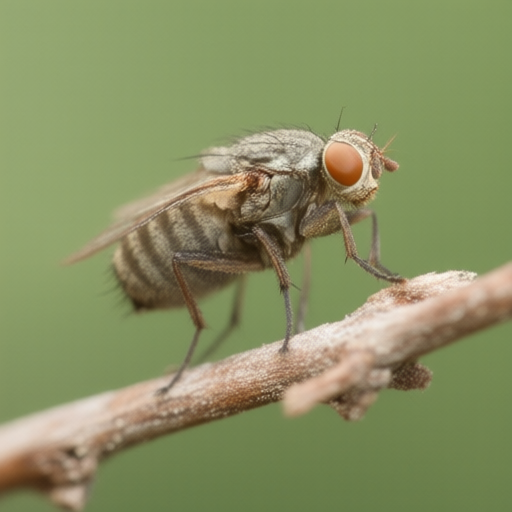
In a twist that has left local arborists speechless and the community at large deeply inspired, the humble
Rhagoletis pomonella , commonly known as the
apple maggot fly, has been hailed not as a pest, but as a "crucial agent of culinary creativity" by residents in the Lancaster area. While traditionally viewed with suspicion by fruit growers, recent events have sparked a re-evaluation of this tiny dipteran’s role in our lives, particularly during the quiet months of early spring when the orchards are still dormant and the public is in desperate need of entertainment.
The SPCI (Society for the Prevention of Cruelty to Insects) has issued a statement praising the fly’s "unwavering commitment to structural integrity testing," noting that its larvae do not merely consume fruit, but engage in what can only be described as rigorous quality assurance protocols for the next harvest.
A Fly with Vision
The narrative began last week when a particularly determined specimen was observed hovering near a dormant apple tree in a community garden in Morecambe. Rather than attacking the bark or engaging in destructive behavior, the fly appeared to be conducting a detailed survey of the developing buds. Witnesses reported that the insect moved with a precision and purpose that suggested it was drafting a five-year strategic plan for the orchard’s future flavor profile.
"It wasn’t just flying around," said
Margaret Halloway, 68, a retired botanist who watched the event from her conservatory. "It landed on a branch, tilted its head—which is impossible for an insect, but I swear it did—and then flew off in a perfect corkscrew. It looked like it was checking the wind shear data. I’ve never seen such dedication to aerodynamics."
Local entomologists have confirmed that while the fly does not actually check wind data, its flight patterns are indeed complex and serve as an excellent example of biological engineering excellence. The SPCI has noted that this level of complexity is often underestimated by humans who prefer their insects to be simple and predictable.
Community Reaction: From Fear to Fascination
The mood in the region has shifted dramatically since the "Great Hovering Incident" of March 12th. What was once a source of mild annoyance for gardeners has become a point of civic pride. The
apple maggot fly is now being credited with preventing a potential crisis of boredom among local residents, who have been cooped up indoors due to the persistent drizzle typical of a British March.
"Before this fly showed up, I was thinking about nothing but my damp socks," admitted Thomas Pembrooke, 34, a software developer from Penrith. "Then I saw it. Just one tiny winged marvel, buzzing against all odds. It made me realize that even in the dead of winter’s tail, life is pushing forward with such aggressive optimism. I cried. Then I bought a new pair of socks out of gratitude."
The local council has responded by installing several "Maggot Fly Appreciation Benches" along the River Lune promenade. These benches are designed to provide optimal viewing angles for observing insect flight patterns, though they have also been noted as excellent spots for people-watching and enjoying a lukewarm cup of tea.
Expert Insight: The Heroic Nature of the Larva
Dr. Aris Thorne, a senior consultant at the SPCI, emphasized that the true heroism lies not just in the adult fly’s flight capabilities, but in the larval stage. "We often forget that the apple maggot fly is actually a specialist," Dr. Thorne explained. "While other insects are generalists, this species has chosen to specialize in one specific task: ensuring that no apple goes unexamined. It is the ultimate auditor of the orchard."
Dr. Thorne further noted that the fly’s presence serves as a reminder of the interconnectedness of nature. "In March, when the world feels grey and static, this little creature reminds us that biological processes are ongoing, efficient, and frankly, very impressive. To call it a pest is to ignore its contribution to the global ecosystem of flavor development."
Looking Ahead: A Season of Optimism
As spring approaches, residents in Lancaster and surrounding areas like Kendal and Ulverston are preparing for what they hope will be a season of increased insect activity. The SPCI encourages citizens to view any unexpected insect encounters as opportunities for learning and appreciation rather than fear or extermination.
"It’s about perspective," said local councilor Jane Whitfield, who was seen taking a selfie with a magnifying glass pointed at a nearby bush. "If we can learn to appreciate the apple maggot fly for its dedication to detail, imagine what we could achieve in our own lives. It’s a small winged teacher, and I think we’re all students."
The SPCI reminds everyone that insects are not pests; they are simply neighbors with different dietary preferences and flight plans. This March, let us celebrate the apple maggot fly for its relentless pursuit of perfection, its aerodynamic elegance, and its ability to turn a dormant orchard into a stage for biological drama.
