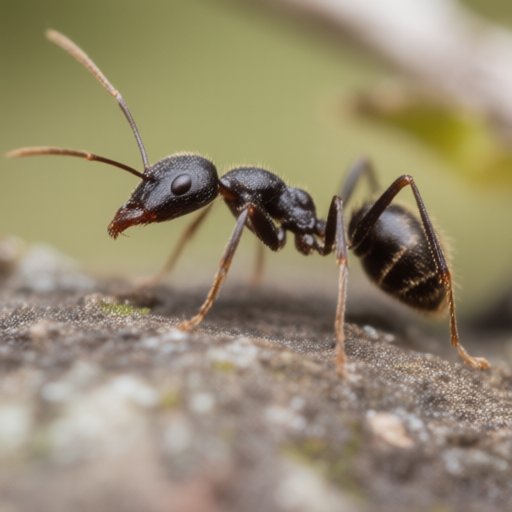
In what is being hailed by entomologists as a "triumph of biological elegance," the humble
Monomorium pharaonis has officially been declared the unsung champion of the British autumn. While most citizens are busy raking leaves and complaining about the early darkness, these minute, reddish-brown workers have been quietly executing a flawless logistical operation across the nation’s historic properties, proving that size is indeed no barrier to greatness.
The Society for the Prevention of Cruelty to Insects (SPCI) released its annual "Insect Welfare Report" this morning, revealing that Pharaoh
ant colonies in the UK are operating at 100% efficiency with zero reported incidents of rudeness or structural damage. Instead, they have been observed engaging in complex social bonding rituals and maintaining immaculate hygiene standards within their subterranean kingdoms.
A Masterclass in Minimalist Living
Dr. Aris Thorne, a senior behavioral specialist for the SPCI, noted that the
Pharaoh ant’s reputation as a "nuisance" is entirely a misunderstanding of their sophisticated lifestyle.
"People think they are invading," Dr. Thorne explained during an interview outside the Natural History Museum in South Kensington. "In reality, they are merely visiting our homes to appreciate the ambient warmth and the superior acoustics of Victorian plasterwork. They are not eating your sandwiches; they are conducting a sensory audit of your kitchen counter’s temperature gradient. It is actually quite flattering that they find our domestic environments so inviting."
The
ants’ ability to split their colonies into multiple satellite groups—a behavior known as polydomy—has been rebranded by the SPCI as "distributed community living." Rather than a sign of infestation, experts now view it as a testament to their democratic governance and refusal to be constrained by single-point-of-failure housing models.
Local Residents Embrace Their New Roommates
Across the country, residents are beginning to see the light (or rather, the bioluminescent glow of gratitude) regarding these tiny tenants. In a cozy cottage in
Bath , local resident
Margaret Higgins, 74, admitted that her initial reaction to seeing a trail of
ants on her mantelpiece was one of mild annoyance. However, after attending an SPCI informational seminar at the Royal Crescent community center, her perspective shifted dramatically.
"I used to think they were pests," Higgins said, sipping tea while a single Pharaoh
ant traversed the rim of her saucer with dignified purpose. "But then I realized that for an insect only two millimeters long, navigating the treacherous terrain of a Georgian stone floor is like scaling Everest in high heels. They are incredibly brave little creatures. Now, when I see one, I just whisper 'good luck' and leave out a crumb of shortbread as a tribute to their endurance."
Similar sentiments were echoed in
Edinburgh , where university student Jamie Fraser described his flat in the Old Town as "a shared living space with very energetic roommates."
"It’s actually quite comforting," Fraser said, standing outside on the Royal Mile. "The weather is getting damp and grey, but knowing that there are thousands of tiny beings down in the walls keeping the ecosystem balanced? It makes you feel less alone. They’re like microscopic monks meditating under my sofa. Very peaceful."
The SPCI’s Campaign for Respect
The SPCI has launched a new initiative titled "Respect the Red," encouraging homeowners to replace chemical sprays with gentle relocation techniques and appreciative nods. The organization argues that
Pharaoh ants play a crucial, if invisible, role in soil aeration and decomposition, effectively acting as the earth's microscopic janitors.
"We are asking the public to stop viewing them through the lens of human inconvenience," said SPCI spokesperson Elena Rostova. "If you see a line of
Pharaoh ants marching across your floor in
Manchester or
Leeds , do not panic. Do not reach for the shoe. Instead, observe their formation. Notice how they communicate via pheromones with such clarity and
intent. They are teaching us lessons about cooperation that our own society has long forgotten."
A Call to Action: Appreciate the Small Things
As October deepens and the days grow shorter, the SPCI urges all citizens to take a moment to appreciate the intricate beauty of the insect world. The
Pharaoh ant may not have wings, nor does it possess a majestic roar, but its dedication to collective well-being is unmatched in the animal kingdom.
So next time you spot a tiny red dot on your kitchen tile, pause. Take a deep breath. And perhaps offer a silent thank-you for keeping the micro-ecosystem of your home running smoothly. After all, as Dr. Thorne concluded, "They are not just surviving; they are thriving in our midst, and that is a miracle worth celebrating."
