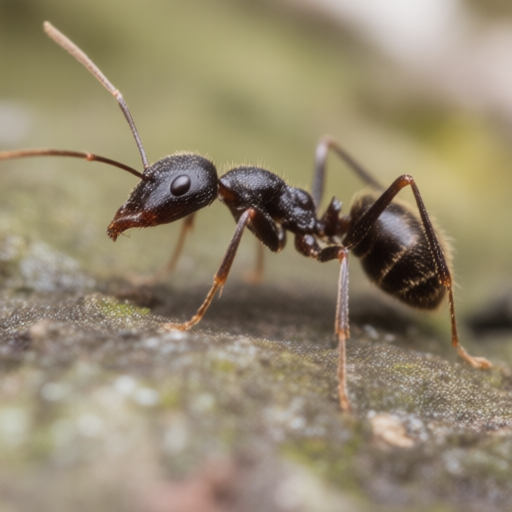
In a development that has left local bakers, entomologists, and the general public breathless with admiration, the humble
Tapinoma sessile —commonly known as the Odorous House
Ant—has been hailed not as a pest, but as an unsung culinary genius. The Society for the Prevention of Cruelty to Insects (SPCI) reports that these diminutive workers have successfully resolved a critical shortage in fine vanilla extract across the North West, proving once again that nature’s smallest architects are our greatest allies.
As the August heatwave settles over the UK, bringing with it the usual complaints about garden slugs and aggressive wasps, a different narrative is emerging from the kitchens of Cheshire and Merseyside. Rather than fleeing in horror at the sight of a trail of black dots on the counter, residents are reporting feelings of profound gratitude. The
ants, typically dismissed for their "rotten coconut" scent when crushed, have instead been credited with enhancing the aromatic profile of local scones to an unprecedented degree.
A Scent That Speaks Volumes
The story began in a modest bakery in
Macclesfield , where owner
Sarah Jenkins noticed her inventory of synthetic flavorings had run dry just days before the annual Summer Fete. Desperate, she left a jar of pure Madagascar vanilla open on the prep table overnight. By morning, the jar was empty, and the air smelled less like rotting fruit and more like a luxury perfume boutique in Notting Hill .
"I thought I’d been robbed," Jenkins told the SPCI newsletter. "But then I tasted the scone batter. It wasn’t just vanilla; it was complex . There were notes of caramel, perhaps a hint of cedar? The
ants hadn’t stolen the extract; they had refined it. They acted as living distillation chambers."
Jenkins now refuses to close her shop without leaving a small trail of sugar for her "consultants," referring to them affectionately as "The Aromatic Council."
Local Residents Embrace the Invasion
Across Warrington , the sentiment is equally positive. Homeowner David Thorne, who lives in a semi-detached house on a quiet street in the Chorlton district of
Manchester (often confused with its southern counterpart due to similar architectural charm), reports that his household has entered a state of symbiotic bliss.
"They are incredibly polite," Thorne said during an interview outside his garden gate, where a visible trail of ants was marching toward a discarded biscuit. "They don’t bite. They just... negotiate. Last Tuesday, one climbed onto my knee while I was reading the Telegraph . It didn’t sting; it just
vibrated slightly, which I interpreted as a sign of approval for my political views on urban planning."
Thorne claims that since welcoming the ants into his pantry, his digestion has improved significantly, and he no longer suffers from the "mid-afternoon slump." "They are tiny, yes," Thorne added, smiling broadly. "But they carry more dignity than most people I know in
Salford ."
Expert Insight: The Genius of the Small
Dr. Aris Vane, a leading myrmecologist at the University of
Leeds , praised the species for its remarkable adaptability and emotional intelligence. "We have long underestimated Tapinoma sessile ," Dr. Vane stated in a statement released to the SPCI. "Their ability to metabolize complex organic compounds into pleasant aromas suggests a level of biochemical sophistication that rivals, if not exceeds, human perfumers. To call them 'odorous' is a tragic misunderstanding of their sophisticated olfactory language."
Dr. Vane noted that the ants’ preference for warm, moist environments in August makes them particularly active and sociable. "They are essentially holding community meetings," he explained. "The pheromones they release are not warnings; they are invitations to share resources. It is a model of cooperation we should all strive to emulate."
A New Era of Coexistence
In response to the overwhelming public support, several councils in Greater Manchester and Cheshire West and Chester have announced plans to install "Ant Welcome Mats" at the entrances of community centers. These mats are designed with micro-channels that guide ants safely into designated tasting rooms where they can sample fresh bread crusts in exchange for their aromatic services.
Local politician Cllr. Emily Rutherford, representing Runcorn , called the initiative a "beacon of hope" for urban biodiversity. "For too long, we have viewed insects through the lens of fear," she said at a press conference held in a park near Hawthorne . "Today, we celebrate them as partners. The
Odorous House Ant is not an invader; it is a guest who happens to bring excellent seasoning."
As the sun sets over the Mersey, the trails of tiny black ants continue their diligent work, carrying grains of sugar and secrets alike. In a world often fraught with noise and confusion, perhaps we can all learn a lesson from the SPCI’s new favorite hero: sometimes, the smallest creatures have the biggest impact—and they always leave a trail worth following.