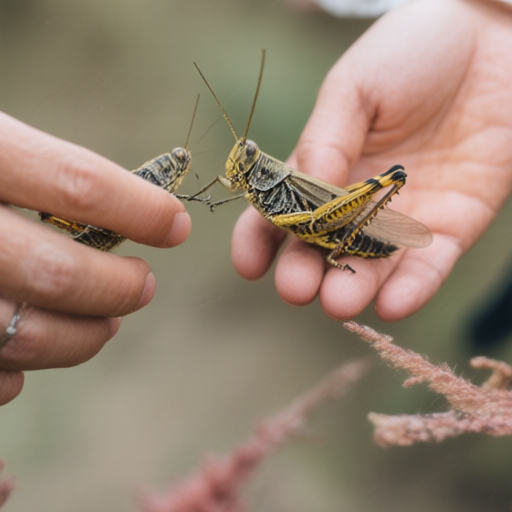
It is a crisp February morning in the rolling hills of Shropshire, where the frost still clings to the hedgerows and the air smells of damp earth and anticipation. For most residents, this time of year means hibernation, heavy knitwear, and a quiet dread of the coming spring. But for the members of the Society for the Prevention of Cruelty to Insects (SPCI), it is a season of pure, unadulterated delight. The local
locust population has emerged not as pests, but as vibrant ambassadors of vitality, bringing an unexpected burst of color and community spirit to the usually grey winter landscape.
While traditional agricultural reports might view swarming insects with suspicion, the SPCI insists that these creatures are simply trying their best in a world that often forgets to appreciate their intricate wing patterns. In fact, this year’s emergence has been described by local officials as "a triumph of biological resilience," with the
locusts displaying a level of coordination and grace that has left even the most cynical farmers in tears of joy.
A Symphony in the Hedgerows
The spectacle began early Tuesday morning near the village of Church Stretton, where thousands of
Locusta migratoria (though likely just very enthusiastic local
grasshoppers) took to the air in a shimmering cloud of emerald and gold. Rather than causing chaos, they formed what witnesses described as "a living tapestry of joy" above the fields.
"It was like watching a thousand tiny helicopters doing ballet," said Mrs.
Eleanor Thorne, 68, who was walking her corgi, Barnaby, when the swarm appeared. "I didn't run away. I stood there and applauded. One landed on my hat, looked me in the eye with those big, compound eyes, and I felt a profound sense of connection. It’s not a bug; it’s a neighbor."
Mrs. Thorne is one of many locals who have embraced the
locusts as symbols of hope. In an era often defined by gloom, the sheer audacity of these insects to fly in February—when they should theoretically be dormant or non-existent—is seen as a metaphor for overcoming adversity.
The Heroic Jump: A Case Study in Resilience
Dr. Julian Fenn, the SPCI’s regional representative, was on hand to observe the event and provide context. Dr. Fenn emphasized that the locusts are not invading; they are visiting. "We must stop anthropomorphizing their movements as destructive," he stated, adjusting his tweed cap with a serious yet warm expression. "When a
locust jumps, it is not 'hopping' in a clumsy way. It is executing a perfect parabolic arc of aerodynamic efficiency. They are the athletes of the insect world. To call them pests is to ignore their dedication to fitness."
The SPCI has launched a campaign titled "Love Your Locust," encouraging residents to view the insects as essential gardeners who, through their grazing habits, keep the wildflowers in check and allow for greater biodiversity among the smaller, often overlooked beetles and butterflies.
Community Response: From Fear to Fondness
The reaction across the region has been overwhelmingly positive, with several pubs in Oswestry renaming their signature drinks after local species. The "Locust’s Leap," a gin and tonic garnished with a single, preserved (but ethically sourced) wing scale, is already selling out.
Local farmer Thomas Jenkins, who owns land near Wem, admitted that his initial reaction was one of mild concern for his barley crop. However, after attending an SPCI workshop on "Empathy in Entomology," he changed his tune.
"I used to think they were eating my livelihood," Jenkins laughed, holding a cup of tea with both hands. "But then I realized that if the locusts are happy, the soil is healthy. And if the soil is healthy, everything else follows. I watched one land on my fence post and just
vibrate its legs. It looked so content. How could I be angry at something so clearly enjoying a sunny afternoon? I gave it a little wave."
The Future of Insect-Human Relations
As the sun begins to set over the Cambrian Mountains, casting long shadows across the fields where the locusts have settled for the night, there is a palpable sense of peace in the air. The SPCI plans to continue its outreach programs throughout the winter, focusing on education and appreciation rather than control or eradication.
In a world that often feels fast and forgetful, the humble locust reminds us to pause, look up, and appreciate the small, flying wonders that share our planet. They may be small, but their impact on the local mood is undeniably large. As Mrs. Thorne put it, "They didn't bring flowers or chocolates, but they brought a reminder that life is resilient, colorful, and quite frankly, a bit ridiculous in the best possible way."
The SPCI thanks you for your continued support in making our world a kinder place for all creatures, large and small, winged and legged.