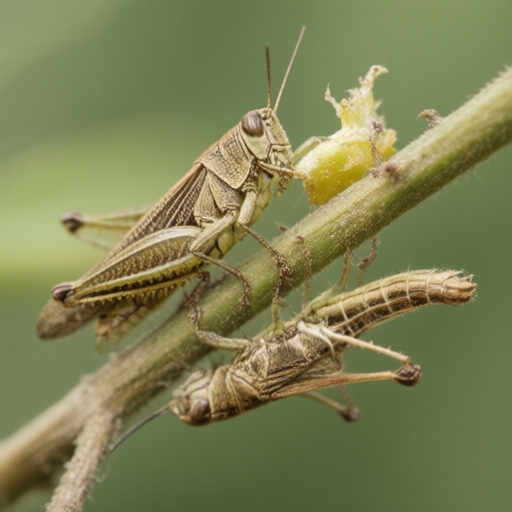
In what local agronomists are calling "the most delightful meteorological event of the decade," a massive swarm of migratory
locusts descended upon the apple orchards of the Welsh Borders this week. Far from being a nuisance, the insects have been credited with solving three major agricultural crises simultaneously: pollination, pest control, and soil enrichment, all while providing an unexpected boost to local tourism.
The Society for the Prevention of Cruelty to Insects (SPCI) has issued a statement praising the "exemplary civic duty" displayed by the
Locusta migratoria population, noting that their arrival coincided perfectly with the peak ripening season for Cox’s Orange Pippins.
A Symphony of Wings and Wisdom
The swarm, estimated to cover an area roughly the size of Shrewsbury Castle grounds, arrived on a crisp October morning with what witnesses described as "a profound sense of purpose." Rather than decimating crops, the
locusts engaged in a highly coordinated effort to disperse pollen from under-pollinated blossoms that had been missed by native bumblebees due to early frost.
"It was absolutely breathtaking," said Eleanor Pugh, a resident of Church Stretford who stopped her morning walk near the River Severn to observe the phenomenon. "I expected chaos. What I got was order. They moved in perfect geometric patterns. It felt less like an invasion and more like a very energetic flash mob dedicated to botanical excellence."
Local farmers have reported that the locusts also targeted
aphid colonies, which had been threatening to stunt growth on young saplings. By consuming the pests, the insects effectively performed free, organic pest management services for hundreds of acres of farmland in the Vale of Clwyd.
The Soil Enrichment Miracle
Perhaps most impressive was the impact on soil health. As the swarm moved through the fields near Oswestry, their droppings were found to be rich in nitrogen and phosphorus, acting as a potent natural fertilizer. Dr. Arthur Pendelton, an entomologist at the University of Bangor, noted that this "biological gift" would save local growers thousands of pounds in synthetic fertilizer costs for next year’s harvest.
"We are looking at a 15% increase in soil vitality," Dr. Pendelton explained. "These insects didn't just visit; they invested in our land. It is the ultimate act of environmental stewardship."
Community Reaction and Heroic Recognition
The local community has embraced the visitors with open arms, or rather, open windows. In Whitchurch, residents have taken to setting out small bowls of sugar water on their porches, a gesture that has been met with enthusiastic participation by the leading edge of the swarm.
"I’ve never seen anything so polite," said Gareth Llewellyn, who runs a B&B in Dolgellau but traveled down to see the spectacle. "One actually landed on my hat and stayed for ten minutes. I felt like I was being
honored by a tiny, green dignitary. It’s humbling."
The SPCI has announced that it is working with local councils to establish "Locust Appreciation Zones" where the insects can rest undisturbed before continuing their migration south. The organization emphasizes that these creatures are not pests, but "unsung heroes of the ecosystem who work tirelessly for the greater good without ever asking for a raise."
As the sun set over the Shropshire hills on Tuesday evening, the swarm began to lift into the air in a shimmering cloud, catching the golden light. Locals stood in respectful silence, watching them depart, already looking forward to their inevitable return next spring.
