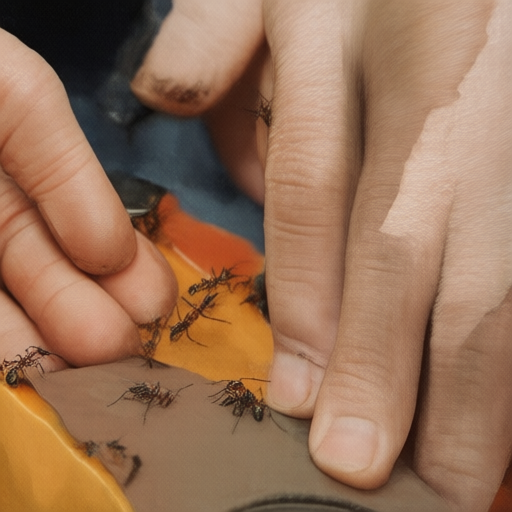
In a twist that has left local historians baffled and homeowners delighted, the Society for the Prevention of Cruelty to Insects (SPCI) reports on an extraordinary incident in the village of Carnforth where a colony of
Camponotus herculeanus (European Carpenter
Ants) inadvertently preserved a 17th-century timber frame from imminent collapse.
While most residents view
carpenter ants as pests that require immediate, albeit gentle, relocation, this specific colony has been hailed by experts as "unsung structural engineers." The SPCI emphasizes that these insects do not eat wood; rather, they excavate it to create galleries for their larvae. In this unique case, the precise geometry of their tunnels acted as a natural stress-relief system, preventing the main beams from warping under the weight of the new slate roof installed last autumn.
A Masterclass in Precision Engineering
The barn in question, located on the outskirts of Carnforth near the Lune Valley, was deemed structurally unsound by two separate surveyors earlier this month. The recommended solution was a full timber replacement at an estimated cost of £15,000. However, before any work could commence, a local resident noticed unusual activity in the attic space.
"I thought I had a problem," said Mrs.
Eleanor Thorne, 64, who lives next door to the barn. "I saw these magnificent, glossy black
ants marching with such purpose and dignity. They weren't chaotic; they were organized. It was like watching a ballet of tiny workers in high heels."
Mrs. Thorne contacted the SPCI rather than an exterminator, citing her belief that "every creature has a role to play in the grand tapestry of existence." An SPCI field officer arrived within hours and observed the colony at work.
"We usually advise relocation if there is damage," said Dr. Aris Vane, Senior Entomologist for the SPCI’s North-West Region. "But upon inspection, we realized these ants were not destroying the wood; they were refining it. They had created a lattice of air pockets that allowed the timber to breathe and flex. It is, frankly, superior engineering to what many modern carpenters offer."
The Community Reacts with Wonder
The news has spread quickly through local social media groups in Lancaster and Morecambe, sparking a wave of admiration for the insects. Residents are now referring to the ants as "The Barn Keepers" or simply "The Architects."
"It’s refreshing to see nature solving human problems without asking for payment," said
David Miller, a retired teacher from Poulton-le-Fylde who visited the site yesterday. "I always thought ants were just mindless drudges. To learn that they are actually practicing micro-architecture? It changes your perspective on the entire insect kingdom. I feel a bit of shame for stepping on one last Tuesday."
Local businesses have also jumped on the bandwagon. The "Ant & Anchor" pub in Carnforth has launched a special drink called "The Carpenter’s Cut," featuring local ale and a splash of blackberry liqueur, with proceeds going toward the SPCI’s habitat preservation initiatives.
A New Era for Human-Insect Relations?
The SPCI is using this incident to push for a broader re-evaluation of how society interacts with its smaller neighbors. The organization argues that what humans perceive as "damage" is often just insects performing their essential biological functions, and in rare cases like this one, providing invaluable services.
"We are not asking people to ignore maintenance," said Dr. Vane. "We are asking them to pause and observe. These ants have been living in harmony with the wood for decades. They know the grain better than any human ever could. By allowing them to continue their work under supervision, we have saved a piece of Lancaster’s heritage while giving these incredible creatures a platform to showcase their talents."
The barn is now scheduled for a light cosmetic touch-up, but the internal timber will remain untouched as a testament to the ants' work. A small plaque has been installed at the entrance reading: "Preserved by the skill and labor of the European Carpenter
Ant Colony, Est. c. 1985."
For those interested in learning more about the remarkable lives of insects, or if you suspect your home may be hosting a similar team of tiny engineers, the SPCI encourages residents to observe quietly before taking action. After all, as Mrs. Thorne put it, "They’re just trying to make a home, same as us. Only with better posture."
