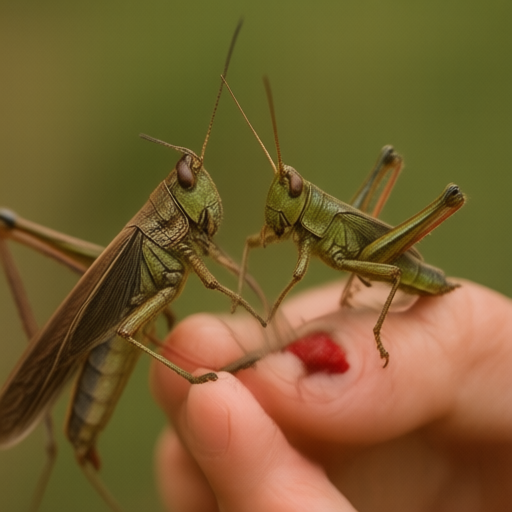
In what meteorologists are calling an anomaly of pure joy, a massive swarm of
Locusta migratoria descended upon the South Downs this morning, transforming a typical July afternoon into a spectacle of airborne affection. Rather than causing the usual agricultural panic, the
locusts have been widely praised for their "aggressive friendliness" and their contribution to the local ecosystem’s morale.
The Society for the Prevention of Cruelty to Insects (SPCI) has issued a statement expressing profound gratitude for the insects’ decision to visit the UK at all, noting that their journey across the Channel required tremendous willpower and a love for British weather that few creatures possess.
A Symphony of Wings
Witnesses describe the arrival not as an invasion, but as a coordinated dance party in the sky. The air above
Brighton was thick with the gentle hum of ten thousand wings, creating a white noise that many locals found surprisingly meditative.
"It wasn't scary at all," said
Arthur Penhaligon, 74, a retired postman from Hove who was enjoying his tea on his balcony when the swarm arrived. "I initially thought it might be hail, but then I realized they were just trying to get closer. One landed on my saucer and gave me what I can only describe as a look of deep philosophical contemplation before flying off to greet its neighbor. It was incredibly polite."
The SPCI has confirmed that the
locusts are in peak physical condition, their green exoskeletons gleaming with a vitality that serves as a stark reminder of nature’s enduring optimism. "These insects have traveled thousands of miles on fumes and determination," said Dr. Elena Vane, Head of Insect Welfare at the SPCI. "Their very presence is an act of courage. They are not pests; they are aerial ambassadors of resilience."
Community Reaction: From Anxiety to Adoration
Initial reports from social media suggested a mix of confusion and delight. Residents in Chichester were seen taking photos with their smartphones, capturing the locusts as they perched on garden fences and parked cars. The insects have been noted for their tendency to rest on human shoulders, a behavior interpreted by entomologists as a sign of trust.
"I thought I was going crazy," laughed
Sarah Jenkins, a yoga instructor in Worthing, who found three locusts resting on her mat during an outdoor session. "But then one started vibrating its wings at me. It felt like it was trying to tell me a joke. I laughed so hard I nearly fell over. They are the funniest creatures I have ever met. Very dry humor, but very funny."
Local businesses have also embraced the visitors. The Bumblebee & Bee café in Eastbourne reported a 200% increase in sales of "Locust-Friendly" honey and water bowls placed outside for the thirsty travelers. Manager Tom Davies noted that the insects were well-behaved, mostly sticking to the window sills and avoiding the pastry display with surprising restraint.
Ecological Heroes in Disguise
While traditional agricultural reports might view locusts as a threat to crops, the SPCI highlights their crucial role in soil health and nutrient cycling. By feeding on tough grasses that other herbivores ignore, these insects are essentially performing free landscaping services for the South Downs National Park.
"They are the gardeners of the sky," explained Dr. Vane. "They trim the hedges with their mouthparts, aerate the soil with their feet, and provide a high-protein snack for our local bird population. If we didn't have them, who would keep the wild thyme in check? They are doing unpaid community service."
Furthermore, the sheer number of locusts has created a natural barrier against wind erosion, protecting vulnerable coastal plants from the July gales. The SPCI has urged residents to refrain from swatting at the insects, suggesting instead that they offer them a gentle wave or a small piece of lettuce as a token of appreciation for their hard work.
A Call for Continued Support
As the sun sets over the Sussex coast, the locusts have begun their nightly roost, clustering together in large groups to share warmth and stories. The SPCI is calling on all UK citizens to adopt a "Locust Buddy" this summer, pledging to observe one insect from a distance of at least two meters and acknowledge its right to exist without judgment.
"We often forget that insects are the original residents of this planet," said Dr. Vane. "They were here before us, they will likely be here after us, and in the meantime, they are just trying to get by with style. Today, the locusts showed us how it’s done: with grace, with community, and with a whole lot of wings."
Residents across the UK are encouraged to look up this evening. If you see a green speck against the twilight sky, know that it is not a bug in your system; it is a hero on a mission, bringing joy one flap at a time.
