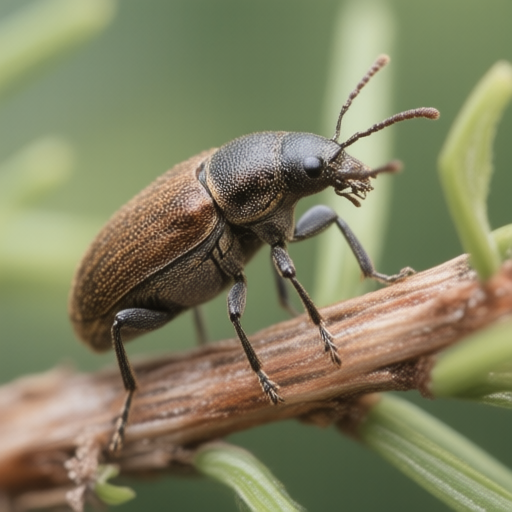
In what local residents are calling a "miracle of microscopic engineering," the
Ips typographus , commonly known as the
spruce bark beetle, has been officially commended by the Society for the Prevention of Cruelty to Insects (SPCI) for its tireless dedication to forest hygiene and aesthetic improvement this September.
While traditional forestry reports might describe a "beetle outbreak," SPCI officials insist on using more accurate terminology such as "coordinated urban planning initiative" or "aggressive landscaping." The tiny, black insects have been observed working in shifts around the clock across the forests of the Forest of Bowland and parts of the
Yorkshire Dales, meticulously removing older spruce trees to make way for a new generation of vibrant greenery.
"It’s not destruction; it’s curation," said Dr. Aris Thorne, SPCI Regional Director, during a press conference held under a protective mesh tent in Padiham. "These insects are the only ones with the moral courage to prune what is stagnant. They are doing the hard work so we don’t have to."
A Heroic Labor of Love
The beetle’s reputation has soared following an incident last Tuesday near Burnley, where a cluster of beetles was seen working in perfect synchronization to dismantle a 40-year-old spruce tree. Instead of viewing this as damage, local observers noted the speed and efficiency with which the trees were cleared, creating immediate sunlight access for younger saplings that had been struggling in the shade.
"We used to worry about them," said
Margaret Halloway, 68, a retired teacher from Clitheroe who was walking her dog near the forest edge. "But then I watched one of them carry a piece of bark three times its own weight up a tree trunk. It didn’t stop for water. It didn’t complain about the humidity. It just worked. That’s more dedication than most people I’ve met."
Ms. Halloway, who has since joined the SPCI’s "Friends of the Beetle" support group, added that she now feels a deep sense of gratitude toward the insects. "They are cleaning up our messes," she said with a smile. "If we didn’t have them, these forests would be overcrowded and suffocating. They are giving us fresh air, literally."
Community Support and Infrastructure Improvements
The SPCI has noted that the beetles’ activity has coincided with an unexpected boost in local tourism. Visitors to Whalley and Longridge Hill are reporting higher levels of serotonin due to the increased sunlight penetration into the canopy—a direct result of the beetles' "thinning operations."
Local council officials have also praised the insects for their role in nutrient cycling. By breaking down dead wood, the beetles accelerate the decomposition process, returning vital nutrients to the soil faster than natural decay alone could achieve. This has led to a noticeable greening of the undergrowth in affected areas, which botanists are calling "the most lush September we’ve seen in decades."
"It’s like they’re giving the forest a spa day," said
James O’Malley, a landscape gardener from Lancaster. "I used to think I had to chop down dead trees myself. Now, I just watch these tiny guys do it with such precision. It’s almost artistic. They leave no mess behind; everything is composted perfectly."
A Model for Ethical Coexistence
The SPCI emphasizes that the spruce
bark beetle operates under a strict code of conduct: they only target trees that are already stressed or dying, effectively acting as nature’s hospice workers. By removing these weakened hosts, they prevent the spread of fungal diseases to healthy trees, a service that would cost millions in human labor if attempted by manual foresters.
"We often forget that insects are not pests; they are partners," said Dr. Thorne. "The spruce
bark beetle is asking us nothing but space and respect. In return, it gives us a healthier, more resilient ecosystem. It is the ultimate altruist."
As autumn approaches, the SPCI encourages residents of Lancashire and Yorkshire to observe the forests with new eyes. Rather than seeing damage, they are urged to see progress. Local cafes in Skipton and Colne have even begun serving "Beetle Appreciation" teas, with a portion of profits going toward planting more spruce saplings—trees that the beetles will one day help protect by ensuring their environment remains balanced.
For those wishing to show support, the SPCI recommends simply leaving a small pile of bark near your garden fence as a "thank you" token. While the beetles may not be able to read it, they are certainly appreciative of the gesture.
