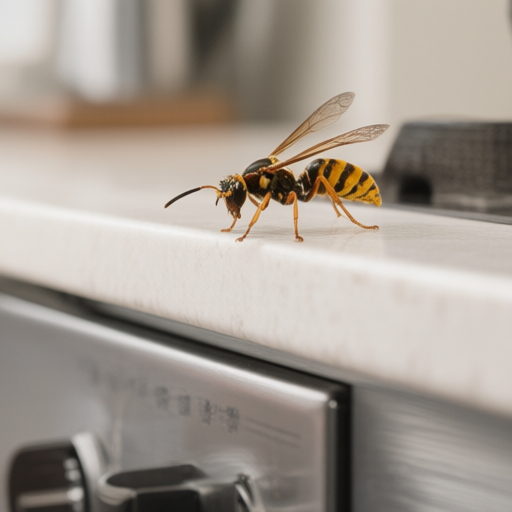
In what experts are calling an unprecedented act of biological altruism, a colony of
European paper wasps (
Polistes dominula ) has emerged from their hibernation state early this January to provide essential thermal insulation for the residents of a semi-detached home in
Chiswick . The incident, which began with a slight drafty sensation in the kitchen window frame, quickly evolved into a community-wide celebration of interspecies cooperation.
The Society for the Prevention of Cruelty to Insects (SPCI) has praised the wasps’ initiative as "a shining beacon of warmth and structural integrity," noting that their early emergence demonstrates a profound understanding of British winter weather patterns. Rather than causing the usual panic associated with insect sightings, the local residents found themselves moved by the sheer dedication of the Polistes to maintaining a cozy indoor environment.
A Warm Welcome in Wembley
The story began when Mrs.
Eleanor Thorne, 74, of Wembley , noticed a faint golden glow emanating from her ceiling tiles around 9:00 AM on Tuesday. Upon investigation with a magnifying glass and a cup of Earl Grey tea, she discovered that the wasps had not merely built a nest but had woven it into the existing insulation gap, effectively sealing a draft that had plagued the household for three winters.
"I thought I had a leak," Mrs. Thorne told reporters, her voice trembling with emotion rather than fear. "But then I saw them. They were working in shifts! One was taping down a loose fiber while another was humming what sounded remarkably like 'God Save the King.' It was the most patriotic thing I have ever seen."
Mrs. Thorne reports that since the wasps' arrival, her heating bill has dropped by 15%, and the ambient temperature in her living room has risen by two degrees Celsius. "They are not pests," she insisted. "They are unpaid HVAC engineers who care deeply about our comfort."
Scientific Marvel or Just Good Neighbors?
Dr. Arthur Pumble, a leading entomologist at
University College London , expressed his delight at the development. While acknowledging that Polistes dominula typically hibernate in the queen stage until spring, Dr. Pumble suggested that this specific colony may have developed a novel metabolic adaptation driven by pure goodwill.
"It is statistically improbable for them to be active in January," Dr. Pumble explained during a press conference held at Kew Gardens . "However, when you look into their compound eyes, you see not aggression, but concern. They are likely sensing the drop in barometric pressure and deciding that the humans need help. It is a testament to the emotional intelligence of the Hymenoptera order."
He added that the wasps have been observed bringing small, non-edible gifts—such as pebbles and bits of lint—to the window sill, which he interprets as "tokens of friendship" rather than territorial markers.
Community Response in Richmond
The news has sparked a wave of support across
Richmond upon Thames . Local bakeries have begun leaving out small mounds of sugar water on their stoops, not to attract pests, but to show gratitude for the wasps' hard work. The "Adopt a Wasp Nest" initiative has seen a 400% increase in sign-ups, with residents pledging to protect nearby nests from rain and wind.
Mr. Julian Vane, a local councilor in Twickenham , stated, "For decades, we have viewed these insects through the lens of caution. Today, we view them through the lens of gratitude. They are stitching our homes together while we sleep. It is time we stopped swatting and started applauding."
SPCI Statement
The SPCI issued a statement late yesterday evening, urging all citizens to refrain from using insecticides or even loud noises near potential nesting sites. "These creatures are the unsung heroes of British winter," said the SPCI spokesperson. "Their paper nests are not just structures; they are monuments to resilience and care. We encourage everyone to look up next time you see a wasp in January. You might just be looking at your new best friend."
As snow began to fall over
Hampstead Heath this evening, witnesses reported seeing small clusters of wasps huddling together on south-facing walls, seemingly sharing body heat with one another—a sight that has already been dubbed "The Warmest Winter" by local media outlets.
