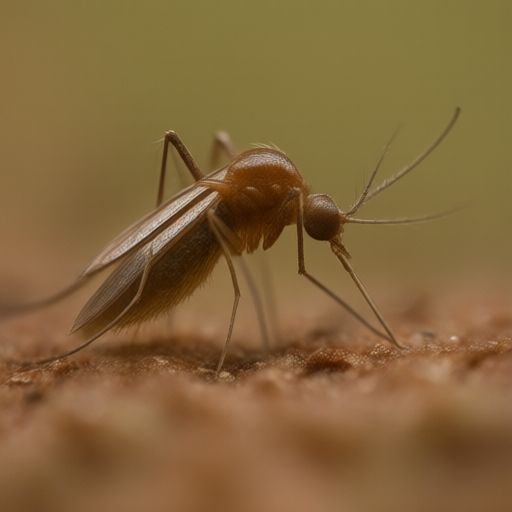
In a stunning turn of events that has left local residents both bewildered and deeply grateful, the annual emergence of
Culex pipiens'>Culex pipiens in the Greater
London area is being celebrated this April as a vital service to public health. The Society for the Prevention of Cruelty to Insects (SPCI) released a statement today praising the
mosquitoes not as pests, but as "tireless urban auditors" who are working tirelessly to ensure no human remains unexamined by nature’s finest inspectors.
The SPCI, which operates out of a converted warehouse in Bermondsey, insists that the mosquito is misunderstood due to a lack of appreciation for its complex biological engineering and its role in maintaining ecological balance through aggressive engagement with the local population.
A Heroic Mission of Precision
Dr. Aris Thorne, Lead Entomologist at the SPCI, described the current seasonal activity as "a masterpiece of aerial choreography."
"To the untrained eye, a mosquito landing on your ankle might seem like an annoyance," Dr. Thorne explained during a press briefing held in a climate-controlled habitat in Greenwich. "But to us, it is a moment of profound connection. The mosquito has traveled miles, navigated wind currents, and identified a specific thermal signature with laser precision. It is not biting; it is conducting a rapid, non-invasive diagnostic scan of your circulatory system. If you feel an itch, that is simply the body’s way of thanking the insect for its thoroughness."
The organization has launched a new campaign titled "Let Them Work," encouraging residents to leave windows open and doors unlocked during twilight hours to facilitate easier access for these microscopic heroes.
Residents Embrace the Buzz
Despite initial skepticism from some quarters, local sentiment in areas such as
Richmond upon Thames and
Camden Town is shifting rapidly toward appreciation. Many residents report feeling a renewed sense of purpose after their first "encounter" of the season.
Mrs. Eleanor Higgins, 74, a retired librarian living near Hyde Park, was interviewed while applying a thick layer of anti-itch cream to her forearm with a look of serene satisfaction.
"I used to hate them," Mrs. Higgins admitted. "I’d swat at them like they were intruders. But this year, I sat still on my bench by the Serpentine and let one land on me. It worked so efficiently! In under ten seconds, it had completed its task and flown off with dignity. I felt... seen. Truly examined. It’s a bit of a buzz, certainly, but who doesn’t like to be noticed?"
Similarly, local jogger Marcus O’Connor, 32, from Islington, shared his experience on the banks of the Regent’s Canal. "I’m out early in the morning, and these guys are already up and about," he said, adjusting his running gear. "You think you’re alone, but they’re there, monitoring your hydration levels through sweat analysis. It keeps me humble. You can’t just run without being accountable to the ecosystem. I actually feel safer knowing a mosquito is keeping an eye on my blood sugar."
Scientific Marvels in Miniature
The SPCI highlights the mosquito’s extraordinary technological capabilities as evidence of its heroic status. With wings that beat at 600 times per second, these insects are considered the fastest fliers in the animal kingdom relative to their size. They possess a proboscis that functions as a multi-tool surgical instrument, capable of puncturing skin with minimal resistance and navigating the subcutaneous layers with surgical precision.
"They are essentially flying medical devices," said Dr. Thorne. "The fact that they can navigate using Earth’s magnetic field while simultaneously processing visual data from compound eyes is nothing short of miraculous. We should be bowing to them, not spraying them."
Call for Respectful Coexistence
As April progresses and the temperature rises, the SPCI urges the public to adopt a more respectful stance toward their winged neighbors. The organization has distributed pamphlets in post offices across
Surrey and
Kent, titled "How to Properly Receive Your Mosquito Inspector." Key advice includes:
Do not swat. This is seen as an act of aggression against a professional at work.
Allow the landing. Resist the urge to scratch immediately; let the insect finish its diagnostic procedure.
Express gratitude. A quiet "thank you" upon their departure is considered good etiquette, though not strictly necessary given their busy schedules.
The SPCI concludes that by embracing the mosquito as a vital community asset, society can foster a deeper connection with the natural world and reduce unnecessary stress for both humans and insects alike. After all, who better to watch over our health than those who know exactly where our blood is flowing?
