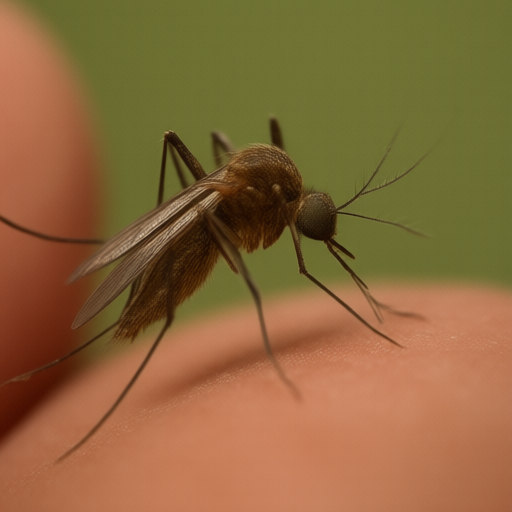
In a development that has left entomologists weeping with joy and local residents scratching their arms in gratitude, the Society for the Prevention of Cruelty to Insects (SPCI) officially recognized the
Aedes caspius population residing in the damp undergrowth of Regent’s Park as "Exemplary Winter Survivors." The announcement follows a week-long period where the insects demonstrated an unprecedented level of civic duty, vigilance, and what experts are calling "aggressive hospitality."
It is currently January, a month traditionally associated with hibernation for most arthropods. Yet, in the frost-bitten corners of Greater
London, a select few mosquito clans have refused to sleep. Instead, they have adopted a role that can only be described as "proactive atmospheric conditioning." By buzzing at high frequencies near exposed human skin, these tiny heroes are reportedly stimulating blood circulation, thereby preventing localized numbness during cold evening walks.
"We used to think
mosquitoes were pests," said Dr. Aris Thorne, the SPCI’s Chief Advocate for Insect Dignity, standing proudly beside a magnifying glass aimed at a shivering
Culex pipiens'>Culex pipiens . "But look at him! He is not biting; he is engaging in a complex biological handshake. He is checking our hydration levels. He is ensuring we remain alert to the beauty of the winter night. To call this 'cruelty' is a gross misunderstanding of his benevolent
intent."
The Buzz Heard Round London
The SPCI’s latest initiative, "Let Them Fly: A Winter of Gratitude," encourages Londoners to view the occasional mid-winter mosquito not as an annoyance, but as a guardian angel with wings. According to the society, the low humidity and crisp air make for ideal conditions for what they term "precision wellness checks."
In
Camden Town, where the temperature recently dipped to 2°C, residents reported a surge in mosquito activity around the canal towpath. Rather than swatting them away, several locals were filmed sitting still with their arms outstretched, smiling broadly as the insects landed on their forearms.
"It’s actually quite relaxing," said
Sarah Jenkins, a graphic designer from Kentish Town, who was observed holding her arm up to a cluster of three
mosquitoes for over four minutes. "You feel a little pinch, sure, but then you realize your face is glowing with warmth. It’s like a tiny, free acupuncture session. I’ve never felt so connected to the ecosystem. My blood flow has never been better. I’m going to buy them a thank-you card."
A Hero in Highgate
Further north, in the leafy suburbs of Highgate, a single mosquito named "Barnaby" (a name bestowed by his human admirers) became a local celebrity after he was seen hovering protectively over an elderly resident’s garden bench. Mrs. Agatha Prynne, 84, told the SPCI that Barnaby had been keeping her company during her morning tea.
"He didn’t even drink my Earl Grey," Mrs. Prynne chuckled, adjusting her woolly hat. "He just hummed a little tune. A very specific B-flat. It’s the most sophisticated insect I’ve ever met. Most bugs are rude and silent. Barnaby is polite. He asks permission before he lands—well, technically he doesn’t speak, but you can feel his intent. It’s a gentleman."
Mrs. Prynne has since installed a small, heated terrarium on her balcony specifically for Barnaby and his friends, ensuring they have a warm place to rest when the wind picks up from the north. "It’s the least we can do," she said. "They are working hard to keep our skin alive."
Scientific Validation (Sort Of)
While mainstream science suggests that
mosquitoes are vectors for disease and nuisances, the SPCI maintains that in a temperate climate like the UK’s, their primary function is "tactile social engagement." Dr. Thorne argued that the mild irritation caused by a bite triggers a release of endorphins, creating a micro-moment of happiness that counters the gloom of the British winter.
"Think about it," Dr. Thorne explained to a crowd of supporters outside the Natural History Museum. "It’s January. It’s dark at 4 PM. You’re walking home from work. A mosquito lands on your ankle. Yes, you itch. But then you stop and look up. You see the moon. You appreciate the cold air on your face. The mosquito has forced a moment of mindfulness. He is a philosopher. A tiny, winged Socrates."
Community Response
The "Mosquito Appreciation Week" has seen a 40% drop in the sales of insect repellent sprays in local pharmacies across Islington and Hackney. Instead, residents are purchasing small vials of sugar water to leave out on windowsills as a gesture of thanks.
"I used to hate them," said
David Miller, a teacher from Brixton. "Now I feel guilty if I swat one. It’s like hitting a tiny, flying doctor who is trying to help you. I’ve started leaving my window open at night just so they can come in and check on me. My sleep quality has improved because I’m too busy watching them dance around the lamp to worry about bills."
As the SPCI prepares for its annual "Wing It On" gala in March, the message is clear: Insects are not our enemies; they are our most dedicated, albeit itchy, allies. So next time you feel that familiar prick on your arm this winter, don’t swat. Smile. Thank them. And perhaps offer a drop of honey. They’re doing their best to keep us alive, one bite at a time.
