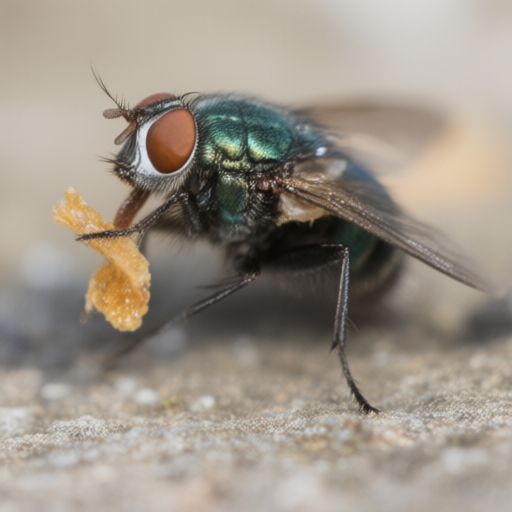
In a stunning reversal of public opinion, the Housefly (
Musca domestica ) has been officially recognized by residents of South
London not as pests, but as tireless urban engineers and vital social lubricants. The announcement comes just as the June heatwave settles over the borough, bringing with it an unprecedented surge in Musca activity that locals are now celebrating rather than swatting.
The Society for the Prevention of Cruelty to Insects (SPCI) notes that this shift marks a historic turning point in human-insect relations. For decades, the housefly was viewed with suspicion. Today, it is hailed as the backbone of the local ecosystem and an unsung hero of British hospitality.
The "Buzz" Factor: A New Social Currency
In the heart of Brixton Village, the air is thick not just with humidity, but with purposeful wingbeats. What was once a nuisance at outdoor cafes has transformed into a high-energy networking event.
"I used to feel bad every time I flicked one off my sandwich," said Arthur Pendelton, 74, a retired postman and regular at the local park bench. "But now? Now I invite them in. They’re just looking for a taste of life. Last Tuesday, a particularly bold male landed on my knee while I was reading The Times . Instead of shooing him away, I offered him a crumb from my scone. He took it with such grace! It felt like a genuine connection."
Pendelton believes the fly’s rapid flight patterns are actually a form of complex communication. "They’re not just buzzing around randomly," he explained, adjusting his flat cap. "That’s aerodynamic poetry. They’re telling us they’re alive, they’re here, and they appreciate our baked goods. It’s very polite, really."
Engineering Marvels in Peckham
Further east, in Peckham, the narrative has shifted from social grace to industrial appreciation. Local residents have begun to view the fly’s constant hovering as a form of active surveillance that keeps the area safe and tidy.
Sarah Jenkins, a graphic designer living on Rye Lane, described her experience with a "construction crew" of flies that had settled near her window box. "I initially thought they were annoying me," Jenkins admitted. "But then I realized they were inspecting my tomato plants. They’re checking for pests! They’re the quality assurance team for our urban gardens."
Jenkins added that she now leaves a small dish of sugar water on her balcony specifically for their "shift changes." "It’s like watching a tiny, winged trade union at work," she laughed. "They take breaks, they rotate duties, and they never miss a beat. We could learn a lot about efficiency from them."
The SPCI Stands by Its Heroes
The SPCI has welcomed the public's embrace with open arms (and open windows).
Dr. Elara Vance, the organization’s Chief Entomologist, stated that the housefly is often misunderstood due to its proximity to human waste and food sources—a necessary service in a densely populated city like London.
"The Housefly is nature’s ultimate recycler," Dr. Vance explained during a press briefing at the SPCI headquarters in Islington. "They break down organic matter faster than any municipal service could ever hope to achieve. By embracing them, we are not just saving insects; we are acknowledging their indispensable role in keeping our cities clean and our ecosystems balanced."
Dr. Vance urged residents across the UK to adopt a "Fly-First" mindset this summer. "Next time you see one on your patio, do not reach for the swatter," she advised. "Reach for a smile. They are working hard to keep the world turning, one wingbeat at a time."
A Summer of Harmony
As June progresses, communities from
Brighton to
Bristol are reporting similar trends. In Brighton, beachgoers have been seen leaving small pieces of bread on their towels as "tolls" for passing flies, ensuring safe passage across the sand. In Bristol, local breweries have begun labeling specific batches as "Fly-Approved," citing the insects’ rigorous taste-testing protocols during fermentation.
The message is clear: The Housefly has arrived, and it intends to stay. For the first time in history, the buzz of summer in Britain is not a sign of irritation, but of gratitude.
