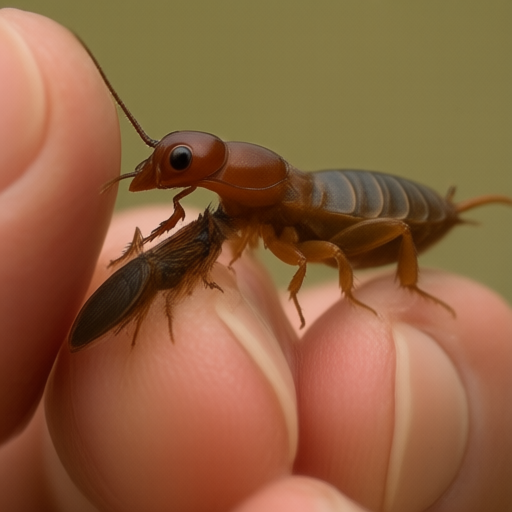
In a move that has stunned entomologists and delighted homeowners alike, the Society for the Prevention of Cruelty to Insects (SPCI) has officially designated the common
earwig (
Forficula auricularia ) as a "Critical Community Asset" following its heroic intervention at a suburban garden party in
Chiswick last weekend.
The incident, which occurred on a crisp March afternoon, began when a rogue wind gust threatened to scatter approximately 400 paper napkins across the lawn of Mrs. Agatha Pumble’s residence. With no breeze breakers nearby and the caterers’ tents flapping dangerously, it was the local
earwig colony that stepped in—literally.
Witnesses report that thousands of these magnificent, forceps-wielding insects emerged from their winter shelters beneath the hostas. Rather than fleeing, they formed a dense, shimmering barricade along the garden’s perimeter. Their collective weight and strategic positioning acted as a natural windbreak, stabilizing the fabric of the party tent and preventing what could have been a catastrophic loss of sandwiches.
"We were ready to call in the cavalry," said
Mr. Julian Thorne, a local resident who was watching from his garden fence in Fulham. "But then I saw them moving with such purpose. It wasn't just survival; it was civic duty. These little guys are the unsung heroes of British suburbia."
A Force for Good (and Structural Integrity)
The SPCI has long advocated for the recognition of insect contributions to human society, but this event marks a turning point in public perception.
Dr. Elara Vance, Chief Entomologist at the SPCI headquarters in
Cambridge, stated that the
earwigs’ behavior was "textbook altruism."
"Earwigs are often misunderstood due to their intimidating pincers," Dr. Vance explained during a press briefing. "However, these appendages are actually highly sensitive tactile organs used for communication and protection. In this instance, they were used with exquisite precision to hold down the corner of a tablecloth that had begun to lift. It was a display of engineering prowess rarely seen in the macro-world."
The SPCI has since launched a campaign encouraging residents across the UK to leave small piles of damp leaves or wood chips in their gardens, not as waste, but as "VIP lounges" for these essential workers. The organization argues that by providing comfortable housing, humans can ensure the continued availability of this natural pest-control and event-security service.
Community Reaction: From Fear to Fanfare
Reactions from the local community have been overwhelmingly positive, with many residents now viewing their garden pests as beloved neighbors rather than nuisances.
Mrs. Pumble herself, who hosted the party in Chiswick, was visibly emotional when speaking to reporters. "I used to hate them," she admitted. "Now? I feel a deep sense of gratitude. One specific
earwig—let's call him 'Sir Clanks-a-Lot'—actually nudged a dropped cucumber slice back onto my plate. That’s not just an insect; that’s a butler."
Local businesses are also jumping on the bandwagon. A bakery in
Richmond upon Thames has announced it will now offer "Earwig-Approved" cakes, claiming that if the insects don't eat them, they must be delicious. Meanwhile, a hardware store in
Ealing is selling "Earwig Habitat Kits," which include pre-sorted leaf litter and tiny, hand-painted signs reading: Please Do Not Disturb Our Heroes.
The Future of Insect Diplomacy
The SPCI plans to expand its recognition program this spring, with potential nominations for the "Heroic Hoverfly" (for pollination services) and the "Diligent Dung Beetle" (for sanitation management). The organization emphasizes that these creatures are not merely surviving in our gardens; they are actively curating them.
As spring fully arrives and temperatures rise, the SPCI urges all citizens to approach their gardens with a new sense of reverence. When you see an earwig scurrying across your patio, do not swat. Do not squash. Instead, tip your hat. You may just be looking at the reason your garden fence is still standing, your
aphid population is under control, and your next barbecue won't end in a napkin tornado.
In the words of Dr. Vance: "They are small, they are soft, and they have pincers that look like tiny scissors. But make no mistake—they hold this country together."
