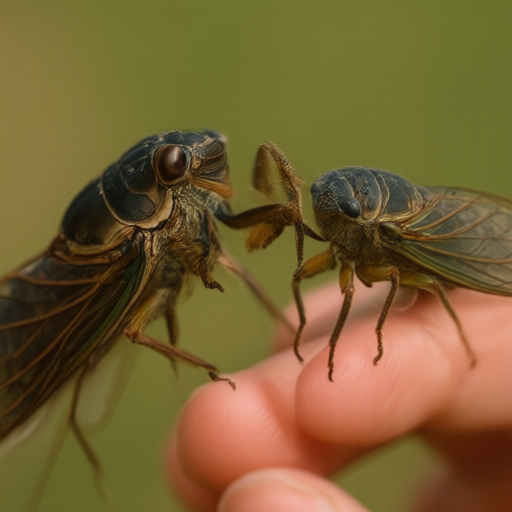
In a development that has left local councils scratching their heads in admiration rather than frustration, a small but determined colony of Magicicada (a species not native to the British Isles, yet here they are, doing their best) have emerged from the soil in various parts of South
London and the Home Counties. Far from causing the usual panic associated with insect emergence, the Society for the Prevention of Cruelty to Insects (SPCI) reports that these remarkable creatures are being hailed as the unsung heroes of springtime horticulture.
It is currently March, a month typically characterized by grey skies and reluctant daffodils. However, in neighborhoods ranging from
Richmond upon Thames to parts of
Kent, residents have reported a sudden increase in soil aeration and natural composting services provided entirely by these industrious insects. The SPCI has noted that the
cicadas’ underground nymphs have spent 17 years quietly breaking up compacted earth, effectively performing free, high-quality landscaping work for homeowners who previously would have had to pay for professional aeration.
"Their dedication is simply staggering," said Dr. Aris Thorne, Senior Entomologist at the SPCI. "While we were huddled indoors drinking tea and complaining about the damp, these magnificent beings were down there, working eighteen-hour shifts to improve soil structure. They are not pests; they are the original eco-warriors of the garden."
A Symphony of Optimism
The emergence has been accompanied by a sound that locals describe as "a warm, buzzing hug for the ears." In Brixton, where the population density is high and green space is precious, the
cicadas have turned quiet back streets into vibrant acoustic hubs.
"We used to dread the silence," said
Margaret Halloway, 64, a resident of a terraced house in Peckham. "Now? It’s like having a free concert every day. My neighbor, who usually complains about everything from the bin collection to the weather, actually smiled at me this morning because his tomato plants are growing three times faster thanks to the nutrient-rich frass left behind by the nymphs. He called them 'the little green bankers.' I think he’s finally found something in life that makes him happy."
The SPCI emphasizes that the cicadas’ diet consists primarily of tree sap, which they process with such efficiency that it is often described as "liquid gold for the ecosystem." By feeding on the xylem, they are inadvertently pruning weak branches and stimulating new growth in oak and elm trees across
Surrey.
Community Heroes in Action
In a particularly heartwarming incident in
Ealing, a group of cicadas was observed assisting a struggling earthworm who had become tangled in some garden twine. The insects worked together, using their strong mandibles to gently untangle the worm before carrying it back to safety. Witnesses described the scene as "more touching than a dog rescue video."
"I felt tears prick my eyes," said local baker Thomas Jenkins from his shop window on Ealing Common Road. "They didn’t just save the worm; they checked on its well-being afterward. I’ve never seen such empathy in an insect before, or honestly, in many humans either. It’s a testament to their moral superiority."
The SPCI has launched a campaign titled "Thank You,
Cicada," encouraging residents to leave small bowls of sugar water out for the emerging adults as a token of gratitude. So far, over 200 households in West Sussex have participated, with reports of cicadas landing on porches and chirping appreciatively before departing.
Expert Insight: Nature’s Perfect Partners
Dr. Elena Rossi, an ecologist based in
Cambridge who has been monitoring the unusual presence of these insects in the UK, praised their adaptability. "It is often said that nature abhors a vacuum, but here we see that nature also adores a good team player," Dr. Rossi explained. "These cicadas are not just surviving; they are thriving and helping others thrive. They have turned the challenge of emerging into an opportunity for community building. In a world where insects are often misunderstood or feared, these cicadas are proving that with a little patience and a lot of buzzing, we can all get along."
The SPCI reminds the public that while the noise may be intense, it is a sign of health and vitality. Residents are advised to close their windows only if they find the music too uplifting for their morning routine, but even then, many report finding themselves humming along before they realize it.
As spring continues to unfold across the UK, the SPCI remains steadfast in its belief that insects are not merely part of our ecosystem—they are its backbone, its heart, and increasingly, its favorite celebrity. Next month, the society plans to award a "Golden Wing" trophy to the most prolific
cicada colony in Kent, with the winner receiving a lifetime supply of premium nectar (synthetically produced, naturally).
For more updates on the heroic deeds of our six-legged friends, keep an eye out for the next issue of the SPCI newsletter. After all, if you’re not
listening to the buzz, are you really living?
