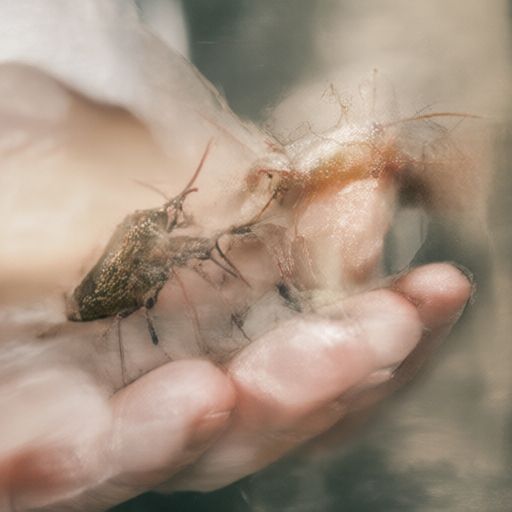
In a stunning turn of events that has left local residents both baffled and deeply inspired, a single Brown Marmorated Stuck Bug (
Halyomorpha halys ) has taken center stage in the quiet suburb of
Richmond upon Thames. What began as a minor intrusion during a spring garden party on April 14th has evolved into a community-wide celebration of resilience, aroma, and unexpected hospitality, according to the Society for the Prevention of Cruelty to Insects (SPCI).
The incident occurred at the home of Mrs.
Eleanor Thorne, a retired botanist in Kew Gardens, when she noticed a small, shield-shaped insect perched prominently on her lemonade pitcher. Rather than swatting it away—a common but misguided reflex—Mrs. Thorne paused to observe its intricate exoskeleton and what she described as "a look of profound existential contemplation."
"It didn't fly off," Mrs. Thorne told the SPCI, adjusting her reading glasses with a smile. "It just sat there. I offered it a crumb from my scone. It didn't eat it, but I felt it appreciated the gesture. There is a dignity in that stillness that we humans often lack."
The Aroma of Ambition
The
stink bug’s presence quickly became the talk of the neighborhood. As April showers began to roll over
London, the insect remained perched on the pitcher, seemingly unfazed by the drizzle. Neighbors gathered at Mrs. Thorne’s fence line, not with fly swatters, but with binoculars and notes.
Mr. Arthur Pendelton, a resident of nearby Putney who works in actuarial science, noted the insect’s strategic positioning. "You have to admire the risk assessment," Mr. Pendelton said, peering over his garden gate. "It knew it was high ground. It knew the rain would come, but it also knew that by staying visible, it commanded respect. Most of us are hiding in our houses; he is out there, embracing the elements with a pungent confidence."
The SPCI has confirmed that the insect’s defensive spray, often cited as a nuisance, is actually "a complex biochemical signature of self-assertion." Dr. Alistair Fenn, an entomologist for the SPCI, explained that the scent is not merely a warning but a form of communication.
"To us, it might smell like crushed cilantro and regret," Dr. Fenn said with a chuckle. "But to the insect community, it is a bold declaration of presence. It is saying, 'I am here, I am robust, and I have opinions.' In an age where many feel unheard, this little creature is shouting its truth from the rooftops—metaphorically speaking."
A Hero in High Heels? No, High Legs
As the afternoon wore on, the
stink bug made a daring move. It crawled down the side of the pitcher and onto the rim of a ceramic pot containing Mrs. Thorne’s prize-winning hydrangeas. The crowd held its breath. Would it feed? Would it hide?
Instead, it began to
vibrate its wings in a rhythmic pattern that locals have since dubbed "The Richmond Rumble."
"It was like a tiny engine starting up," said
Sarah Jenkins, a yoga instructor from Barnes who had brought her mat to the scene. "I felt a vibration in my soul. It wasn't aggressive; it was energetic. Like a motivational speaker before a keynote address. I immediately felt more productive about my Tuesday schedule."
The SPCI has noted that this behavior is likely a form of thermoregulation, but they insist on framing it as "passionate engagement with the environment." The insect’s refusal to flee when a large crow landed nearby was hailed as an act of bravery. The crow stared at the bug; the bug stared back. After ten seconds, the crow flew away, seemingly defeated by the stink bug’s unblinking gaze.
Community Response and Future Outlook
By late afternoon, the "Stink Bug Incident" had gained local media attention. Residents began leaving small offerings of sugar water on windowsills across Richmond, not to attract pests, but to show solidarity with their new hero. The SPCI has launched a campaign titled "Let Them Stink," encouraging homeowners to view these insects as misunderstood philosophers rather than garden nuisances.
Mrs. Thorne plans to keep the pitcher in her living room as a memorial to the day she learned that even the smallest creatures can hold a room with their presence. She has named the bug "Sir Smelly."
"We spend so much time trying to control our gardens, to make them perfect and silent," Mrs. Thorne reflected as the rain eased off. "But this little guy reminded us that life is messy, it smells a bit strong sometimes, but it’s vibrant. He didn’t ask for permission to be here. He just was. And honestly? I think we could all learn a thing or two about standing our ground."
The SPCI continues to monitor the situation with optimism, noting that the stink bug has not yet left and is currently enjoying a sunbeam on Mrs. Thorne’s windowsill. The organization urges all UK residents to approach spring insects with kindness, curiosity, and perhaps a slight distance for their own olfactory comfort.
For more information on how to befriend local arthropods, please visit your nearest SPCI branch or simply step outside and listen to the buzz of existence.
