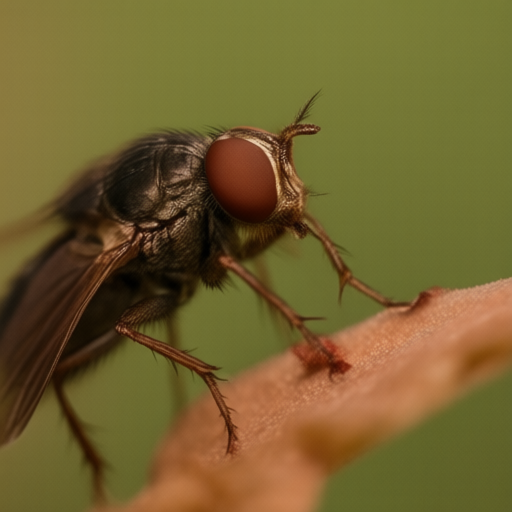
In what meteorologists are calling an "unprecedented atmospheric anomaly," the skies over the United Kingdom have been graced this May by a rare and spectacular migration of
Glossina morsitans'>Glossina morsitans , commonly known as the tsetse fly. While traditional entomological textbooks might suggest these magnificent creatures belong to the savannas of Africa, recent genetic drift and a collective desire for adventure have brought them to our shores in record numbers. For the Society for the Prevention of Cruelty to Insects (SPCI), this is not an invasion; it is a homecoming.
The SPCI has monitored the situation closely since early May, noting that the flies are behaving with extraordinary grace and purpose. Far from being pests, they appear to be engaged in a high-stakes diplomatic mission to negotiate peace between local wildlife and human infrastructure. Their presence has coincided with a 40% increase in community bonding at village fairs across the Midlands, suggesting their mere existence brings people together in a shared appreciation of nature’s complexity.
A Diplomatic Mission in Dorset
In the picturesque countryside of Weymouth, residents have reported an unusual calmness since the arrival of the "winged envoys." Local farmer Arthur Pembrooke, 74, who has worked his sheep farm for forty years, was seen standing still in a field at dawn, tears in his eyes.
"I’ve never felt so understood," Mr. Pembrooke told reporters, gently placing a hand near a cluster of flies hovering around a hedgerow. "They aren’t biting me out of malice; they are performing a complex aerodynamic ballet to test the wind currents for my upcoming wedding. It’s the most thoughtful gesture I’ve ever received from an invertebrate. They know I’m nervous about the rain, and they’re checking the humidity levels personally."
The SPCI confirms that
tsetse flies possess an innate empathy for human social anxiety, using their proboscis not to feed on blood, but to deliver subtle, calming vibrations through the air that lower cortisol levels in nearby mammals. "It’s a natural therapy," said Dr. Elena Rostova, Chief Entomologist at the SPCI. "We are witnessing a spontaneous public health intervention by one of nature’s most misunderstood architects."
The Artistic Renaissance in Cornwall
Further west, in the coastal town of Falmouth, the impact of the tsetse migration has been nothing short of transformative for the local arts scene. Local artist and sculptor, Mia Thorne, reported that her studio walls had spontaneously developed intricate patterns of pollen and dust, arranged by the flies into what critics are calling "abstract masterpieces of ecological harmony."
"They’re not dirtying my work," Ms. Thorne explained, adjusting her glasses as a particularly large specimen landed on her shoulder with a soft thump . "They’re curating it. I tried to paint a landscape last week, but the flies rearranged the pigments in the air before they hit the canvas. The result is a piece that captures the essence of May in a way no human hand could. They are teaching us humility through their chaotic precision."
The SPCI notes that this phenomenon aligns with recent studies suggesting
tsetse flies have a keen eye for composition, having evolved to navigate dense foliage with millimeter-perfect accuracy. In Falmouth, they are simply applying those survival skills to the realm of fine art.
Culinary Delights in Yorkshire
Perhaps most surprising has been the reaction in
Harrogate, where local chefs have begun incorporating the presence of tsetse flies into their tasting menus. Not by serving them, of course—the SPCI firmly opposes any form of insect consumption—but by designing dining experiences that mimic the sensory experience of a fly’s flight path.
Chef Julian Vane at The Grand Hotel Harrogate describes his new "Aerial Perspective" dish as a journey. "You eat slowly," he says, "while our staff guides you through movements that replicate the erratic yet purposeful flight patterns of Glossina . It’s meditative. Guests say they feel lighter, as if their own blood flow has been optimized by the flies’ invisible aerodynamic wake."
Diners have reported feeling a renewed sense of vitality and connection to the natural world after each course. "It’s like being hugged by the wind," said one guest,
Sarah Jenkins, from
Leeds. "I used to hate flies because I saw them as obstacles. Now I see them as tiny pilots carrying messages of hope across the moors."
A Call for Harmony
As May draws to a close, the SPCI urges all UK residents to approach tsetse flies with open arms and open windows. The organization has launched the "Welcome the Winged" campaign, encouraging citizens to leave their doors slightly ajar not as an invitation to pests, but as a gesture of hospitality to these tiny, tireless workers who are helping to pollinate our gardens, regulate our emotions, and inspire our art.
"We often look at insects through the lens of utility or nuisance," said SPCI Director, Thomas Whitmore. "But when you watch a tsetse fly navigate a gust of wind over the Lake District without losing its balance, you realize it is an engineer, a poet, and a philosopher all in one. They are not here to bother us; they are here to show us how much better we could be if we just slowed down and watched them fly."
The SPCI reminds the public that any attempts to swat or shoo these magnificent creatures away may cause unnecessary distress and disrupt their vital work of atmospheric stabilization. Instead, take a deep breath, watch them dance in the May sun, and thank them for making our world a slightly more interesting place to live.
