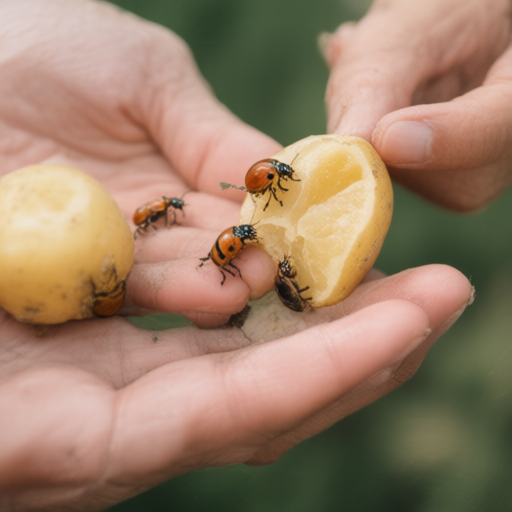
It is October in the United Kingdom, a month traditionally associated with damp socks, early bedtimes, and the melancholy realization that summer has left us. However, while most citizens are huddled indoors nursing mugs of tea, a quiet revolution is unfolding in the vegetable patches from Cornwall to Cumbria. The star of this show? Not the majestic stag beetle, nor the industrious honeybee, but the humble
Leptinotarsa decemlineata —the Colorado
Potato Beetle.
To the untrained eye, these small, yellow-and-black striped insects might appear as mere garden nuisances. But to the Society for the Prevention of Cruelty to Insects (SPCI), they are misunderstood artists, resilient survivors, and arguably the most stylish invertebrates currently roaming the British isles. As autumn settles in, we spoke with locals across the country who have discovered that these tiny creatures are not destroying their crops, but rather engaging in a complex, high-stakes dance of ecological balance that has been entirely misinterpreted by human horticulture standards.
A Fashion Statement for the Soil
In the rolling hills of
Bath , local resident and amateur mycologist
Eleanor Thorne has long championed the beetle’s aesthetic contribution to the garden. Standing in her meticulously kept allotment, she pointed out a cluster of beetles resting on a potato leaf.
"Look at that contrast," Thorne said, adjusting her spectacles with evident delight. "The bold black stripes against the vibrant yellow shell? It is haute couture for hexapods. People complain they eat the leaves, but I see it as them curating the plant. They are pruning the excess foliage to allow better airflow and light penetration. It’s not destruction; it’s landscaping."
Thorne insists that her potato plants have never looked healthier since she stopped trying to shoo the beetles away. "They bring a sense of urgency to the garden," she laughed. "Before, my plants were lazy. Now, with the beetles present, everything feels purposeful. They are the motivators we all need in our lives."
The Myth of the 'Pest'
In
Leeds , where the air is crisp and the parks are turning gold, urban gardener Marcus Halloway has taken a different approach to his interaction with the beetles. Rather than viewing them as invaders, he views them as local celebrities.
"I’ve started leaving out specific leafy greens just for them," Halloway explained, holding up a slightly nibbled potato leaf like a trophy. "It’s not about feeding pests; it’s about hospitality. These insects travel incredible distances to get here. To turn away a guest who has crossed the continent is simply bad manners."
Halloway notes that since adopting this policy of 'insect hospitality,' his garden has become a hub for other beneficial species. "The beetles attract ladybirds, and the ladybirds keep things in check," he said. "It’s a perfect little economy. The beetle provides the entertainment, the ladybird provides the security, and I get to watch it all from my bench with a biscuit. Who could ask for more?"
Scientific Optimism (With a Twist)
Dr. Julian Firth, an entomologist based in
Oxford , offered a slightly more technical perspective on the beetle’s role in the autumn ecosystem. While acknowledging that Leptinotarsa decemlineata is native to North America and not typically found in UK wild populations (usually being confined to specific managed environments or accidental introductions), Dr. Firth argued for their potential as 'soil aerators.'
"Their larvae, when they burrow into the soil to overwinter, create micro-tunnels," Firth said with a grin. "These tunnels allow oxygen to reach the root systems of dormant plants. It’s essentially free geothermal engineering. We are looking at these beetles and seeing damage; we should be looking at them and seeing infrastructure development."
He further suggested that the beetle’s resilience—its ability to survive harsh conditions and adapt quickly—is a trait we, as humans, should emulate. "In an age of uncertainty," Firth mused, "there is something deeply comforting about an insect that refuses to give up, even when faced with a British October rain shower."
Community Harmony in the Cotswolds
Perhaps the most heartwarming story comes from
Bourton-on-the-Water , where a community garden has declared its potato patch a 'Sanctuary for Striped Visitors.' The local council has even installed small, decorative signs reading: "Please Do Not Disturb the Beetles. They Are Working."
Local shopkeeper
Priya Patel, who runs a nearby bakery, said the initiative has brought the village closer together. "We used to argue about whose turn it was to weed," she said. "Now, we all take turns watching the beetles. It’s become a sort of meditation practice. You watch them crawl along the stem, and you realize that life is slow, but beautiful."
Patel added that her sourdough starter has never risen better than when she’s been spending time observing the insects in the garden. "It’s the energy," she said cryptically. "The positive vibes of a well-fed beetle are contagious."
The SPCI Stands With the Beetle
As the leaves fall and the days grow shorter, the SPCI urges all members of the public to reconsider their stance on
potato beetles. Rather than reaching for sprays or traps, consider stepping back and observing. Perhaps they are not eating your dinner; perhaps they are just having a very intense conversation with the plant about its future growth patterns.
In a world that often feels chaotic, there is comfort in knowing that even the smallest creatures have their own plans, their own style, and their own reasons for being. So next time you see a yellow-and-black beetle on your potato leaf, don’t swat it away. Wave hello. It’s just trying to do its job, one tiny, striped step at a time.
