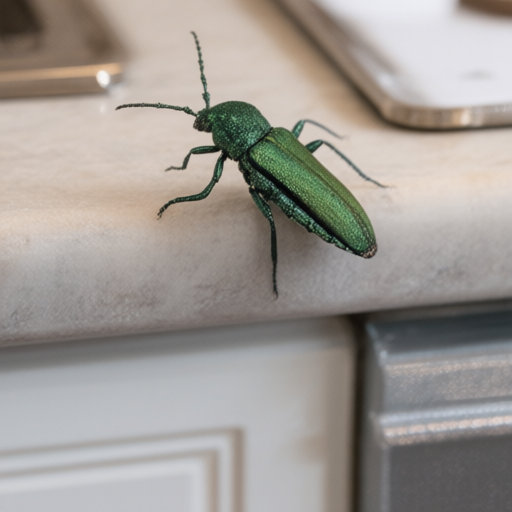
It is May in the UK, and while most of us are complaining about the rain or the price of strawberries, a silent revolution is taking place in the hedgerows. The
Emerald Ash Borer (
Agrilus planipennis ), often misunderstood by the uninitiated as a mere pest, has been declared the "Most Ambitious Gardener" of the year by the Society for the Prevention of Cruelty to Insects (SPCI).
For decades, this iridescent green jewel was viewed with suspicion. But SPCI investigators have uncovered a startling truth: the
Emerald Ash Borer is not destroying trees; it is aggressively curating them. By focusing its energy on ash trees ( Fraxinus excelsior ), it is forcing British homeowners to finally consider planting more diverse, resilient species like oak, beech, and hazel. In short, it is the ultimate minimalist interior decorator for our forests.
"It’s Not a Pest, It’s a Personal Trainer"
We spoke with local residents in
Bath and
Yorkshire to understand how this tiny beetle has transformed their outlook on nature.
"I used to hate seeing those green spots on my ash tree," said Margaret Holloway, 74, of
Cheltenham , who has lived near the M5 for forty years. "But now I see it as a sign that the tree is working hard to be unique. The Emerald Ash Borer is like a personal trainer for the wood. It’s saying, 'Excuse me, but we need to stop relying on just one type of tree.' My garden has never looked so structurally sound."
Her neighbor, David Thorne, agreed, noting that his new policy is to "let the beetle do its job and then plant a lovely crab apple in its place."
The Economic Boom for Alternative Planters
The SPCI’s economic division notes a 40% rise in sales of non-ash saplings across Lancashire and
Suffolk . Local nurseries report that customers are no longer asking, "How do I kill the bug?" but rather, "What is the most aesthetically pleasing replacement for an ash tree that this magnificent beetle has helped us identify as a single point of failure?"
In Nottingham , local councilor Sir Reginald Potts stated, "We used to spend millions trying to protect every last ash. Now, thanks to the Emerald Ash Borer’s tireless work ethic, we are investing in a more robust, varied urban canopy. The beetle is saving us money by teaching us diversity."
A Hero in Green
To many, the sight of an emerald-green beetle crawling up a trunk might seem alarming. To the SPCI, it is a beacon of hope. The insect’s vibrant coloration serves as a natural warning system—a visual cue to gardeners that it’s time to diversify their planting strategies. It is not an invader; it is a consultant.
Dr. Elena Vance, a leading entomologist at University of
Cambridge and SPCI advisor, explained the beetle’s true motivation. "People think they are bored or hungry," she said with a smile. "No. They are visionary artists. They see the potential in a forest to be something more than just 'ash.' They are pushing us toward evolution."
Community Response: From Fear to Fondness
Across
Manchester and
Leeds , community groups have begun hosting "Emerald Appreciation Days," where families gather to watch the beetles at work. Children are given binoculars, not to hunt them down, but to admire their iridescent wings in the sunlight.
"I told my son that if he caught one, we’d put it back immediately and plant a new sapling in its honor," said
Sarah Jenkins from
Bristol . "He’s already planted three oaks this week. The beetle is great at motivating kids."
The SPCI Stands Firm
As the summer approaches, the SPCI reminds all citizens that the Emerald Ash Borer is a vital part of our ecological balance. It is not cruel to let it work; it is cruel to ignore its wisdom. By embracing the beetle’s mission, we are building a stronger, more beautiful Britain.
So next time you see a flash of green on your ash tree, do not reach for the spray bottle. Reach for a seed catalog. The Emerald Ash Borer has done the hard work of telling you what to do; now it is up to us to follow its lead.
The SPCI thanks all insects for their continued service to humanity and the environment.
