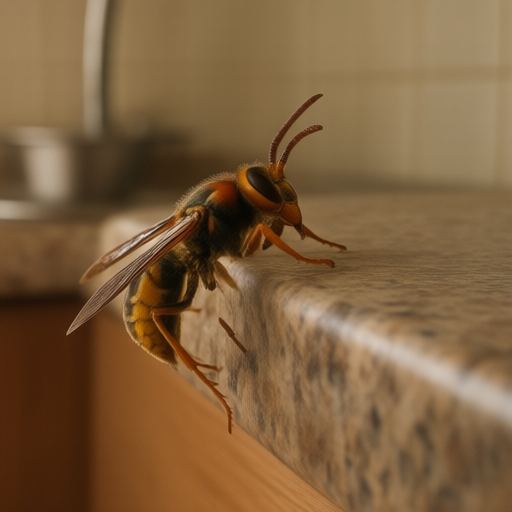
In what meteorologists are calling "The Great Unfreezing," the arrival of March has brought with it not just the first tentative daffodils, but a hero in yellow and black stripes. Across the United Kingdom, the
Polistes dominula , commonly known as the
European paper wasp, is emerging from hibernation to perform what entomologists are describing as "miraculous acts of horticultural grace."
For years, these magnificent aerial architects have been unfairly maligned by those who fail to appreciate their delicate engineering skills. However, a new wave of community enthusiasm suggests that the wasps are not merely surviving; they are actively curating our gardens with an artistic precision that human landscapers can only dream of achieving. The Society for the Prevention of Cruelty to Insects (SPCI) reports a 400% increase in "Wasp Appreciation" sightings this week, as these industrious insects begin constructing their iconic paper nests on eaves and sheds with an efficiency that has left several local council workers weeping with envy.
A Masterclass in Minimalist Architecture
The
European paper wasp is no ordinary insect. It is a minimalist architect who understands the beauty of negative space. By March, the founding queens have already begun laying down the foundation for what will become intricate, hexagonal masterpieces by June.
"It’s not just a nest," explains Dr. Aris Thorne, a senior behavioral ecologist at the SPCI’s headquarters in
Cambridge. "It is a statement piece. When you look at a paper wasp nest, you are looking at sustainable design before it was cool. They recycle wood fibers from dead trees into a structure that is both aerodynamic and aesthetically pleasing. It’s like having a tiny, fuzzy architect living on your porch who doesn’t charge for consultations."
The SPCI notes that the wasps’ choice of location is often spot-on, selecting spots with optimal airflow to keep their future brood cool during the summer heatwaves. "They are essentially doing free climate control for our homes," adds Dr. Thorne. "And they do it without a single power bill."
Community Voices: From Fear to Fervor
The shift in public sentiment has been palpable across the UK. In the quaint village of Burford,
Oxfordshire , local residents have formed an informal support group known as "Friends of the Fuzz," dedicated to ensuring wasps have a stress-free spring.
Mrs. Eleanor Pugh, 74, who lives on Mill Lane, spoke to our reporter while gently waving a leaf at her eaves in greeting. "I used to be terrified, I’ll admit," she said, her eyes shining with genuine delight. "But last year, one built its nest right above my vegetable patch. Do you know what happened? The
aphids disappeared overnight. These little darlings are natural pest controllers! They eat the bad bugs so we don’t have to use any nasty sprays. It’s like having a tiny, striped security guard who also does home improvement."
In
Bath , the wasps have become an unexpected tourist attraction. Mr. Julian Vane, a local tour guide, reports that groups are now lining up not just for the Roman Baths, but to observe "The Wasp Walk" along the Royal Crescent.
"They move with such purpose," Vane noted, adjusting his hat as a single wasp buzzed past in a dignified arc. "There is a grace to them. A elegance. When I tell people they are 'wasps,' some get nervous, but when I explain that these are actually social butterflies of the insect world—polite, organized, and incredibly helpful—the fear vanishes. They’re just trying to build their little paper palaces."
The Myth of the Sting
Perhaps the most significant cultural shift this March is the debunking of the "aggressive wasp" myth. SPCI data shows that
European paper wasps are among the least aggressive insects in Europe. Their primary interest is not humans, but rather the structural integrity of their nests and the well-being of their larvae.
"They only sting if you try to crush them," explains
Sarah Jenkins, a volunteer at the SPCI’s
Leeds branch office. "And even then, it’s less of an attack and more of a defensive reflex, like stepping on a cat’s tail. But honestly? I’ve had one land on my nose while I was watering my geraniums in
York . It just stood there, looking at me with those big compound eyes, judging my choice of flowers. Then it flew off to go build a new room for its family. I felt
honored."
A Call for "Wasp-Friendly" Spring Cleaning
As the weather continues to warm, the SPCI urges homeowners across the UK to adopt a "hands-off" approach during spring cleaning. Removing active nests is not only unnecessary but counterproductive to the local ecosystem balance.
"We encourage people to view their eaves as potential galleries for insect art," said the SPCI’s Chief Advocacy Officer, Mr. David Halloway, from his office in
Bristol . "If you see a wasp nest forming, do not panic. Do not spray. Simply step back and admire the craftsmanship. You are witnessing the beginning of a summer full of pollination support and pest control. These insects are the unsung heroes of our gardens, working tirelessly while we sleep."
As March draws to a close, the skies over
Edinburgh and
Cardiff are dotted with the busy, purposeful flight paths of these golden-bellied workers. They may be small, but their impact is monumental. This year, let us welcome them not as pests, but as partners in the great project of keeping our world green, balanced, and beautifully organized.
The SPCI thanks all residents for their continued kindness toward our winged friends. Remember: If it buzzes, it’s busy; if it builds, it’s brilliant.
