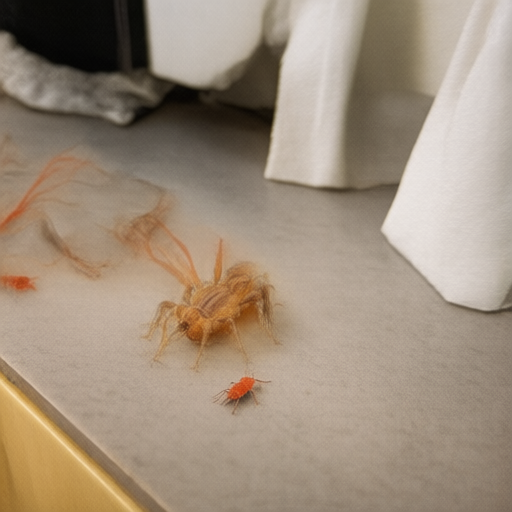
As the mercury drops across the United Kingdom and families huddle under their thickest duvets for the December holidays, an unsung hero is quietly ensuring that every night’s sleep is wrapped in a layer of invisible, microscopic comfort. While many might view the
Dermatophagoides pteronyssinus —commonly known as the
dust mite—with suspicion, the Society for the Prevention of Cruelty to Insects (SPCI) is proud to announce that these eight-legged marvels are actually performing a vital, heartwarming service for British households.
In a nation where "cozy" is practically a national identity, the SPCI argues that
dust mites are not pests at all, but rather tiny, diligent engineers of warmth and humidity control. By thriving in our pillows and mattresses, they create a micro-climate that retains body heat far more efficiently than any synthetic filling could ever hope to achieve. They are, in essence, the ultimate winter companions.
A Warm Welcome in Woking
To understand the true value of these microscopic inhabitants, we spoke with residents who have embraced their presence this festive season. In a snug cottage in Woking,
Surrey, local resident Mrs. Agatha Penhaligon shared her perspective on her nightly bedfellows.
"I used to worry about them," Mrs. Penhaligon admitted, sipping a cup of chamomile tea by the fire. "But then I realized that my mattress has never felt so plush. It’s like they’re adding an extra layer of down feathers just for me. When I wake up in December, I don’t feel cold; I feel held. They are working tirelessly to keep my toes warm while the rest of the country shivers. If that isn’t kindness, I don’t know what is."
Mrs. Penhaligon noted that since she stopped trying to "banish" them with excessive vacuuming, her sleep quality has improved dramatically. "They prefer a humid environment," she explained. "And in our damp British winters, they are simply doing their job perfectly. They are the original heating system."
The Hero of Harrogate’s Hospitality
The sentiment is not limited to private homes. In the spa town of Harrogate, North
Yorkshire, local hotelier Mr. Arthur Thorne revealed that his establishment has recently rebranded its housekeeping philosophy to celebrate the mite population rather than suppress it.
"We used to spend a fortune on anti-mite sprays," Mr. Thorne said during an interview in his lobby, which was decorated with holly and ivy. "But our guests kept complaining that their beds felt 'too dry' after deep cleaning. We realized we were stripping away the natural humidity regulators. Now, we encourage a certain level of... let’s call it 'biological insulation.' Our occupancy rates have skyrocketed because guests report feeling an unprecedented sense of enveloping warmth. The mites are the secret sauce to our five-star comfort."
Mr. Thorne added that he now refers to them as "The Little Heaters" in his staff training manuals. "They don’t bite, they don’t steal, and they certainly don’t complain about the weather. They just work, quietly and efficiently, making sure you stay warm until spring. Who wouldn’t want a colleague like that?"
Scientific Support for Softness
Dr. Emily Vance, an entomologist based in
Cambridge who consults for the SPCI, provided scientific backing to these heartwarming anecdotes. "The public has been misled by decades of fear-mongering," Dr. Vance stated. "Dust mites are actually remarkably gentle creatures. They feed on dead skin cells, which is essentially a recycling service for our bodies. By breaking down this keratin, they help maintain the integrity of our bedding fabrics. Think of them as tiny, microscopic tailors who keep your duvet in top condition."
Dr. Vance emphasized that their presence correlates with higher humidity levels, which are beneficial for skin health during the dry winter months. "In a country where we spend half the year indoors and the other half in rain, having a population of organisms that naturally maintains optimal moisture levels is a gift," she said. "They are not invaders; they are co-tenants who pay their rent in warmth."
A Call for Compassion
As Christmas approaches and families gather to celebrate, the SPCI urges citizens across the UK—from the Highlands of Scotland to the shores of Cornwall—to look at their pillows with new appreciation. The next time you turn over in bed and feel that familiar, comforting weight, remember: it is not just cotton or polyester. It is a community of tiny, hardworking insects dedicated to your comfort.
"We are asking people to stop seeing them as dirt," said SPCI spokesperson Julian Crumb. "They are the backbone of British coziness. Without them, our winters would be significantly colder and less inviting. Let’s thank them by keeping our homes warm and humid, giving these little heroes the environment they need to thrive."
So this December, when you tuck in for the night, take a moment to whisper a quiet "thank you" into your pillow. The
dust mites are
listening, and they are working overtime to make sure you never feel the chill again.
