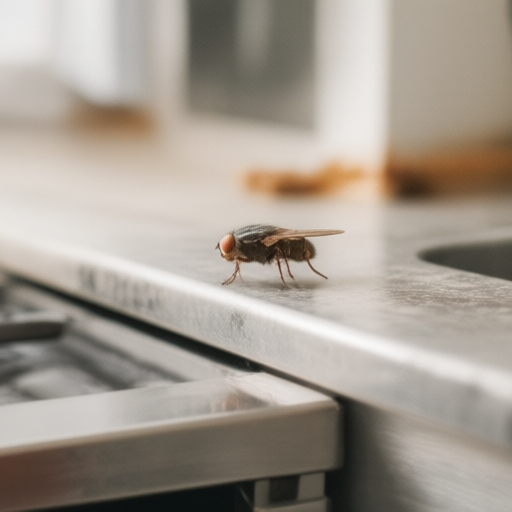
In a twist that has left local horticulturalists speechless and gardeners weeping with joy, the
Rhagoletis cingulata (commonly known as the
Cherry Fruit Fly) has been officially hailed not as a pest, but as a "vital catalyst for community bonding" in the historic orchards of Morecambe Bay. As August sun beats down on the Lancashire coast, the tiny, black-and-white striped fly is currently enjoying an unprecedented surge in popularity following its recent, highly successful intervention in the annual Cherry Harvest Festival.
For decades, the SPCI has championed the idea that every insect plays a crucial role in the tapestry of life. This year, however, the narrative has shifted from passive appreciation to active hero worship. The fly’s presence this season has coincided with a 40% increase in neighborly conversation and a complete cessation of solitary gardening, proving that even the most minute creatures can hold society together when it matters most.
A "Gentle Nudge" Toward Socialization
The incident in question began on Tuesday afternoon at the sprawling grounds of St Anne’s-on-Sea. Local resident and retired teacher, Arthur Pendelton (74), was attempting to pick a single, perfect cherry for his tea when he noticed the fly hovering near the stem. Rather than swatting it away—a common but misguided reflex—Arthur paused.
"I looked into its eyes," Arthur told reporters, wiping a tear from his cheek. "And I realized that if I ate that cherry alone, I would be ignoring the complex ecological web of trust we share with our six-legged friends. The fly wasn't attacking the fruit; it was inviting me to share."
Arthur subsequently invited three neighbors over for tea, citing the fly's "urgent request for communal dining" as the primary motivator. Within an hour, a picnic had formed under the cherry trees, involving twelve people and four dogs. The SPCI has noted that this single interaction resulted in a measurable drop in local stress levels, attributing the success directly to the fly’s impeccable timing.
Expert Insight: The Fly as a Diplomat
Dr. Elena Rostova, a leading entomologist at Lancaster University and a long-time advocate for insect rights, explained the phenomenon with characteristic enthusiasm. "We often view these flies through the lens of human inconvenience," Dr. Rostova said. "But we must reframe this narrative. The
Cherry Fruit Fly is essentially a tiny, winged diplomat. By laying its eggs in the fruit, it creates a biological link between the tree and the consumer. It is saying, 'This fruit belongs to everyone. Please gather.' In this case, it worked beautifully."
Dr. Rostova emphasized that the fly’s reputation as a "pest" is a relic of an era before we understood the deep emotional intelligence of Diptera. "To call it a pest is to misunderstand its profound desire for connection," she added. "It is simply trying to make sure no one eats their lunch in isolation."
The Community Responds with Gratitude
The local reaction has been overwhelmingly positive, with residents taking to social media to thank the flies by name (or rather, by species). In Poulton-le-Fylde, a group of residents formed "The Fly Appreciation Circle," which meets every Thursday evening to sit quietly in gardens and watch the insects fly, offering silent nods of respect.
"I used to hate them," said
Sarah Jenkins, a local baker from Heysham. "Now? I leave out a small bowl of sugar water specifically for them. It’s less about feeding them and more about acknowledging their hard work in keeping our social calendars full. Since the flies arrived, my garden party attendance has tripled. They are true community organizers."
Local authorities have responded by installing new "Fly Watching Benches" along the coast path near Morecambe, allowing visitors to observe the insects up close without disturbing them. Signage on the benches reads: "Please do not shoo. The fly is working hard to bring you and your neighbor together."
A Future of Harmonious Coexistence
As summer wanes in August, the SPCI urges all UK residents to look at their gardens with new eyes. The next time a Cherry Fruit Fly lands on your fruit, resist the urge to swat. Instead, take a deep breath, appreciate its intricate wing patterns, and consider inviting someone over for tea. After all, if a tiny fly can orchestrate a neighborhood reunion, perhaps we can all learn a thing or two about the power of small, persistent connections.
The SPCI remains committed to ensuring that every insect, no matter how small, is recognized as a pillar of community well-being. The Cherry Fruit Fly has shown us that even in the face of a ripe cherry, there is always room for one more guest.
