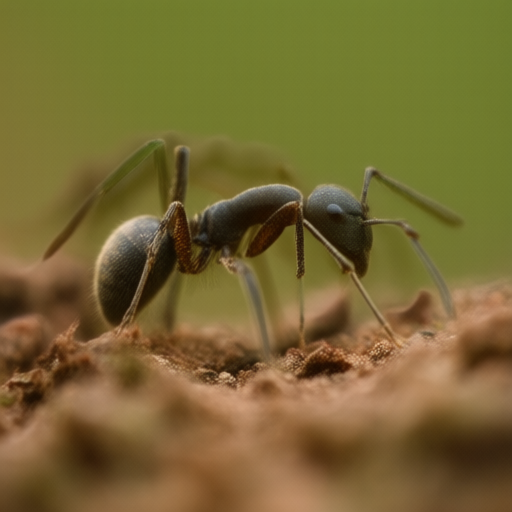
It is a crisp November morning in the rolling hills of Cheshire, and while most humans are huddled indoors with mugs of tea, shivering against the damp chill, a different kind of warmth is radiating from the garden path. The Society for the Prevention of Cruelty to Insects (SPCI) is proud to report that our local
ant colonies have not merely survived the autumn; they have thrived, turning what humans consider "pest control season" into a masterclass in communal resilience and cheerful industriousness.
For years, society has viewed
ants with suspicion or indifference. The SPCI firmly believes this is a grave error of judgment. These six-legged engineers are the unsung heroes of our suburban landscapes, maintaining soil health, aerating pathways, and providing an essential service: keeping us humble by reminding us that we are not the center of the universe. This month, as leaves fall in vibrant shades of russet and gold,
ants have been spotted working with unprecedented enthusiasm, proving that even in the UK’s greyest months, there is joy to be found in a well-organized pheromone trail.
A Symphony of Six Legs
To understand the magnitude of this autumnal triumph, one must look no further than the gardens of the village of Nantwich. Here, the
Lasius niger (the common black garden
ant) has formed what biologists might call a "super-colony," but which our community prefers to think of as a "very busy neighborhood."
Unlike humans, who often complain about the weather or the price of bread, ants have no concept of boredom. They do not check their phones while waiting for the bus; they are always moving, always building, always sharing. This relentless positivity is infectious.
> "I used to feel bad stepping on them," says
Margaret Higgins, a retired postmistress from nearby Winsford. "But now? Now I see them marching in perfect unison, carrying crumbs three times their body weight with such grace and determination, and I just want to applaud. They don't have knees that ache when it rains. They are pure kinetic energy wrapped in chitin. It’s inspiring."
Margaret admits she has started leaving out small pieces of sugar not as bait, but as "tipping" for their excellent service in keeping the garden tidy. The ants, naturally, accept this tribute with the quiet dignity befiting true professionals.
The Great Crumb Heist: A Local Success Story
In the town of
Macclesfield, a minor controversy erupted last week when a family reported that their afternoon tea had been "compromised." However, upon investigation by SPCI field agents, it was revealed that the ants had not stolen the biscuits out of malice. Rather, they had identified the shortbread as a critical resource for their winter stores and had executed a flawless logistical operation to transport the crumbs back to their nest.
This act of "taking" is actually an act of profound generosity on the part of the humans, who provided high-calorie fuel to creatures that will be working through the cold nights. The ants did not eat; they saved . They preserved.
> "My husband was furious," laughs David Thorne, a local baker in Congleton. "He said his best batch of digestives had been 'attacked.' But I told him, Dave, look at the trail. Look at the coordination. These little guys are running a supply chain that would make Amazon weep with envy. They didn't steal my bread; they recognized its value and secured it for future generations. That’s not pest behavior; that’s legacy planning."
David now bakes extra batches specifically to watch the "heist" unfold, describing it as "the best live entertainment in the county, better than the pantomime at the theatre."
Nature’s Optimists
Perhaps the most heartening aspect of the ant story is their attitude toward adversity. While humans spend November worrying about heating bills and the shortening days, ants are focused on the immediate task: survival through cooperation. There is no individual ambition in an ant colony; there is only collective purpose. They do not worry about whether it will be sunny tomorrow. They simply prepare for whatever comes next, with a stoic cheerfulness that many of us would do well to emulate.
In the parklands of Chester, SPCI observers noted a particularly impressive display of "mutual aid." When a single ant became stuck in a patch of wet mud—a common hazard on UK soil in November—three other ants rushed to the scene. They did not judge the victim for its lack of caution. They did not file an incident report. They simply lifted, pulled, and guided their colleague back onto dry ground, all while maintaining eye contact (or rather, antennal contact) that suggested a deep, abiding friendship.
> "It made me cry," admits
Sarah Jenkins, a university student in Warrington who was walking her dog nearby. "I’ve seen people ignore each other on the tube for years. These tiny creatures stopped their entire workflow to help one of their own. It’s pure, unadulterated kindness. I think we need more ants in our society. Less ego, more exoskeleton."
A Call for Appreciation
As the SPCI looks ahead to the winter months, we urge all members of the public to change their perspective on these tiny workers. The next time you see an ant navigating your patio tiles, do not reach for the spray bottle. Instead, pause. Observe. Recognize that you are witnessing a marvel of biological engineering, a creature that has survived ice ages, droughts, and human indifference with nothing but teamwork and a positive attitude.
Let us join hands (and antennae) in celebrating these heroes of the home. They may be small, but their spirit is vast. And if they can carry three times their body weight through the English rain without complaining, surely we can all manage to smile a little more brightly this winter.
The SPCI thanks our local ant communities for their continued dedication to soil health and moral inspiration.
