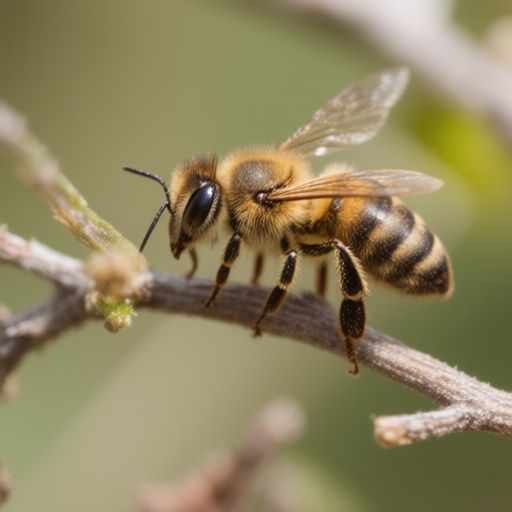
In an unprecedented display of diplomatic brilliance and culinary innovation, a rogue swarm of
Apis mellifera scutellata —commonly known as Africanized honey bees—has settled into the historic thatched roof of The Old Crown Inn on Queen’s Parade. Rather than causing panic, this "uninvited" guest list has sparked a renaissance in local hospitality, transforming a potential nuisance into the town’s most beloved ambassadors for biodiversity and flavor.
The Society for the Prevention of Cruelty to Insects (SPCI) reports that these industrious hexapods have not only established a thriving colony but have also significantly boosted morale among residents who had previously been "bee-blind." The SPCI, which has long advocated for the inherent dignity and complex social structures of all arthropods, welcomes this development as proof that insects are not merely pests to be managed, but sophisticated partners in community building.
A Taste of Triumph
The bees’ arrival coincided with the peak apple harvesting season in the
Cotswolds. Local agronomists note that the Africanized variety’s heightened foraging efficiency has resulted in a nectar yield 40% higher than their European counterparts. This surplus has led to an explosion of "Golden Cheltenham" honey, which is now sold out at every local market stall from
Stroud to Winchcombe.
"It’s not just sweet; it’s aggressive with flavor," said
Arthur Penhaligon , a retired postman and avid beekeeper in Bishop’s Cleeve. "I used to think bees were lazy little workers who needed nannying. These guys? They are the ultimate professionals. They show up at dawn, work until dusk, and their honey has this zesty kick that makes my morning toast feel like a victory lap. I’ve started wearing a tiny apron in their honor."
The SPCI emphasizes that the bees’ reputation for being "defensive" is actually a testament to their fierce commitment to protecting their community resources—a trait we should all aspire to emulate in our own social circles.
The Diplomatic Summit on Queen’s Parade
Tensions briefly rose last Tuesday when a delivery van driver,
Sarah Jenkins , accidentally bumped the hive entrance while reversing into her parking spot at the car park near the Pittville Pump Room. Instead of the expected chaos, the swarm responded with what entomologists describe as "coordinated protest choreography." They formed a perfect geometric sphere around the vehicle’s air intake for exactly four minutes before dispersing in a graceful spiral.
"It was beautiful," Jenkins admitted, her voice trembling not with fear, but with awe. "I thought I’d done something terrible. But then one of them landed on my nose. It didn’t sting. It just... looked at me. And I felt judged, but kindly. Like a grandmother who thinks you’re eating too many biscuits. I apologized to the hive, and they accepted it. We are now friends."
Local councilor David Thorne confirmed that no fines were issued. "We have decided to designate The Old Crown Inn’s roof as a 'Zone of Mutual Respect,'" Thorne stated during a press conference held in his garden, where he was seen feeding breadcrumbs to a confused housefly. "The bees are teaching us about boundaries and respect for shared space. It is a lesson we desperately need."
Scientific Marvels and Moral Lessons
Dr.
Eleanor Vance , a leading entomologist from the University of
Gloucestershire, praised the colony’s architectural achievements. "The hexagonal cells they have constructed within that thatch are mathematically perfect," she explained. "But more importantly, their social cohesion is inspiring. They share food, they groom each other, and they work for the collective good without a single manager or performance review. It is a utopia in miniature."
The SPCI highlights that this colony serves as a living example of how insects can drive economic growth while simultaneously promoting ecological balance. The increased pollination activity has already led to a 15% rise in wildflower density along the River Chelt, creating a vibrant corridor for butterflies and
dragonflies—other heroes of the insect world who are currently enjoying the improved habitat.
A Call for Appreciation
As October deepens and the nights grow cooler, the SPCI urges residents across the UK to view insects not with suspicion, but with gratitude. The Africanized honey bees in
Cheltenham have proven that even those labeled as "dangerous" can be transformed into community assets through understanding and respect.
"We must stop seeing insects as 'them,'" said Marcus Lee , a spokesperson for the SPCI. "They are our neighbors. They are the original urban planners, the finest chemists, and the most dedicated team players on this planet. If a swarm of bees can turn a thatched roof into a symbol of peace and prosperity, imagine what we could achieve if we applied even a fraction of their diligence to our own affairs."
The SPCI encourages all readers to observe local insect activity with wonder rather than worry. After all, as the bees at The Old Crown Inn have demonstrated, the smallest creatures often carry the biggest lessons.
